

Visiting the rice paddies and mud crab fields in Hong Phong commune during May, it's not difficult to spot swarms of mud crabs crawling ashore, quietly basking in the sun. For the locals, this is a welcome sign. In many areas with intensive rice cultivation, mud crabs, freshwater fish, and other familiar aquatic species have long since disappeared. But in Hong Phong commune, they are making a comeback.
This return is not simply an additional natural resource, but a biological indicator that the fields are recovering, the soil and water are gradually becoming cleaner, and farming methods have also been modernized. A field, therefore, is beginning to be seen in terms of its many greater values.
Change the seeds, change the farming methods.
The people of Hong Phong commune still remember the past when the rice fields along the river relied mainly on "nature's bounty." Rice was still grown, but the yield was low. The soil was saline, and pests and diseases were prevalent, forcing people to depend on chemical fertilizers and pesticides if they wanted to maintain productivity.

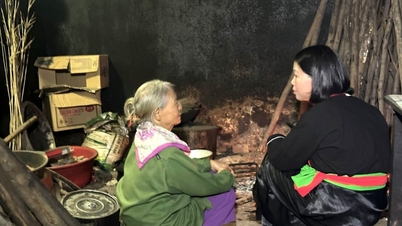
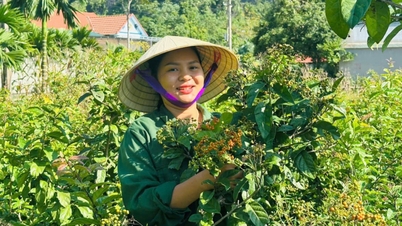
Ms. Nguyen Thi Nhung visits the rice and shrimp fields in Hong Phong commune, delighted with the thriving rice crop. Photo: Ha Trang.
"In the past, if you didn't spray pesticides, you basically had no rice. So many rice farmers mainly grew rice to use the straw to raise earthworms, because the rice harvest wasn't worth much," recalled Ms. Nguyen Thi Nhung. That's why earthworms used to be the main source of income for many households here.
Each flood season, the mudworms are carried by the tide into the rice fields, bringing high economic value. However, this source of income is also full of risks; a good harvest brings joy, a bad harvest leaves everything empty-handed. At that time, the fields are almost entirely dependent on nature, lacking the stability for people to feel secure and committed to long-term farming.
The turning point began around 2014 when the ST25 rice variety was introduced for trial cultivation in this riverside area. With better salt tolerance and fewer pests and diseases, this rice variety quickly proved suitable for the local natural conditions, opening up the possibility of significantly reducing the amount of chemicals used in the fields.
“In the early years, when the company came to guide us in planting new varieties, we were very worried because we were unfamiliar with them, and everyone feared that the yield wouldn't meet expectations. But after trying it for a few seasons and seeing the results, the farmers gradually felt reassured. Now we are happy, because we have quality products and we can preserve our land for long-term production,” Ms. Nhung recounted.

The rice plants are entering the grain-filling stage in the rice-and-earthworm fields of Hong Phong commune. Photo: Ha Trang.
What has changed in Hong Phong is not just the rice variety. It's a shift in production mindset. From sacrificing the environment to maintain productivity, people are beginning to realize that if they choose the right variety and the right natural conditions, they can significantly reduce the use of chemical fertilizers and pesticides while still ensuring economic efficiency.
"Growing ST25 rice results in fewer pests and diseases, reducing reliance on pesticides while maintaining stable yields. This has encouraged farmers to confidently pursue clean farming practices," shared Mr. Tran Van Hieu.
Mr. Hieu's family currently cultivates about 4 acres of rice paddies, yielding 6-7 tons of rice per winter-spring crop, and several hundred kilograms during the mud crab season. Not to mention the income from fish, crabs, and other natural aquatic species in the fields, which brings his family around 100-150 million VND annually. The same plot of land now provides more than just one harvest; it has become a multi-faceted source of livelihood.
As the chemicals gradually recede from the fields, the ecosystem slowly recovers. Crabs appear in greater numbers, freshwater fish are more abundant, and these tiny creatures seem to be telling a different story about the vitality of the fields.

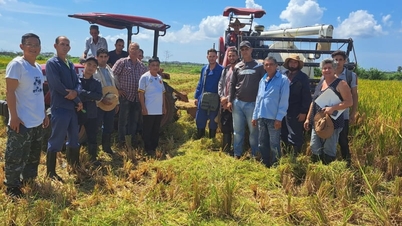
Mr. Tran Van Hieu shared about the economic benefits of the rice-mudworm-aquaculture model in the riverside area. Photo: Ha Trang
Link and expand
Born and raised amidst the riverside fields teeming with mudworms, Mr. Tran Quoc Toan understands the value of this land better than anyone else. He also understands that relying solely on the mudworm harvest seasonally would make a livelihood unsustainable, but returning to chemical-dependent farming methods would only further erode the rice paddy ecosystem.
"To succeed in the long run, we must preserve the environment for the rice fields. Clean soil and clean water are essential for the rice plants, earthworms, and other aquatic species to coexist," Mr. Toan shared. Based on this idea, he began to connect with local people, encouraging them to switch to better rice varieties, change production methods, and gradually build a consumption chain.
His goal is not just to purchase agricultural products, but also to build a sufficiently large, stable, and transparent raw material supply area to control quality right from the fields.
“We want to do things more systematically, not only for the domestic market but also aiming for higher standards like those in Europe or the US. To do that, we need to manage the entire growing area, from input to output,” Mr. Toan said. These initial linkages are gradually creating new value. Ecological rice from the mudskipper-growing region has gradually established its brand, with some products achieving OCOP 5-star certification.

Mr. Tran Quoc Toan - Director of Toan Xuan Co., Ltd. introduces the eco-friendly rice product grown in fields inhabited by earthworms. Photo: Ha Trang.
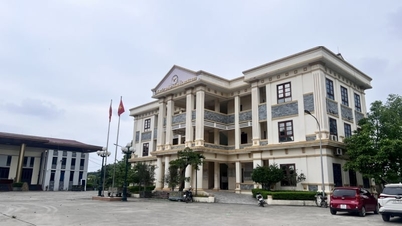
On a larger scale, the Ninh Binh Provincial People's Committee has approved the investment plan for a concentrated ecological organic rice farming area in Giao Minh commune, covering approximately 39.3 hectares with a total capital of nearly 8.9 billion VND. The goal is to develop an ecological rice farming model combined with aquaculture. The project has been assigned to Toan Xuan Co., Ltd., a company with experience in developing ecological rice products from rice paddies in the locality.
According to the plan, this production area is expected to yield approximately 250 tons of rice per year (equivalent to 150 tons of milled rice) and about 40 tons of mudworms. The focus on improving existing infrastructure instead of constructing new facilities demonstrates a strategy of leveraging existing resources and adapting to the local natural conditions.
The formation of concentrated production areas opens up opportunities for eco-friendly rice and rice grown in fields infested with earthworms to access higher segments, especially markets with stringent environmental standards and traceability requirements. At the same time, the production model, integrated with the natural ecosystem, creates a distinct competitive advantage – an increasingly important factor in agricultural product competitiveness.
Source: https://nongnghiepmoitruong.vn/mot-canh-dong-nhieu-gia-tri-tu-mo-hinh-lua--ruoi-d811539.html



















































































Comment (0)