Several textile and footwear businesses, when interviewed, also indicated they were in a similar situation.
Listening to them, it seems that many Vietnamese businesses are moving very fast but still cannot escape the ever-present uncertainty.
Meanwhile, FDI corporations continue to expand production, increase exports, and withstand global shocks quite well.
These two regions coexist within the same economy , but are increasingly diverging in characteristics.
Looking at the World Bank's Vietnam Economic Update, that gap becomes quite apparent. The World Bank calls this a "dual economy," where FDI enterprises and businesses participating in global value chains, although accounting for only about 5% of the total number of businesses, generate up to half of the added value and jobs, and account for up to 73% of export turnover.
Conversely, approximately 98% of domestic businesses remain small or informal enterprises, with limited productivity and the ability to participate in global supply chains.
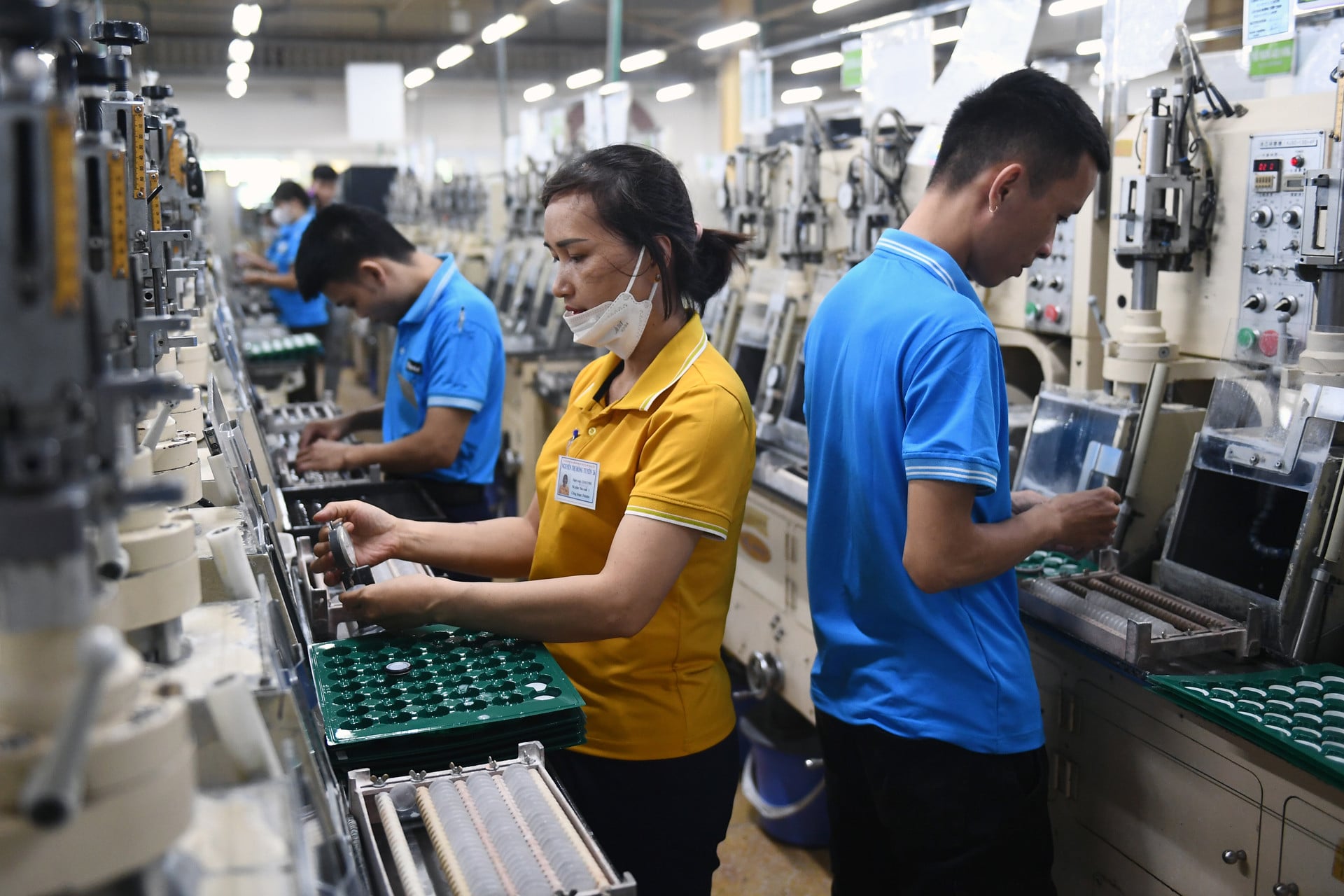

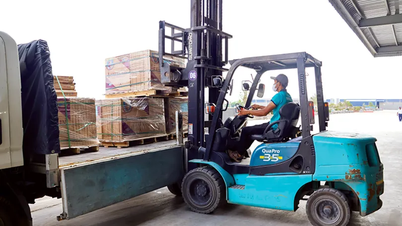
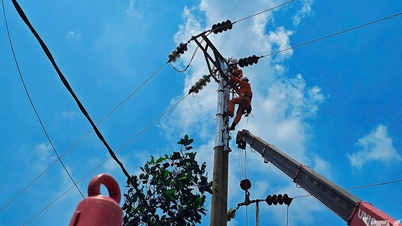
Foreign direct investment (FDI) corporations continue to expand production, increase exports, and withstand global shocks quite well. Photo: Hoang Ha
FDI enterprises currently import more than 50% of the inputs needed for export, while Vietnamese businesses lack the capacity to participate deeply in these supply chains. Even in key industries, domestic businesses still find it very difficult to gain a foothold due to gaps in technology, skills, and management capabilities.
After more than 30 years of attracting FDI, Vietnam has yet to create a sufficiently strong spillover effect on the domestic business sector.
That gap has now become very clear in recent reality.
Following the US announcement of new retaliatory tariffs, exports from the FDI sector surged by 42% in April 2026 compared to the same period last year, while exports from the domestic enterprise sector decreased by 24.5%.
This blow primarily targets industries dominated by Vietnamese businesses, such as textiles, footwear, and wood, with effective tariffs of around 15-38%, many times higher than the approximately 9% applied to electronics and machinery, which are traditionally dominated by FDI companies.
The World Bank argues that the biggest difference lies in "resilience." FDI corporations have long-term contracts, internal supply chains, capital from parent companies, and the ability to command higher prices thanks to complex technological products, giving them sufficient "cushion" to absorb shocks. Meanwhile, most Vietnamese businesses are still small, have limited capital, and are heavily dependent on short-term bank credit, so whenever the market fluctuates, they have almost no financial buffer to withstand it.
Therefore, the domestic private sector is bearing the brunt of the losses, precisely at a time when Vietnam is aiming for double-digit growth.
It's a paradox: a rapidly growing economy, with exports constantly breaking records, yet the domestic business sector – which should be the "backbone" of the economy – is becoming increasingly fragile.
When Vietnamese businesses grow, their growth is not commensurate with their potential.
Meanwhile, domestic businesses are facing numerous difficulties, according to the Vietnam Private Sector Economic Report 2025 by the Vietnam Chamber of Commerce and Industry (VCCI).
The biggest challenge for private businesses today is not technology or exports, but… finding customers. The percentage of businesses complaining about difficulty finding customers has increased from 45.3% to 60.2% by 2025 alone, indicating that demand in the economy is weakening quite rapidly.
An economy struggles to achieve double-digit growth if businesses cannot sell their products in their own domestic market.
But even more worrying is the financial health of Vietnam's business sector. For many small businesses, the first thing they need to do to borrow money is own… land.
As many as 75.5% of businesses are unable to obtain loans without collateral, and 93.5% of loans require collateral – significantly higher than the regional and global averages.
This shows that many Vietnamese businesses are still relying on assets rather than business capabilities. Without collateral, it's almost impossible to access a bank, while credit is virtually the only lifeline for survival for the majority of small businesses.
But market sentiment is quite different from what is typically discussed in reform forums.
According to a VCCI survey, difficulties related to policies and laws increased from 16.9% to 24.3% in 2025, while only about 6–8% of businesses said they could anticipate policy changes “frequently” or “always”.
No one dares to invest long-term in an environment where the rules of the game can change overnight.
Therefore, 2025 seems less like a year of expansion for the domestic private sector and more like a period of intense consolidation.
While the number of businesses entering the market has increased, the number of businesses withdrawing has also risen sharply. Many new businesses are still emerging, but they are becoming smaller and more cautious. After numerous shocks, it seems many now just want to survive rather than grow.
But perhaps the most vulnerable part of the economy lies in the household business sector.
Approximately 6.1 million households with around 10 million workers are currently operating in a weakened state, with up to 81.5% experiencing a decrease in revenue.
This means that behind the business story is not just GDP or growth rate, but also the livelihoods of tens of millions of people.
In fact, Vietnam has no shortage of successes in FDI. After more than 30 years of opening up, Vietnam has become a major manufacturing hub of the world . But the problem is that many Vietnamese businesses are still operating in the lowest-profit sectors within their own economy.
The structure is also out of phase.
This imbalance is also very evident in the structure of the economy. The FDI sector, with approximately 30,000 enterprises, currently accounts for about 73% of export turnover and contributes more than 22% of GDP.
Meanwhile, the officially registered private business sector, numbering around 1 million, contributes just over 10% of GDP, while the individual business household sector accounts for approximately 33% of GDP, according to the Statistical Yearbook.
This shows that the Vietnamese economy still relies heavily on the FDI sector, with small, fragmented, and less resilient production units still making up the majority.
If we exclude the FDI sector, the rest of the Vietnamese economy is actually still quite weak, while the income of most workers remains low, commonly around 8.4 million VND per month, despite continuous strong economic growth and record-breaking exports for many years.
Despite having an export economy worth hundreds of billions of dollars, many workers are still living on wages that barely cover their monthly expenses.
The most worrying issue is not the overwhelming strength of FDI enterprises, but rather that after more than 30 years of opening up, many Vietnamese businesses have yet to escape their role as subcontractors, with low profits and vulnerability even in their own domestic market.
Source: https://vietnamnet.vn/mot-nen-kinh-te-di-hai-toc-do-2517711.html



























































































Comment (0)