

From a folk legend about a chaste girl who perished at sea, Dinh Cô in Long Hai (Long Hai commune, Ho Chi Minh City) has become a spiritual anchor for generations of fishermen in the coastal region. Over two centuries, it has not only preserved a legend steeped in community belief but has also culminated in a major festival, rich in the folk culture of the Southern Coastal region.
From legends to sacred seaside shrines
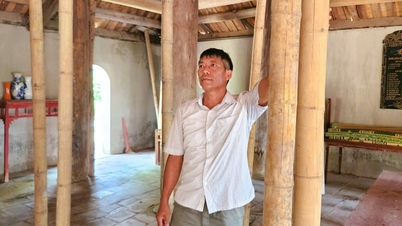
According to Mr. Thai Van Canh, Head of the Management Board of Dinh Co Historical and Cultural Relics, Dinh Co was initially built in the late 18th century to worship a virgin named Le Thi Hong. She was the daughter of Mr. Le Van Khuong and Mrs. Thach Thi Ha, from Tam Quan, in the former Binh Dinh province. At the age of 17, while accompanying her father to Gia Dinh city for trade on a wooden boat, she unfortunately encountered a storm and fell into the sea, resulting in her death.
Her body later drifted ashore in Hon Hang (Long Hai commune), where it was discovered by local people and buried on a mound by the sea. Since then, stories about the young girl's miraculous powers have circulated among the people. They believe that she often appears in dreams to foretell good fortune, helps the people, wards off epidemics, protects seafarers, and blesses the villagers with peace and safety.
Based on that belief, the local people erected a shrine and revered her as "Long Hai Goddess, Protector of Peace and Righteousness." The legend of the Goddess is not only recounted in folk memory but is also mentioned in the book Dai Nam Nhat Thong Chi. This further strengthens the image of the Goddess in the religious life of the coastal residents of Long Hai.
Initially, Dinh Cô was just a small thatched-roof, mud-walled shrine located near the beach. Due to constant erosion caused by strong winds, the shrine had to be moved to the foot of the mountain to avoid damage. In 1930, the ancestors and local people donated to rebuild the shrine into a more spacious and imposing structure. The misfortunes did not end there, as a fire on the night of the 8th day of the first lunar month of the year Dinh Mao (1987) destroyed the main temple. Once again, local fishermen and people from all over joined hands to contribute to rebuilding the shrine.
Among the many versions of the legend, the fishermen of Long Hai believe that the legend recorded in the local Handbook of Historical Sites, Cultures, and Scenic Spots is the closest to the truth and the most widely known. Despite differing interpretations, the stories share core details: she was a virgin, died unjustly, possessed miraculous powers, and has a clearly identified burial site. This consistency forms the solid foundation for folk belief that has lasted through generations.
The miraculous power of the Goddess spread even more strongly through the stories of fishermen who came to worship and pray. They believed that she had protected them on their voyages at sea, helping them overcome storms and misfortunes, or bringing them good luck in their livelihoods. After each such experience, they would return to the shrine to offer thanks, causing the story of her sacredness to spread from generation to generation.
A place where beliefs and the soul of Southern Vietnamese fishing villages converge.
Every year, the festival takes place over three days, the 10th, 11th, and 12th of the second lunar month, and is affectionately known by local fishermen as "Le" or "Le Co." Many days beforehand, people arrange their work and plan their fishing trips to ensure they return in time for the festival. For them, attending the Le Co festival is not only a cultural tradition but also an indispensable spiritual duty.
Every year, tens of thousands of people from various regions gather in Long Hai to attend the Dinh Co Festival. Not only do residents of the former Ba Ria - Vung Tau province participate, but the festival also attracts fishermen from Phan Rang, Phan Thiet, Ben Tre, Go Cong, Tra Vinh, Ca Mau , and Rach Gia, along with numerous tourists from Ho Chi Minh City and Dong Nai. The influx of people creates a vibrant atmosphere, making the Nghinh Co Festival one of the most prominent maritime festivals in the Southeast region of Vietnam.
The Nghinh Cô Festival is a major water festival of the fishermen along the southern coast of Vietnam. Although it belongs to the Mother Goddess worship tradition, this festival is not simply about worshipping the Mother Goddess. In its ritual structure, one can see a combination of the Fishing Festival, the worship of sea deities such as the Water Dragon Goddess and whales, and the Mother Goddess worship of the local inhabitants.
The Nghinh Cô ritual essentially resembles the Nghinh Ông ritual in whale worship ceremonies, meaning it involves welcoming the whales from the sea. Its uniqueness lies in the fact that the festival has incorporated and blended many different cultural layers to create its own distinct character. Perhaps this is why the Dinh Cô Festival is not only a religious activity but also a microcosm of the spiritual life of the coastal inhabitants of Southern Vietnam.

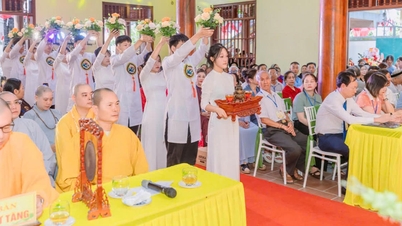
On the morning of February 10th, starting at 6 a.m., the temple committee and fishermen gathered at the shrine to prepare for the Nghinh Co ceremony. At 7 a.m., the ritual of inviting the Dragon Tablets of the Great Lady and the God of the South Sea to the shrine was conducted in a solemn atmosphere. The procession was elaborately organized with ceremonial students, a band, rowers, a dragon palanquin, and five-element flags, all creating a scene that was both vibrant and rich in the colors of maritime rituals.
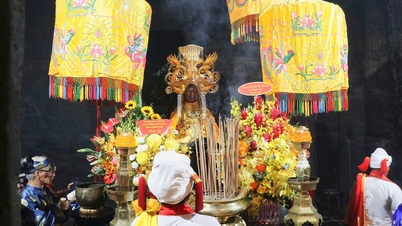
Following the ritual of inviting the ancestors, there is the offering to the forefathers and later generations, and a prayer for national peace and prosperity. Amidst the drums, ceremonial music, and billowing incense smoke, the people express their hopes for favorable weather, calm seas, and bountiful fishing trips. These aspirations may seem simple, but they are the spiritual anchor of an entire community that depends on the sea for its livelihood.
The second day of the festival is when the festivities begin to liven up. In the morning, there are competitions in rowing and swimming, attracting a large number of young fishermen. In the evening, the usual ritual of offering sacrifices to the Ancestors is held, along with prayers for peace chanted by monks and nuns, adding to the sacred atmosphere of the festival.
A special highlight of the 11th day was the "worship of the Goddess" ceremony at sea. From the afternoon, hundreds of boats from Long Hai, Phuoc Hai, Phuoc Tinh, and even some fishing villages in Central Vietnam gathered and anchored in front of the shrine, pointing their bows towards the shore. As night fell, the lights on the boats illuminated a corner of the sky, creating a rare and enchanting scene in the night sea.
Fishermen believe that beautifully decorated boats are an expression of reverence offered to the Goddess. Because of this belief, boat owners strive to decorate their boats as splendidly as possible. A sea ablaze with flags and flowers, illuminated by lights, and teeming with boats participating in the ritual has become an unforgettable image of the "Lệ Cô" season in Long Hai.
From national monument to intangible heritage
February 12th is the main anniversary, and also the most important moment of the festival. From 7 a.m., the Nghinh Cô procession of boats begins to set sail, with hundreds of boats participating, including two main boats and six escort boats. On the boats are displayed ancestral tablets, incense altars, and offerings; the chief priest, the band, the ritual performers, and the rowers all perform the rituals according to solemn customs.
When the procession of boats was about 1km from the shore, the chief priest stopped to offer incense and perform rituals at sea. Afterward, the boats paraded in a large circle, passing the Thuy Long Goddess Temple before returning to the beach west of Dinh Co to enter the temple. On the shore, a formation of young people carrying five-element flags stood in two symmetrical rows, waiting to carry the ancestral tablets and incense altar to their final resting place inside the temple.
A special ritual that defines the festival's unique identity is the singing of "ba trao" after the ancestral tablets have been placed in their designated positions. This form of folk performance is closely associated with the fishermen's culture, very familiar in the South Central region but rarely seen in festivals in the Southern region. The presence of "ba trao" singing at Dinh Co therefore further demonstrates the unique cultural exchange between coastal regions.
Around 9 a.m., the grand ceremony of worshipping the Goddess takes place. Offerings include roasted pig for the Water Dragon Goddess, whole pig for the South Sea God, and various vegetarian dishes offered to the Goddess. From 3 p.m. until well past midnight, a series of folk performances such as Bóng Rỗi singing, Bông dance, Chầu Mời, and Chặp Địa Nàng singing continue, making the festival atmosphere both sacred and lively.
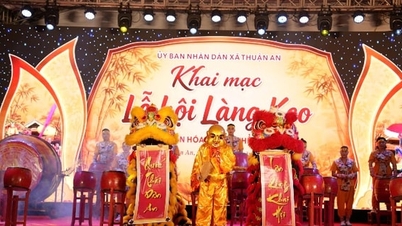
Besides the ceremonial part, the festival also features traditional opera performances, lion and dragon dances, and many folk games such as fishing, eel catching, boat racing, and basket boat racing. In particular, the boat and basket boat races always attract a large number of young fishermen and receive enthusiastic support. These activities make the festival not only a place of worship but also an opportunity for the coastal community to connect, interact, and pass on customs and traditions.
Amidst the modern pace of life and the pressures of urban change, Dinh Cô still holds a special place in the hearts of the Long Hải coastal community. There, legends are not merely preserved in books or the stories of the elderly, but continue to live on in the incense smoke, in the "Lệ Cô" season, in the sound of ceremonial drums, and in the brightly colored boats sailing offshore. It is a living heritage, where culture, beliefs, and the soul of the sea remain firmly anchored in the hearts of the people.
Within the complex of historical relics, the main hall of Dinh Cô houses seven altars, with the central altar dedicated to Bà Cô (the Goddess of the Sea). Most prominent is a statue of Bà Cô, over half a meter tall, wearing a red robe with glittering gold trim and a jeweled headdress. Behind it are altars to Diêu Trì Phật Mẫu (the Mother Goddess of the Sea), Chúa Cậu (the Lord of the Sea), Ngũ Hành Nương Nương (the Five Elements Goddesses), Tứ Pháp Nương Nương (the Four Dharma Goddesses), Ông Địa (the Earth God), and Thần Tài (the God of Wealth), showcasing the richness and intermingling of local folk beliefs.
Another important part of the complex is the Tomb of Cô, located on Cô Sơn Hill, about 1km southwest of the Palace. The path to the tomb consists of 60 cement steps, leading visitors through a breezy space overlooking the vast sea. After the 1999 restoration under the principle of socializing the preservation of historical relics, the tomb complex has become more spacious and attracts many visitors, especially during the festival season.
Mr. Nguyen Minh Tam, Vice Chairman of the Long Hai Commune People's Committee, said that the Dinh Co Festival has long become a cultural and spiritual symbol closely associated with the process of exploration, formation, and development of the Long Hai coastal community. According to Mr. Tam, in folk life, the festival not only carries religious significance with aspirations for national peace and prosperity, calm seas, safe voyages for fishermen, and successful fishing, but also is a valuable cultural heritage preserved by local people through many generations.
In 1995, Dinh Co was recognized as a National Historical and Cultural Monument. In 2023, the Dinh Co Festival was further inscribed by the Ministry of Culture, Sports and Tourism on the National List of Intangible Cultural Heritage.
Source: https://baophapluat.vn/mua-le-co-noi-cua-bien-long-hai.html














































































Comment (0)