

This sacred land preserves many tangible and intangible heritage sites recognized by the State. In particular, the people of Hat Mon still maintain old customs and traditions as a unique aspect of the local culture.
Beautiful customs in Hat Mon
We arrived in Hat Mon just as the village was holding its traditional festival. Nguyen Hoang Tu, Head of the Hat Mon Temple Relic Management Subcommittee, said: “Every year, Hat Mon Temple holds three major festivals: the commemoration of the Trung Sisters (on the 6th day of the 3rd lunar month); the commemoration of the Trung Sisters' flag-raising ceremony and uprising (on the 4th day of the 9th lunar month); and the bathing ceremony (held on the night of the 23rd and early morning of the 24th of the 12th lunar month) – the ritual of bathing and changing the clothes of the Trung Sisters, commemorating the day they declared themselves queens. Among these, the procession of glutinous rice cakes offered to the Trung Sisters on their anniversary is considered a unique and distinctive ritual of the Hat Mon region.”
Legend has it that, before their deaths, the Trung Sisters rested at a tea stall, where the owner offered them glutinous rice balls and two muỗm fruits. This story is what made glutinous rice balls a sacred offering, symbolizing remembrance and gratitude for the great contributions of the Trung Sisters to the nation.
Over thousands of years, this custom has been preserved almost intact, becoming a unique cultural feature rarely found elsewhere. In the days leading up to the main ceremony, the atmosphere of preparation permeates throughout Hat Mon village. Preparations for the festival begin very early with the participation of a large number of villagers.
According to custom, the rituals are not performed directly at the temple but take place at two carefully selected families, called "houses for ceremonies" and "houses for rituals." These families must meet strict criteria such as: both husband and wife being alive, having a well-mannered family, filial children, no deaths in the family during the year, and enjoying the trust of the community.
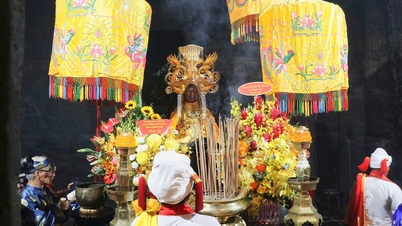
At the home of Mr. Tran Nho Giap – which this year has the honor of being chosen as the "house of literary works" – all preparations were carried out carefully and solemnly. The scent of incense permeated the space, creating a sacred and warm atmosphere.
Mr. Tran Nho Giap said: “After the temple opening ceremony, the chief priest will perform a ritual to ask permission from the Trung Sisters to bring the supervising officials to the two chosen families to oversee the preparation of the ceremony. The ancestral altar is moved to another location, leaving the central hall to welcome the ‘officials’. This ritual expresses the absolute respect of the people for their ancestors.”
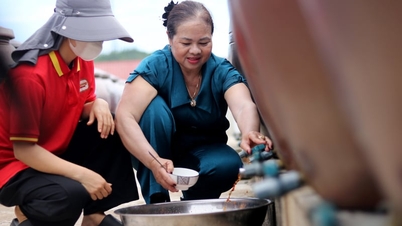
The process of making glutinous rice dumplings offered to the Two Trung Sisters is also carried out according to strict traditional procedures. The rice chosen is glutinous rice of the "golden flower" variety, pounded in a large stone mortar. The rice is pounded until it becomes flour, then sifted to obtain fine, smooth flour. The flour is then carefully kneaded until it is very soft, smooth, and pliable, before being placed on a tray to be shaped into dumplings… All the steps are very elaborate and meticulous. Although many modern machines are available today to assist in grinding and mixing the flour, the people here still maintain the traditional manual methods passed down from their ancestors.
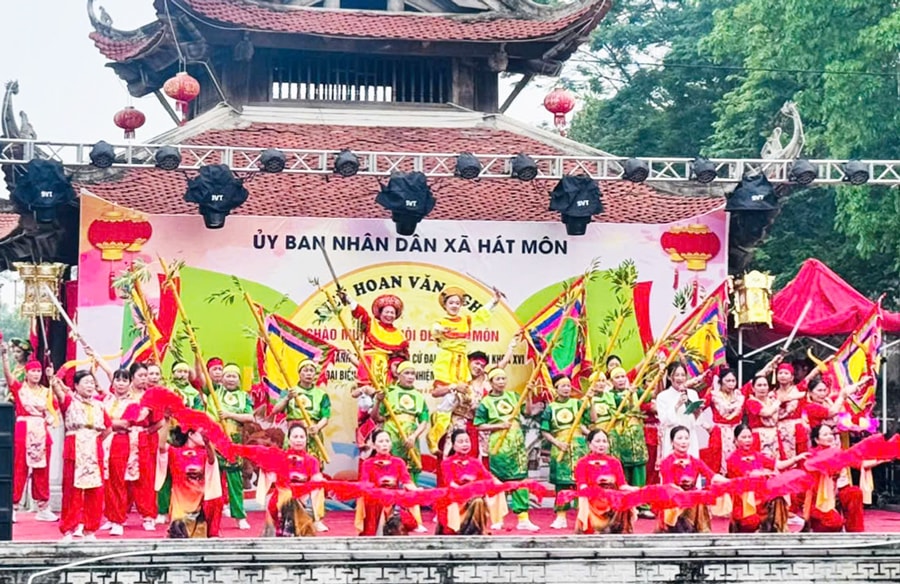
Each festival attracts nearly 1,000 participants from 10 hamlets within the village. Besides glutinous rice balls, other offerings such as sticky rice, steamed rice cakes, roosters, pig's heads, along with incense and flowers, are also meticulously prepared. The large turnout of the community creates a sacred and solemn atmosphere, demonstrating the strong spirit of unity among the local people.
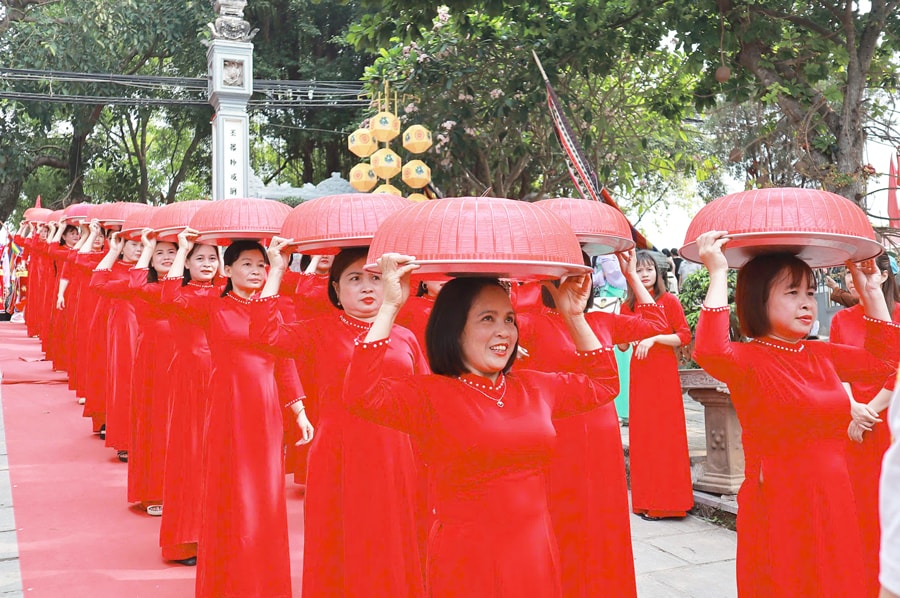
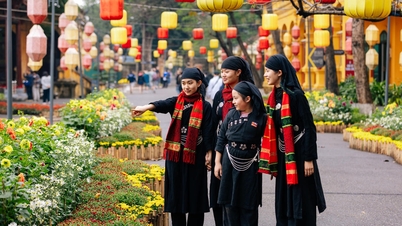
Today, the village of Hat Mon is bustling with the sounds of drums and gongs. Processions carrying glutinous rice cakes from various hamlets make their way to the temple in reverence. Women in the village, dressed in traditional ao dai (long dresses) in the distinctive colors of each hamlet, carry trays of pristine white, round cakes, creating a vibrant and rich cultural scene. The most beautiful trays of cakes are selected to be offered to the Trung Sisters, while the rest are distributed as blessings to the villagers and visitors from all over.
Not only at the temple, but on this day, every family in Hat Mon also makes glutinous rice balls to offer to their ancestors. After completing the rituals, everyone gathers together to enjoy the rice balls.
Deputy Head of the Hat Mon Temple Relic Management Subcommittee, Tran Viet Minh, shared with pride: “The people of Hat Mon refrain from eating glutinous rice balls before the main festival. No matter where they live, the villagers of Hat Mon still maintain this custom. Only after the offering ceremony to the Two Trung Sisters is completed are they allowed to partake in the offerings. This is not just a custom, but also a spiritual belief deeply ingrained in the consciousness of every person from this homeland. This belief becomes a bond connecting the community, helping each person always remember their roots. Many Hat Mon people, even those studying or working far away, still maintain this custom as a way of showing their reverence for the Two Trung Sisters.” This unity has contributed to the enduring vitality of the festival through generations.
Preserving heritage for future generations.
Throughout thousands of years of history, the rice dumpling procession at Hat Mon Temple has been preserved almost intact, despite the changes of time and urbanization.
According to Mr. Tran Viet Minh, it is the family and village traditions, along with the persistent transmission of knowledge through generations, that has helped maintain this custom. "Since 1975, I worked far from home and only returned to my hometown after retirement, but almost all the village rituals have remained unchanged. That makes me extremely moved and proud," Mr. Tran Viet Minh shared.
Honored to be chosen as this year's "house of incense offerings," Mr. Tran Nho Giap (62 years old) said: "This is the third time my family has taken on this responsibility. In the days leading up to the festival, the house is always cleaned thoroughly, and the fragrant scent of incense permeates the entire space."
As someone well-versed in classical Chinese, Mr. Tran Nho Giap also undertook the task of writing the village's commemorative texts, a job requiring meticulousness and reverence. He confided: "The traditions of my homeland were carefully passed down by my parents. Now I continue to pass them on to my children and grandchildren, so that those who know can teach those who don't, and together we can preserve the customs of our ancestors."
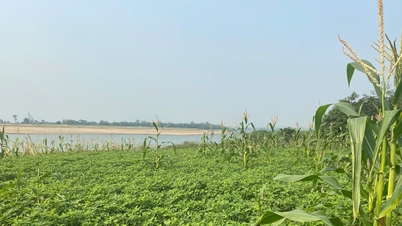
According to Tran Viet Minh, Deputy Head of the Hat Mon Temple Relic Management Subcommittee: “In recent years, with the attention and investment from Hanoi city, the appearance of Hat Mon commune has undergone many positive changes. The road connecting from National Highway 32 to the commune has been widened and paved with a modern lighting system, creating favorable conditions for visitors from all over to travel. The ancient Hat River has been and is being renovated, with clean and beautiful embankments, becoming a highlight of the local landscape. The lakes, ponds, village wells, and village roads and alleys have also been upgraded, contributing to building a new, civilized and modern rural landscape while still preserving traditional identity.”
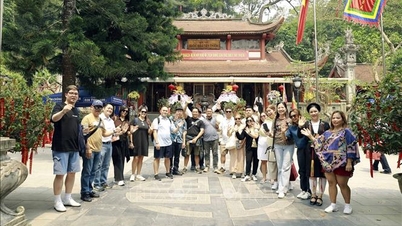
The Hat Mon Temple National Special Monument is a place that embodies many unique cultural and historical values, and since September 2024, it has been recognized as a tourist destination of Hanoi city. There is no entrance fee to the monument. In particular, visitors are warmly welcomed and guided by the Management Board, creating a positive impression of a friendly destination rich in humanistic values. From 2026, the Hat Mon Temple festival will officially open on the 6th day of the first lunar month, extending a series of rich cultural and spiritual activities, attracting numerous groups of students, veterans, and domestic and international tourists.
Furthermore, organizing cultural and sporting events has contributed to promoting the image of Hat Mon, creating a strong ripple effect for the local cultural heritage. The harmonious combination of preservation and development has helped Hat Mon gradually become an attractive destination on the cultural tourism map of the capital city.
Amidst the hustle and bustle of modern life, where many traditional values face the risk of fading away, the beautiful customs of Hat Mon village are preserved as a "living museum" of historical memory. The rituals not only express gratitude to the Trung Sisters but also symbolize community solidarity, national pride, and the principle of "drinking water, remembering the source." In the flow of integration and development, preserving and spreading these values will contribute to enriching Vietnamese cultural identity, ensuring that this precious heritage endures through time.
Source: https://hanoimoi.vn/nep-xua-tuc-cu-doc-dao-o-lang-hat-mon-749050.html















































































Comment (0)