

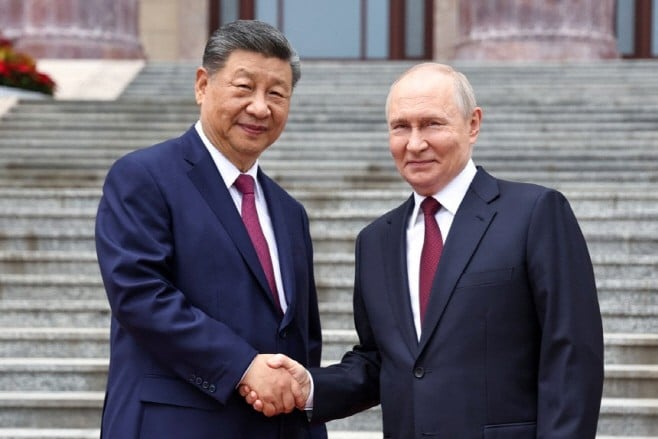
Beijing and Moscow are both signaling a challenge to the US's leadership role.
During talks at the Great Hall of the People in Beijing on the morning of May 20, Chinese President Xi Jinping and Russian President Vladimir Putin both emphasized the need to build a "multipolar world order" to replace the unipolar model led by the United States.
This position was subsequently included in the joint statement adopted by both sides after the summit.
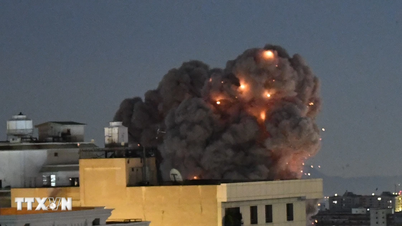
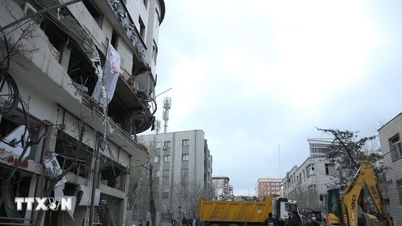
According to Chinese media, Xi Jinping devoted much of his speech to international hotspots, particularly the Middle East. The state-run Xinhua news agency reported that the Chinese leader warned the Middle East and the Gulf region is at a “crossroads between war and peace,” and emphasized that ending conflicts instigated by the United States is an urgent priority.
Although he did not directly name Washington, Xi's statement was seen as an attempt to blame the US for the current instability in the region.
Xi Jinping also reiterated Beijing's "Four Principles for Peace and Stability in the Middle East" initiative, proposed last month, stating that the plan aims to promote international consensus, de-escalate tensions, and contribute to ending hostilities.
According to observers, this clearly reflects the intentions of Beijing and Moscow to counterbalance the unilateral actions of the US and President Donald Trump – which are increasingly causing concern even among Washington's traditional allies in the European Union.
Russia and China strengthen strategic alliances on multiple fronts.
According to Asiatoday, President Putin has shown almost complete alignment with Beijing's position.
The Russian leader stated that the strategic relationship between Russia and China is currently a "crucial stabilizing factor in the world," while emphasizing that close cooperation between the two countries is indispensable for building a multipolar order to balance the influence of the United States.
Putin even directly addressed the restructuring of global governance. According to him, the world is currently undergoing a "complex process" to form a multipolar order based on a balance of interests among participating parties.
"My Chinese partners and I are working together to build a fairer and more democratic international framework," Putin said.
Beyond geopolitical issues, the two leaders also agreed to expand strategic cooperation across most areas, including economics, security, and addressing global issues such as the conflict in Ukraine.
In particular, Putin emphasized energy cooperation, asserting that Russia remains a "reliable" energy supplier to China despite unfavorable external factors.
According to diplomatic sources in Beijing, Xi and Putin are likely to meet several more times this year, including at the Shanghai Cooperation Organization (SCO) Summit in Bishkek (Kyrgyzstan) on August 31, the BRICS Summit in New Delhi (India) on September 12, and the APEC Summit in Shenzhen on November 18. They have met more than 40 times to date.
Observers believe that Beijing and Moscow will continue to utilize these forums to promote their message of a "multipolar world order," thereby maintaining long-term strategic pressure on the United States.
Source: https://danviet.vn/nga-trung-quoc-bat-tay-thiet-lap-trat-tu-da-cuc-d1428296.html
















































































Comment (0)