

Big 4 leads the race to increase capital
Previously, two state-owned banks, Vietcombank and BIDV , also announced plans to increase capital significantly this year. Specifically, Vietcombank approved the profit distribution plan for 2023 and 2022 according to the approval principles of the State Bank. After setting up funds, the bank will use the remaining profits of 2023 and 2022 to pay dividends in shares. Thus, if approved by the authorities, Vietcombank can soon issue shares to increase its charter capital to over VND100,000 billion. At this year's annual shareholders' meeting, BIDV also approved a plan to increase its charter capital by VND21,656 billion to nearly VND91,870 billion, equivalent to an increase of 30.8%, through 3 options: increasing capital from the reserve fund to supplement charter capital, paying dividends and issuing additional shares.
Currently, the group of state-owned commercial banks holds more than 50% of the credit market share of the entire system. This is also the main force implementing policies and guidelines of the Government and the State Bank; and to serve the need for double-digit growth in the coming period, increasing capital for this group of banks is increasingly urgent.
Mr. Nguyen Tat Thai, Deputy Director of the Department of Forecasting, Statistics - Monetary and Financial Stability (SBV) pointed out a worrying fact: the market leadership role of state-owned commercial banks is on a decline relative to that of private joint-stock commercial banks, stemming from the imbalance between asset size and capital capacity. Specifically, although holding up to 42% of the total assets of the entire credit institution system, the charter capital of Big 4 accounts for only 20%. Meanwhile, joint-stock commercial banks account for 45% of total assets but hold up to 65% of the total charter capital of the entire system. This difference leads to the inevitable consequence that the market share of the state-owned sector is gradually narrowing.
In fact, thin charter capital is likened to “a shirt that is too tight”, forcing state-owned commercial banks to face consequences. First of all, the pressure on the capital adequacy ratio (CAR) creates a major barrier in meeting international risk management standards such as Basel II and Basel III. In addition, the thin capital scale causes banks to be stuck with the credit room ceiling, limiting the room to finance key national projects. The overall consequence is that the leading role of the Big 4 market is reduced, because when struggling to ensure financial safety, these banks will have difficulty in pioneering the implementation of policies to support the economy .
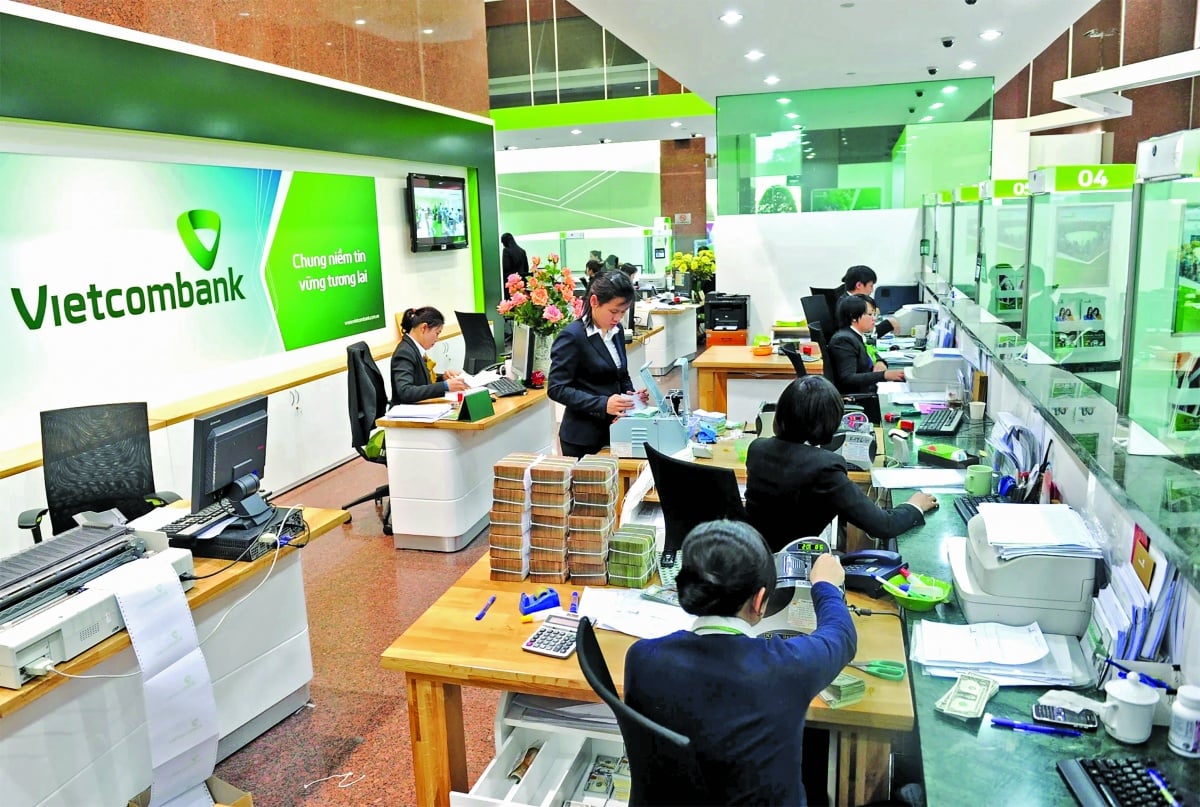 |
| Vietcombank may soon issue shares to increase its charter capital to over VND100,000 billion. |
Reinforced buffers to meet new regulations
The Government also issued Resolution No. 273/NQ-CP, which requires the State Bank to accelerate the increase of charter capital of state-owned commercial banks.
As the pillars of the system, contributing to supporting the implementation of State policies and promoting economic development, the group of State-owned commercial banks is currently in dire need of increasing capital to lead the Vietnamese banking system. Circular 14/2025/TT-NHNN regulating capital adequacy ratios for commercial banks and foreign bank branches has introduced the concept of "systemically important banks", in which the State Bank requires large banks to increase capital buffers as an additional layer of protection to ensure safety for the entire system. Banks such as BIDV, VietinBank, and Vietcombank are almost certain to be on this list, so they will require a strong increase in capital in the coming time, especially when the above banks have long been approaching the minimum CAR threshold.
In addition to the Big 4, commercial banks are also rushing to increase capital. Most recently, the State Bank has just approved HDBank's plan to increase its charter capital through the plan to pay dividends in shares and issue bonus shares to existing shareholders, with a total issuance ratio of up to 30%. According to the approved plan, HDBank will pay dividends in 2024 in shares at a rate of 25%, and issue up to 5% bonus shares. After the issuance, HDBank's charter capital is expected to increase from VND 38,594 billion to more than VND 50,000 billion. Previously, in early October, TPBank was also approved by the State Bank to increase its charter capital from VND 26,420 billion to more than VND 27,740 billion, through the plan to issue 132 million shares (5%) to pay dividends to existing shareholders...
According to Dr. Le Duy Binh, Director of Economica Vietnam, there are many factors that make banks rush to increase capital. Management agencies require credit institutions to gradually meet increasingly strict capital safety standards. For example, Circular 14/2025/TT-NHNN regulating capital safety ratios requires banks to not only increase charter capital but also consolidate their own capital. This is a prerequisite to maintain system safety and improve resilience to risks. In addition, the motivation for banks to increase capital also comes from increasingly fierce competition in the context of integration, forcing us to prepare to confront foreign financial institutions right at home. When charter capital is low, many legal restrictions will directly narrow business space, including credit growth. Therefore, increasing capital will expand the "space" of operation, helping banks improve their capacity to provide credit and services, thereby serving the economy more effectively.
Sharing the same view, Dr. Chau Dinh Linh, Banking University of Ho Chi Minh City, said that increasing capital is to increase the "health" so that banks can respond to risks that occur. Bad debt in the banking industry is always a concern, especially in the current context of many uncertain factors. If there is a good capital buffer, banks will be steadfast in the face of challenges. And having good internal "health" will be an important condition for management agencies to give more proactive authority to credit institutions in credit growth. Dr. Chau Dinh Linh assessed that the trend of increasing capital of banks will continue in the coming years to meet financial safety indicators, consolidate resources to meet capital needs, and support high economic growth in 2026 and the following years.
However, the path to capital increase is not always paved with roses. Experts emphasize that large-scale banks with strong brands can increase capital better, while medium and small banks will certainly face more or less challenges. To overcome difficulties, banks need to set a clear roadmap based on a specific analysis of their current situation. In addition, capital is only the starting point. What is more important is to use capital effectively and improve management capacity. In particular, it is necessary to proactively identify and anticipate new risks such as the risk of falling behind in competition if they do not keep up with technology and digital transformation.
Source: https://thoibaonganhang.vn/ngan-hang-tang-cuong-suc-khoe-dap-ung-yeu-cau-moi-174687.html

![[Photo] Urgently help people soon have a place to live and stabilize their lives](/_next/image?url=https%3A%2F%2Fvphoto.vietnam.vn%2Fthumb%2F1200x675%2Fvietnam%2Fresource%2FIMAGE%2F2025%2F12%2F09%2F1765248230297_c-jpg.webp&w=3840&q=75)

![[Photo] General Secretary To Lam works with the Standing Committees of the 14th Party Congress Subcommittees](/_next/image?url=https%3A%2F%2Fvphoto.vietnam.vn%2Fthumb%2F1200x675%2Fvietnam%2Fresource%2FIMAGE%2F2025%2F12%2F09%2F1765253019536_a1-bnd-0983-4829-jpg.webp&w=3840&q=75)






































































































Comment (0)