

From schools, history is being "awakened" in a different way, so that young people can remember, understand, and translate it into action in their lives today.
From memory to educational space
One morning in late April, the auditorium of the Water Resources University's branch campus in Ho Chi Minh City was packed. What was remarkable wasn't the number of students attending, but the way they listened, engaged in dialogue, and asked questions. The talk show, "The Spirit of April 30th in the New Era: Student Responsibility and Action," broke away from the traditional format of student activities. Instead of recounting history in a familiar sequence, it posed a direct question: what should students today do with the spirit of April 30th?
Nguyen Van Phong, an Information Technology student, said that he used to view April 30th as a milestone to remember. But after the program, the question he asked himself changed: "If the previous generation sacrificed for independence, what must our generation do to avoid wasting that?"
From a different perspective, Dau Thi Diem Quynh, a business administration student, approaches the spirit of April 30th through very specific choices in life: "Patriotism in peacetime doesn't necessarily have to be something grand; it starts with studying seriously, working responsibly, and not letting yourself fall behind."
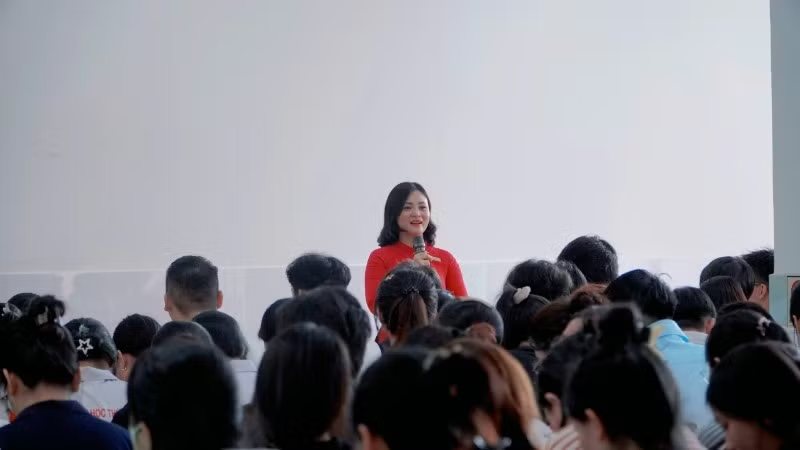
These thoughts reveal a clear shift in the school system: from imparting historical knowledge to fostering individual awareness. “The spirit of April 30th symbolizes the will for independence, the aspiration for unity, and the strength of national solidarity. In today's context, that spirit needs to be continued through the responsibility of learning, training, and innovative creativity of the younger generation,” emphasized Ms. Phan Thi Hong Phu, Head of the Communication and Student Affairs Department of the Water Resources University Branch Campus.
From that perspective, one truth emerges: "The value of history truly comes alive only when it becomes the driving force of the present." When history is placed in direct relation to the choices and actions of each individual, commemorative occasions like April 30th become a living educational space, where the past poses questions and the present must provide answers.
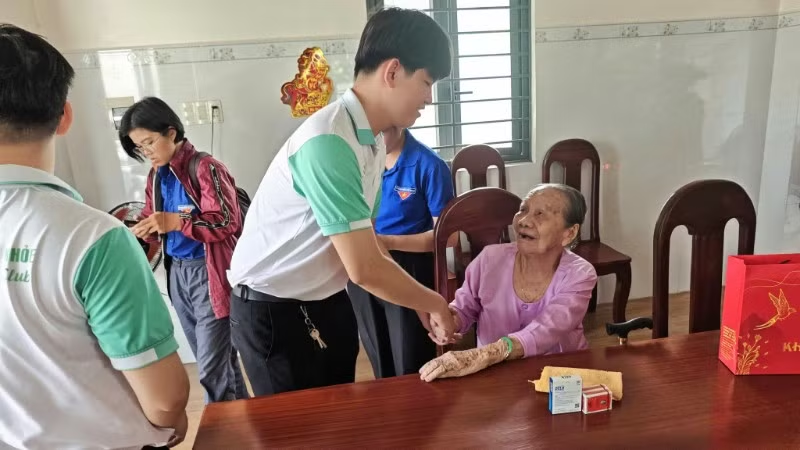
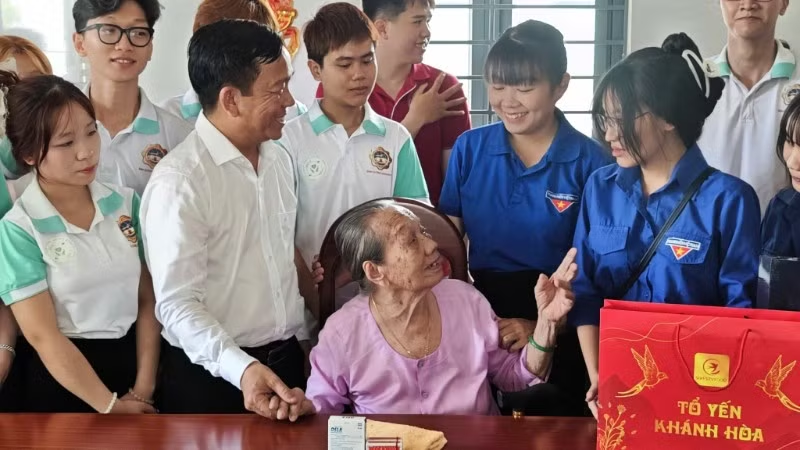
While talk shows open up dialogue, experiential activities create a depth that words cannot easily reach. During the tribute trip to Tay Ninh by students from Binh Duong University, history was not present through concepts, but through specific people and living memories.
A mother silently wipes away tears as she speaks of her husband and sons who never returned. A mother's thin hand and a veteran of the Liberation Army grasp the hand of a student, as if transmitting memories without words. Without explanation or commentary, these moments are enough to change how young people perceive war, sacrifice, and the value of peace.
Student Tran Tan Phat - Vice Chairman of the Medicine and Health Club, who directly participated in the trip, shared: “There are things that we would never fully understand if we only learned them from books. When we met the Mothers and heard their real stories, I understood that my responsibility is not just to remember, but to live in a way that is worthy.”
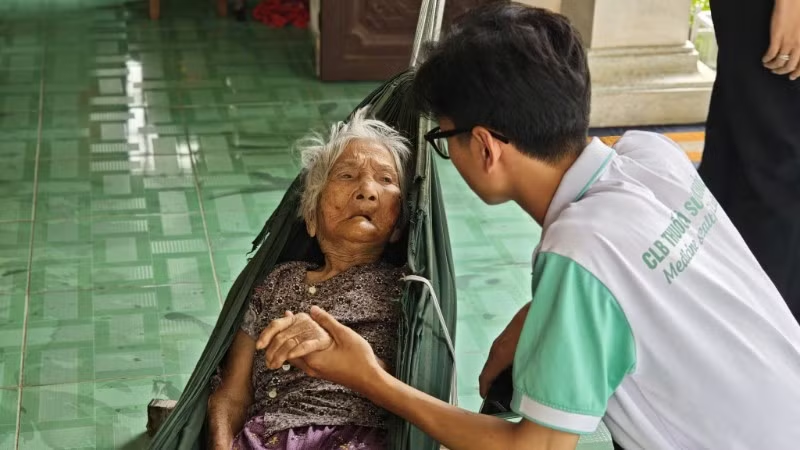
It is from such experiences that a more distinct method of education is gradually taking shape: no longer one-way transmission of information, but creating direct contact between learners and history.
"Ideal education cannot stop at recounting the past, but must help learners find ways to live in the present," stated Ms. Nguyen Thi Minh Ngan, Deputy Director of the Center for Professional Training and Foreign Languages, Ho Chi Minh City Academy of Cadres.
Here, there is a very clear shift: from "knowing" to "feeling," and from "feeling" to "action." When history is touched by genuine emotion, patriotism is no longer an abstract concept, but becomes a vital capacity, manifested in how each person learns, works, and chooses their own path.
Educating patriotism in a new form.
The questions raised at student forums on this occasion reveal a clear reality: today's young people are not lacking in information, but they lack the foundation to guide themselves. They are concerned about motivation for learning, how to overcome stagnation, balancing academics and social activities, loneliness in a new environment, and the pressure to adapt to a world rapidly changing due to technology.
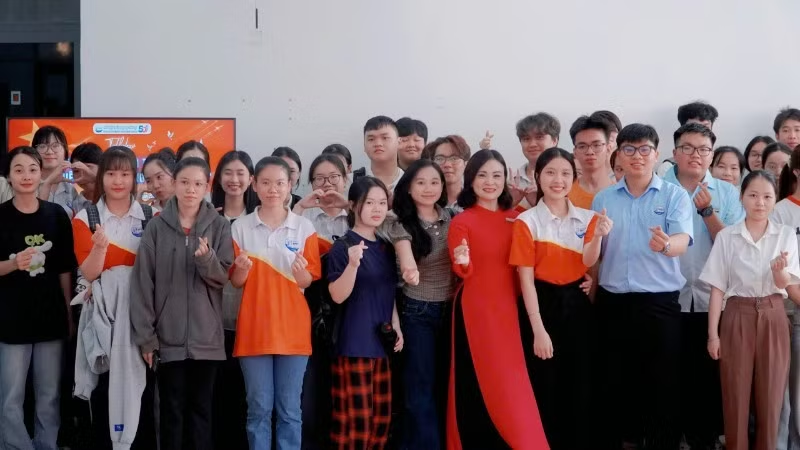
"Today's students are entering a period of tremendous national development. If you don't prepare properly and invest in your skills, you will fall behind," emphasized Dr. Le Xuan Bao, Deputy Director of the Water Resources University Branch Campus.
In this context, the spirit of April 30th cannot be understood merely in its historical sense. It needs to be transformed into a new standard for action. Today's generation does not carry weapons. But they are facing a different "front," where knowledge, technology, and global competition become decisive challenges.
On that "front," patriotism is measured by competence: the ability to learn, adapt, innovate, and lead oneself become key factors.
This places a new demand on schools. Schools should not only be places for imparting knowledge but also for developing civic competence, where students learn self-management, goal setting, and accountability for their choices.
"The spirit of April 30th today is not just a memory, but a motivation for every young person to upgrade themselves, so as not to be left behind in a changing world," shared Ms. Phan Thi Hong Phu, M.A.
Within that developmental context, education not only helps young people understand the past but also prepares them for the future. The activities commemorating April 30th in schools clearly demonstrate a shift in contemporary education. History is no longer confined to memory but is being brought into life, "touched" by experience, and transformed into the capacity for action of the younger generation.
When memories are not only remembered but also lived, civic responsibility is no longer something to be reminded of, but becomes a natural choice. And it is from these choices that the spirit of April 30th continues to be extended, not through stories, but through concrete actions in life today.
Source: https://nhandan.vn/ngay-chien-thang-304-khong-chi-la-ky-uc-post959382.html





















































































Comment (0)