Is "Q-Day" coming soon? Is the internet facing the risk of collapse?
Lessons learned from the Flame malware have prompted Google and Cloudflare to accelerate preparations for the post-quantum era, where the internet could be disrupted before 2029.
Báo Khoa học và Đời sống•22/04/2026
One of the biggest warnings about modern cybersecurity stems from the Flame malware, which exploited a vulnerability in the MD5 hash function to spoof certificates and infiltrate Microsoft's update systems. The incident demonstrates that even a small vulnerability in a cryptographic system can pave the way for global-scale attacks, especially when outdated standards persist in modern infrastructure.
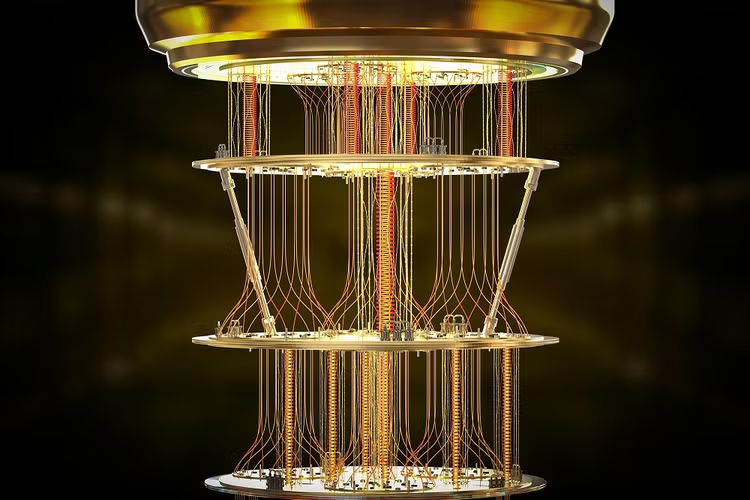
Today, the threat is even greater as quantum computers can break popular algorithms like RSA and ECC using the Shor algorithm in a very short time.
Faced with this threat, Google and Cloudflare have shortened the deadline for deploying post-quantum cryptography to 2029, much earlier than originally planned.
New research suggests that quantum computers can crack ECC-256 encryption in just minutes, raising concerns about "Q-Day"—the point at which all current security systems become useless. What's even more worrying is that when the authentication layer is broken, hackers can not only steal data but also impersonate identities, gain control of the system, and carry out unauthorized transactions. While some corporations like Amazon and Microsoft have roadmaps for transition, the process remains complex due to the involvement of numerous legacy protocols, devices, and systems that have yet to be upgraded.
The lesson from Flame shows that if we delay, history can absolutely repeat itself, and this time the consequences will not be limited to a localized attack but could shake the entire internet.






 Báo Khoa học và Đời sống•22/04/2026











![[GALLERY] Witnessing the first landing of an Italian F-35B fighter jet on a highway.](https://vphoto.vietnam.vn/thumb/402x226/vietnam/resource/IMAGE/2026/05/24/1779625960562_f-35b-della-marina-militare-2-jpg.webp)








![[GALLERY] Elon Musk shocks with the statement that people may not need to go to work.](https://vphoto.vietnam.vn/thumb/402x226/vietnam/resource/IMAGE/2026/05/24/1779625359765_el-png.webp)







































































Comment (0)