


Doctors screen high-risk people for kidney disease - Photo: D.LIEU
However, according to urologists, not all “cysts” that appear in the kidney are harmless. A significant proportion of them may be lesions suspected of kidney cancer, requiring close monitoring or early intervention to preserve kidney function and prevent the risk of malignancy.
At An Binh Hospital, Master Tran Quoc Phong, Head of the Urology Unit, said the number of patients referred for “kidney cysts”, but in fact, cystic kidney tumors, is on the rise.
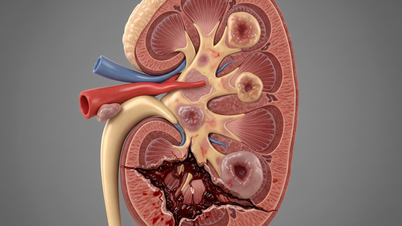
These masses initially appear quite similar to simple cysts, but have more dangerous characteristics such as thick walls, calcification, increased vascularity, or solid tissue components inside, signs suggesting cystic renal cell carcinoma, a malignancy that cannot be detected by conventional ultrasound.
Distinguishing between benign and malignant cysts is not easy.
According to Dr. Phong, most simple renal cysts are benign, do not require treatment, and only require periodic monitoring. However, the difficulty lies in the fact that not all patients understand the difference between benign cysts and cystic lesions suspected of cancer.
Even on ultrasound, the images are sometimes not clear enough to draw a definitive conclusion. Many cases require CT scans with contrast or MRI to differentiate the complexity of the cyst, according to the international standard classification used to assess cancer risk.
Dr. Phong said that he had received patients with ultrasound results from the previous year that only showed “kidney cysts,” but when re-examined at An Binh Hospital, the lesions showed signs of abnormal thickness, septa, and increased blood vessel proliferation - high risk factors for kidney cancer.
There are cases where the tumor has grown large enough that the team must perform surgery to remove part of the kidney to ensure the entire tumor is removed while still preserving maximum remaining kidney function.
For complex lesions or suspected cancer, kidney-sparing surgery is the preferred method, especially when the tumor is small. This technique requires high experience because the doctor must remove the entire malignant lesion while leaving the healthy kidney parenchyma intact.
If performed late, when the tumor is large or invasive, the patient is forced to have the entire kidney removed, which unfortunately can be avoided if detected early.

Doctors recommend regular health check-ups to detect potential diseases early - Photo: D.LIEU
What should patients do when they discover they have "kidney cysts"?
One of the biggest challenges is subjective psychology. Many people when hearing “kidney cyst” often immediately think of benign disease and refuse to do the necessary additional tests.
Others are worried about the cost or are reluctant to undergo CT scans, so they accept vague monitoring. Some patients even believe in folk remedies, take herbal medicines or think that the cyst will disappear on its own, which Dr. Phong asserts has absolutely no scientific basis.
Dr. Phong said: “There is no natural method to remove cysts or prevent kidney cancer. Kidney cysts are anatomical structures that cannot be ‘dissolved’ with leaf juice or any folk remedies. The most important thing is to correctly classify cysts from the beginning. Benign cysts should be monitored, while lesions suspected of being cancerous must be treated promptly.”
Experts also emphasize that cystic kidney cancer often does not cause symptoms in the early stages. Patients do not have pain, do not have blood in the urine and do not have any specific warning signs.
The tumor is only discovered incidentally during an ultrasound or when it is large enough to cause back pain, fatigue or weight loss. This further confirms the role of regular general check-ups, because kidney ultrasound is a simple, inexpensive but extremely useful test in detecting abnormalities early.
In his recommendation to the public, Master Tran Quoc Phong emphasized: “If you are found to have kidney cysts, especially kidney cysts larger than 4cm, do not just hear the word 'cyst' and feel absolutely assured. Bring the results to a urologist for a proper assessment of the severity.
If your doctor orders a CT scan or MRI, it doesn't mean you're seriously ill, but it's a necessary step to distinguish between benign and malignant lesions. The earlier it's detected, the easier the treatment will be, and the higher the chance of preserving the kidney."
Dr. Phong also noted that any abnormal lesions in the kidney, no matter how small, need to be systematically monitored. Patients need to return for check-ups as scheduled, not to delay them and not to skip imaging tests. A few months of indifference is sometimes enough for a benign cyst to become a more complex lesion that is more difficult to treat.
Source: https://tuoitre.vn/nguoi-co-nang-than-ngay-cang-tang-benh-lanh-tinh-hay-dau-hieu-ung-thu-tiem-an-20251202084040287.htm
![[Photo] Parade to celebrate the 50th anniversary of Laos' National Day](/_next/image?url=https%3A%2F%2Fvphoto.vietnam.vn%2Fthumb%2F1200x675%2Fvietnam%2Fresource%2FIMAGE%2F2025%2F12%2F02%2F1764691918289_ndo_br_0-jpg.webp&w=3840&q=75)



![[Photo] Worshiping the Tuyet Son statue - a nearly 400-year-old treasure at Keo Pagoda](/_next/image?url=https%3A%2F%2Fvphoto.vietnam.vn%2Fthumb%2F1200x675%2Fvietnam%2Fresource%2FIMAGE%2F2025%2F12%2F02%2F1764679323086_ndo_br_tempimageomw0hi-4884-jpg.webp&w=3840&q=75)



























































































Comment (0)