

Popular majors when studying abroad in Germany
The German Academic Exchange Service (DAAD) and the German Center for University and Scientific Research (DZHW) last week published the report "Wissenschaft weltoffen" (Science Open to the World), updating aspects related to the country's international education sector. This is an annual publication, considered a prestigious document for the world to follow on trends in studying abroad in Germany.
An important piece of information reported is that in the winter semester of the 2024-2025 academic year, Germany welcomed 402,083 international students to study at higher education institutions in the country, an increase of about 6% compared to the same period last year and continuing the growth trend in recent years. More than half (53.7%) of these chose to pursue engineering and natural sciences; law and economics , social sciences also accounted for a significant proportion (25.4%).
Another notable point is that the number of Vietnamese students studying in Germany increased for the first time after 2 consecutive years of decline, at 5,857 people. This number is just over 80 people away from the record level in the past 5 years (2021-2022 school year) and is a signal that Germany is attracting Vietnamese students again.
It should be noted that the group of international students just mentioned is called "Bildungsauslaender", that is, those who received a certificate of eligibility for admission to German universities issued from outside Germany. In parallel, there is another group called "Bildungsinlaender", that is, those who received a certificate from a school in Germany, in other words, have completed all or most of their secondary education in Germany.
In the framework of the report, only data on the "Bildungsauslaender" group is mentioned. Therefore, this figure does not fully reflect the total number of Vietnamese studying in Germany at the university level. Moreover, the data does not mention the group studying at vocational training institutions, which is increasingly receiving attention in Vietnam.
Another report from the DAAD said that about 49% of Vietnamese students are enrolled in universities of applied sciences , an increase of more than 10%. "The strong practice orientation, the free tuition model and the international prestige of German degrees make Germany a particularly attractive destination. The majority of Vietnamese students coming to Germany belong to the growing middle class, which is increasingly investing in education and international experiences," the report said.
The report added that there are currently 1,415 Vietnamese in the "Bildungsinlaender" group. Thus, it is estimated that there are more than 7,200 Vietnamese students studying at German universities this school year.

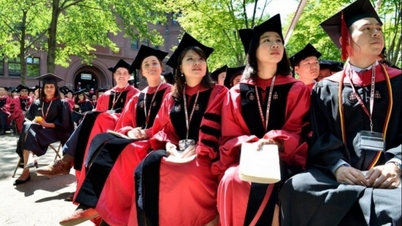
Students at the lecture hall of Berlin Humboldt University, Germany
PHOTO: HUMBOLDT-UNIVERSITÄT ZU BERLIN
Increase the number of training programs in English
Another piece of information pointed out by the DAAD is that the number of English-taught programs in Germany continues to increase. In the summer of 2025, universities offered nearly 2,400 English-taught programs, including about 420 bachelor's programs and 1,930 master's programs. The proportion of English-taught programs at the master's level is about 18%, while at the bachelor's level it is about 4%.
"Almost all universities in Germany offer at least one degree program in English. The number of international staff in university administrations has also increased sharply in recent years. Most German higher education institutions also have an Office for International Cooperation. The number of international partnerships between universities is also on the rise," said Dr. Marcus Beiner, Scientific Director of DZHW.
Increasing internationalization and promoting English-taught education are also among the reasons why Germany attracts more international students.
This is also the first time that "Wissenschaft weltoffen" has announced the dropout rate of international students. Specifically, according to statistics from the first three semesters, the dropout rate of international students enrolled in 2020 was 16% for undergraduates and 9% for masters. For German students, the corresponding rates were 13% and 6%. Thus, the dropout rate of international students is only slightly higher than that of German students.
“International student dropout rates are particularly low in art and music schools, while higher in social sciences, humanities and health sciences,” the report added.
Professor Joybrato Mukherjee, President of the DAAD, called this a "positive signal", especially as Germany's position in the non-English-speaking world becomes increasingly important. "The success of international students in their studies and their ability to enter the labor market is crucial for Germany, especially in the context of a shortage of skilled workers and demographic changes," Professor Mukherjee said in an official statement.
The report added that the three regions with the largest number of international students in Germany are North Rhine-Westphalia (78,200), Bavaria (67,500) and Berlin (41,500). Meanwhile, the three regions with the fewest international students are Schleswig-Holstein (4,500), Saarland (4,200) and Mecklenburg-Western Pomerania (3,400).
How can Vietnamese students study at German universities?
Previously, according to ANABIN, the information portal managed by the German Central Office for International Education (ZAB), Vietnamese students taking the exam under the current general education program must satisfy two conditions to be able to study in Germany for a university preparatory course and then transfer to the first year. The regulation was updated by Germany after the Vietnamese Ministry of Education and Training organized the high school graduation exam under the 2018 general education program.
First, candidates must take the high school graduation exam in two compulsory subjects: math and literature, and two elective subjects out of the prescribed nine. Second, the average score of the four subjects must be 6.5 or higher (without coefficients) and no subject must be below 4 points. These are all regulations that have been applied since previous years, the only difference is the number of subjects.
Sharing more about this issue, DAAD Vietnam said that from 2023 until now, Germany does not require candidates to pass the university entrance exam to study preparatory courses at German universities. At the same time, this agency emphasized that "there are no regulations on exam subjects to study any university major in Germany". This information is updated compared to April, when this unit only noted that "this matter will have an opinion later".
Source: https://thanhnien.vn/nguoi-viet-du-hoc-duc-tang-tro-lai-sau-2-nam-giam-vi-sao-185251207102119363.htm
































































































Comment (0)