

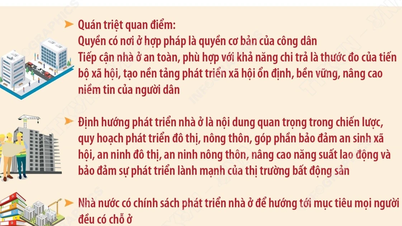
Access to housing is a fundamental right of the people.
Developing social housing for the people has been identified by the Party and the State as a political commitment and an important task for the entire political system, reflecting the characteristics and positive nature of our regime; it is one of the key priority tasks in the socio-economic development of the country. Promoting the development of social housing not only aims to achieve socio-economic targets but also clearly demonstrates the Party and the State's determination to ensure social security and gradually realize the goal of "settling down and making a living" for the people.
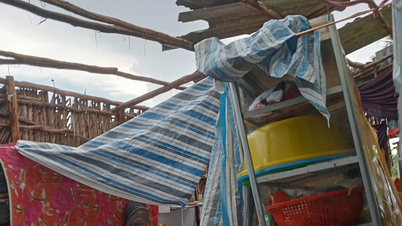
A society will struggle to achieve sustainable development if the workers who directly create material wealth and bring vitality to cities and industrial zones are still living in makeshift rented rooms, their children lack access to education, and they dare not even dream of a stable place to live for their families.
Therefore, at the working session with the Party Committee of the Government and relevant ministries and agencies on the implementation of Directive No. 34-CT/TW of the Party Central Committee on the development of social housing in the new situation (held on May 19th), General Secretary and President To Lam delivered a very noteworthy message: Housing policy in the new period must be designed with new thinking and a new vision, ensuring that everyone has a place to live. At the same time, the head of the Party and State emphasized: "Access to safe and affordable housing must be considered a fundamental right of the people and a measure of social progress."
For many years, the story of social housing was often viewed primarily from the perspective of supporting low-income earners or addressing basic needs. However, in the new context, with rapid urbanization, continuously rising real estate prices, and a widening gap between income and home ownership, social housing is no longer just a simple social welfare policy but has become a crucial issue for social stability, quality growth, and sustainable development.
This spirit has been clearly stated in the national development orientation for the period 2026-2030 of the Resolution of the 14th National Congress of the Party: perfecting the model, mechanism, and policies for managing modern, comprehensive, inclusive, and sustainable social development; developing the economy while ensuring social progress and equity; and continuously improving the lives and happiness of the people… Therefore, housing development must be placed within a holistic mindset, not solely the responsibility of the construction industry or poverty alleviation policies; and certainly not a short-term support issue. This is a crucial task of the national development strategy, centered on people; it is an inter-sectoral, inter-level, and inter-regional issue linked to urban planning, land use, industry, public transport, the labor market, and population management.
Having a stable home is the foundation of sustainable development.
Over the past period, the Government and the Prime Minister have decisively directed and implemented many tasks with specific solutions and objectives to overcome difficulties and promote the development of social housing. As a result, the development of social housing has achieved many positive results. Immediately after the issuance of Government Resolution No. 07/NQ-CP dated January 12, 2026, many localities proactively allocated land, selected investors, and organized the commencement of new projects.
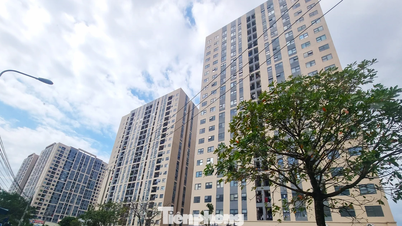
According to the Ministry of Construction, in the first four months of 2026, 40 social housing projects with nearly 36,600 units were started nationwide. To date, approximately 226 projects are underway with a total of 228,725 units, reaching 144% of the assigned target. However, some areas have not given sufficient attention to compensation and resettlement support; the quality of land in some projects is limited, located far from the city center, and lacks synchronized technical and social infrastructure connections, affecting the living and working conditions of residents. Furthermore, administrative procedures in some localities have not been handled according to the "green channel" or "priority" mechanisms, causing delays in project implementation…
One of the notable directives from General Secretary and President To Lam is: "Houses are for living in, not for business or asset accumulation." This message is both a guiding principle and points to the reality that housing is being pushed away from its core value. For many periods, real estate has been considered a tool for speculation and asset accumulation, causing house prices to continuously rise, while access to housing for people, especially young people and those with middle and low incomes, is increasingly limited. A paradox arises in many large cities where those who directly generate growth find it difficult to secure housing in the very places where they work. Therefore, the requirement to strictly control beneficiaries, prevent housing from becoming a speculative asset, and prevent housing policies from being exploited for profit, aims to bring the real estate market back to its proper social function: ensuring housing for the people, instead of becoming a tool for making profits.
In particular, the housing development model for the new phase, as outlined by the General Secretary and President, is one where the State does not provide subsidies, but also does not completely leave everything to the market. The State will play a role in creating land funds, planning, providing financial support, setting standards and regulations; simplifying and facilitating related administrative procedures. The market will participate in construction and operation with reasonable benefits. People will have access to stable, safe housing that is affordable and suitable for the right target group; in which rental housing must become a long-term pillar… This is a modern approach that harmonizes economic development and social responsibility.
A nation cannot achieve rapid and sustainable development if millions of workers remain in temporary housing in the very places where they contribute to growth. When housing prices become unaffordable, workers are forced to live far from their workplaces, their quality of life deteriorates, social costs increase, and their ability to stay in urban areas is limited. The consequences extend beyond just basic living conditions; they directly impact labor productivity, the quality of human resources, and the stability of development. Therefore, "secure housing" is no longer just a matter for individual families, but has become the foundation of sustainable development.
Integrating housing into national development strategies.
A crucial new point in the directives of General Secretary and President To Lam is the need to place housing within the national urban development strategy. Specifically, each urban area, industrial zone, economic zone, growth region, and growth corridor must plan housing alongside technical infrastructure and social services, cultural institutions, healthcare, and education for the people. Areas with a high concentration of workers, migrant laborers, industrial zones, universities, hospitals, and service sectors must be prioritized for the allocation of land, infrastructure, and appropriate mechanisms for the development of social housing.
Government Resolution No. 07/NQ-CP on assigning targets for social housing development to localities for the period 2026-2030 also shows a strong determination to promote social housing development. Accordingly, the goal by 2030 is to “complete or exceed the set target of investing in and constructing at least 1 million social housing units for low-income earners and industrial zone workers.” More importantly, along with the quantitative target, the Government also requires a strong push to reform administrative procedures, placing social housing projects in the “green lane” and “priority lane”; minimizing the time for project appraisal and approval, land allocation, construction permits, and related procedures, ensuring a minimum 50% reduction in administrative procedure processing time and 50% reduction in compliance costs compared to current regulations.
This is absolutely essential because for many years, the biggest "bottleneck" in social housing has been lengthy procedures, a lack of clean land, inconsistent planning, and a lack of decisive action in some localities.
The story of social housing today is not just about how many projects are built or how many apartments are completed. More importantly, it's about building a development model where people truly benefit from the fruits of growth. This perspective is clearly reflected in the national development orientation of the 14th Party Congress: "Using development to stabilize, stability to promote development, and continuously improving the lives and happiness of the people." And in that journey, ensuring access to suitable housing for the people is not only a social welfare policy, but also a measure of progress and social justice.
Source: https://baophapluat.vn/nha-de-o-khong-phai-de-dau-co.html

































































































Comment (0)