
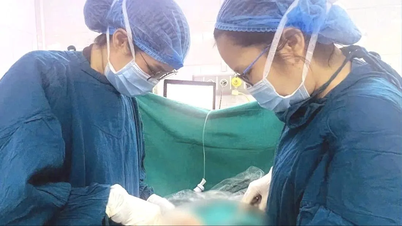
Doctors at Hung Vuong Hospital in Ho Chi Minh City perform surgery to remove an ovarian dermoid cyst from a patient - Photo: T. Hien
Although most tumors are benign and slow-growing, in reality, many cases require emergency hospitalization due to complications such as torsion, rupture, and infection resulting from late detection or delayed treatment.
Why are ovarian dermoid cysts common in young women?
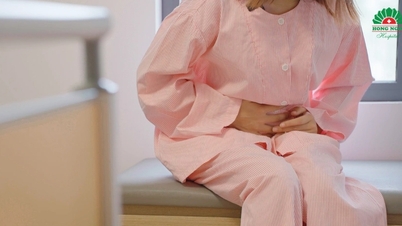
Recently, NTCL, a 24-year-old woman residing in Tay Ninh , visited Hung Vuong Hospital for examination due to severe menstrual cramps.
Previously, the patient occasionally experienced pain in the right lower rib area but ignored it and did not seek medical attention. This time, due to significantly increased abdominal pain, the patient decided to go to the hospital for a check-up.
Ultrasound results revealed bilateral ovarian dermoid cysts accompanied by endometriosis within the uterine muscle. After blood tests yielded normal results and assessed the risk of malignancy as low, the patient was referred for consultation and scheduled for laparoscopic cystectomy.
Dr. Hoang Le Minh Hien, Deputy Head of the Social Work Department at Hung Vuong Hospital, said that the hospital performs laparoscopic ovarian cyst surgery on 1-2 patients every day.
According to Dr. Le Thi Thu Ha, former Head of Obstetrics Department N at Tu Du Hospital, ovarian dermoid cysts (medically known as mature teratoma) account for a relatively high percentage of ovarian tumors in women of reproductive age.
"The unique characteristic of dermoid tumors is that they can contain various types of tissue such as skin, hair, fat, teeth, or bone. This is because the tumor originates from germ cells – a type of cell capable of differentiating into many tissues in the body," Dr. Thu Ha explained.
Ovarian dermoid cysts commonly appear in women aged 20-40. According to doctors, this is directly related to the vigorous activity of germ cells and ovarian hormones during the reproductive period. The more active the ovaries are, the higher the likelihood of tumor formation from germ cells.
Furthermore, dermoid cysts are characterized by their slow growth and minimal long-term symptoms, so many women are unaware they have the condition. In many cases, it is only discovered incidentally during routine gynecological examinations or ultrasound scans.
In the early stages, ovarian dermoid cysts are almost asymptomatic. Some women may experience dull pain in the lower abdomen, lower abdominal distension, bloating, mild menstrual irregularities, or pain during intercourse.
However, these symptoms are nonspecific and can easily be confused with common gynecological or digestive disorders.
Furthermore, because the ovaries are located deep within the abdominal cavity, patients cannot feel the tumor themselves when it is still small. The habit of infrequent gynecological checkups, especially among young, unmarried women, makes the disease more likely to be detected late.
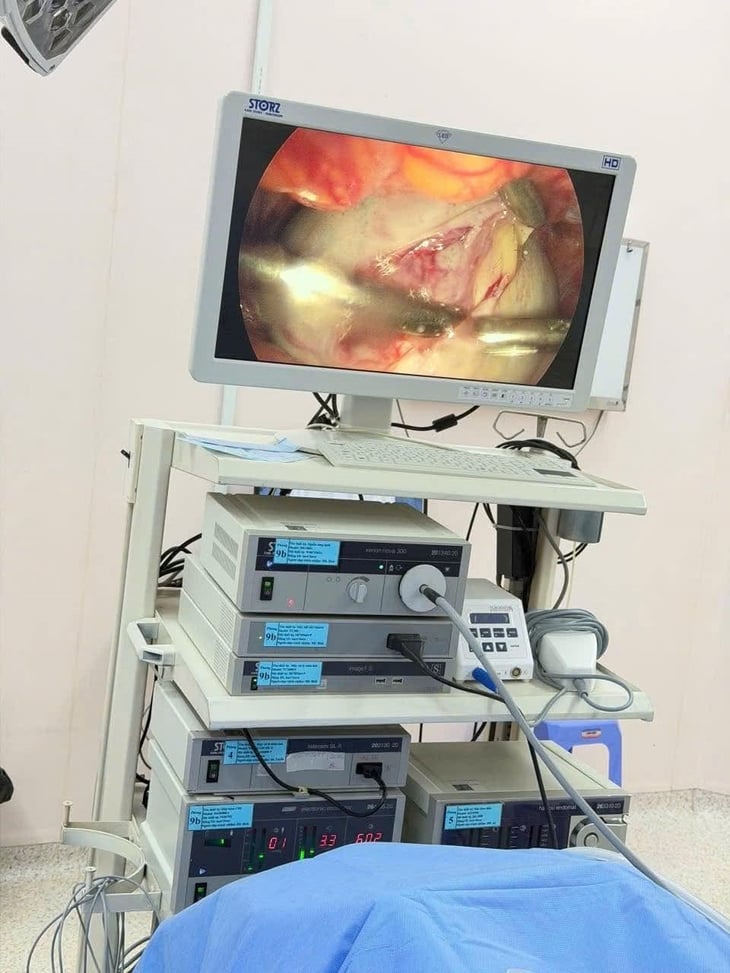
Doctors at Hung Vuong Hospital in Ho Chi Minh City are performing surgery to remove an ovarian dermoid cyst from a patient - Photo: T. Hien
Without timely surgery, the ovaries may have to be removed.
Doctors at Tu Du Hospital and Hung Vuong Hospital say they regularly receive and treat cases of ovarian dermoid cysts.
Most patients are diagnosed when the tumor is still localized in the ovary, small to medium in size, and has not yet caused complications. This is a favorable stage for treatment and preservation of fertility.
However, in reality, there are still many cases where patients are only hospitalized when the tumor has grown large or dangerous complications have occurred, such as ovarian torsion, tumor rupture, or compression of neighboring organs. These cases usually require emergency surgery.
According to Dr. Minh Hien, in the early stages, the tumor grows slowly and causes almost no symptoms. However, when the tumor size increases (≥ 5-6cm), the risk of complications becomes apparent, the most dangerous of which is ovarian torsion.
This condition causes sudden, severe abdominal pain, possibly accompanied by nausea and vomiting, and requires emergency intervention. Additionally, the tumor may rupture, causing peritonitis or compressing nearby organs, affecting urination and digestion.
In a small number of cases (<2%), the tumor can transform into a malignant form. "If not monitored and treated promptly, the disease can lead to ovarian loss due to torsion or necrosis, reducing fertility and even causing dangerous emergency complications," Dr. Minh Hien warned.
According to Dr. Thu Ha, ovarian torsion is the leading dangerous complication of ovarian dermoid cysts. When the cyst grows large, the ovary becomes heavy and easily rotates around its vascular axis. When torsion occurs, the blood vessels are compressed, causing acute ischemia to the ovary.
In more severe cases, prolonged torsion or rupture of the tumor can cause peritonitis, severe infection, even sepsis, and be life-threatening if the patient arrives at the hospital late.
Treatment for ovarian dermoid cysts depends on the size of the cyst, symptoms, risk of complications, as well as the patient's age and reproductive needs.
For small, asymptomatic, and uncomplicated tumors, doctors may recommend regular monitoring with ultrasound.
However, surgery remains the definitive treatment when the tumor is large, painful, or at risk of torsion. Currently, there is no medication that can make dermoid cysts disappear on their own.
For young, non-childbearing women, the primary goal of surgery is to remove the tumor and preserve as much healthy ovarian tissue as possible. In most cases, minimally invasive laparoscopic surgery can be performed.
Regular health checkups are recommended.
Doctors advise that most ovarian cysts are benign and completely manageable if detected early. Neglecting the condition and delaying examination can lead to dangerous complications.
Women should have regular gynecological checkups and ovarian ultrasounds, and seek immediate medical attention if they experience any unusual symptoms such as sudden lower abdominal pain, rapidly increasing pain on one side, nausea, or vomiting.
THUY DUONG
Source: https://tuoitre.vn/nhieu-co-gai-tre-mac-u-bi-buong-trung-20260514092410283.htm






































































































Comment (0)