

Constantly becoming a victim
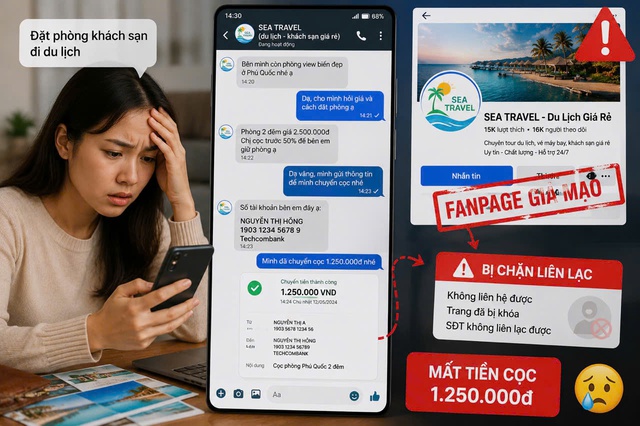
Many victims are scammed out of their hotel deposits as the peak summer tourist season approaches.
PHOTO: CREATED BY WHOM BY KHANG KA
On May 13th, Ms. Tran Thi Thanh Truc, phone number 0702.607.xxx, contacted the Asteria Mui Ne Fanpage to book a room for her family's summer vacation. After receiving advice from the staff, Ms. Truc transferred a 50% deposit of 4.5 million VND. Before making the payment, she carefully called the phone number on the booking confirmation slip to verify, but no one answered. After transferring the money, the "employee" said that she had mistakenly transferred the letter "I" instead of the number 1, so the system did not register it. She asked her to transfer the money again and promised that the outstanding amount would be refunded within a few minutes.
Despite feeling suspicious, Ms. Truc transferred another 4.5 million VND based on the "resort employee's" explanation. Immediately, the "employee" blocked her phone number, making contact impossible. Using similar tactics, in a short period, many consumers looking to book accommodations fell victim to numerous fake Fanpages, from Madala Cham Bay Mui Ne to Cat Ba The May Legend, with each case resulting in millions of VND being scammed.
According to experts from the Anti-Fraud Project, scams involving hotel, resort, or vacation rental deposits have been around for a long time and are very common, yet people still fall for them. The scam involves using deceptive tactics like offering great deals, creating fake Fanpages , and running ads or posting articles with incredibly good deals and stunning hotel/resort images at half the market price to entice customers to quickly make a deposit. After the victim transfers 50% of the deposit, the scammer immediately informs them: "You sent the wrong character in the transaction details; the automatic check-in system couldn't register it," and asks them to transfer the correct details again for the system to register.
If the customer is suspicious and refuses to transfer more, they will introduce a third party (posing as an accountant) to guide them through the refund procedure using a QR code and may pre-set a larger amount than the 50% deposit to trap those who are not paying close attention.
Why are so many people easily scammed out of deposits?
According to cybersecurity experts, the victim is officially considered a victim from the very first deposit transfer, and the lost money is difficult to recover. The request for another transfer is a second stage of the scam; those who are not vigilant will suffer even greater losses. There's no such thing as "incorrect account details" resulting in the money being held up because if the account number is correct, the money has already gone into the scammer's pocket.

Leaving tourist destinations, resorts, hotels, etc., entirely to distributors is creating a loophole that allows scammers to operate with impunity.
PHOTO: PROVIDED BY THE SUBJECT
According to many victims, they did research before transferring money, but in reality, they couldn't find the official Fanpages or websites. Even after realizing they had been scammed, they couldn't find the correct place to rebook. Speaking with Thanh Nien newspaper, Mr. Vo Do Thang, Director of Athena Cybersecurity Training Center, acknowledged that the fact that tourist destinations, resorts, and hotels rely on distribution agents is creating loopholes that allow scammers to operate freely. "Besides large hotels that invest in official websites and Fanpages, most resorts and hotels use agency channels to sell rooms and find customers. Therefore, they invest little in official Fanpages, and their websites often lack complete contact information. Even if they own a website, with advertising tactics, fake pages can appear and compete with the real ones," Mr. Vo Do Thang explained.
According to Mr. Ngo Minh Hieu, Director of the Anti-Fraud Project (Chongluadao.vn), users of travel booking websites need to carefully check the domain name. Websites with unusual extensions such as .xyz, .cc, .tk, or domain names that closely resemble large brands but differ by a few characters, all pose a potential risk of fraud. For Fanpages with attractive images, users should carefully check the "Page Transparency" section on Facebook to find out the page creation date and name change history. Fraudsters may buy verified Fanpages and change the name to carry out their scams.
Most importantly, people need to be especially wary of travel packages priced 30% or more below market value. This is often the first sign of a high-risk transaction. In the tourism sector and many other consumer sectors, excessively low prices compared to the general market are a tactic that preys on the "desire for cheap deals" and turns customers into victims. "The more attractive the offer, the more carefully you need to check. A cheap vacation may be appealing, but just one moment of carelessness can cause travelers to lose their entire deposit, or even a year's worth of savings for a trip," warned a representative from the Chongluadao.vn project.
Source: https://thanhnien.vn/nhieu-nguoi-bi-lua-coc-dat-phong-khach-san-co-vo-can-185260514161927186.htm

































































![[Photo] Hue: Admire the 2.4 trillion VND sea bridge, the longest in Central Vietnam.](https://vphoto.vietnam.vn/thumb/402x226/vietnam/resource/IMAGE/2026/05/24/1779614018347_anh-man-hinh-2026-05-24-luc-16-13-29.png)






























Comment (0)