

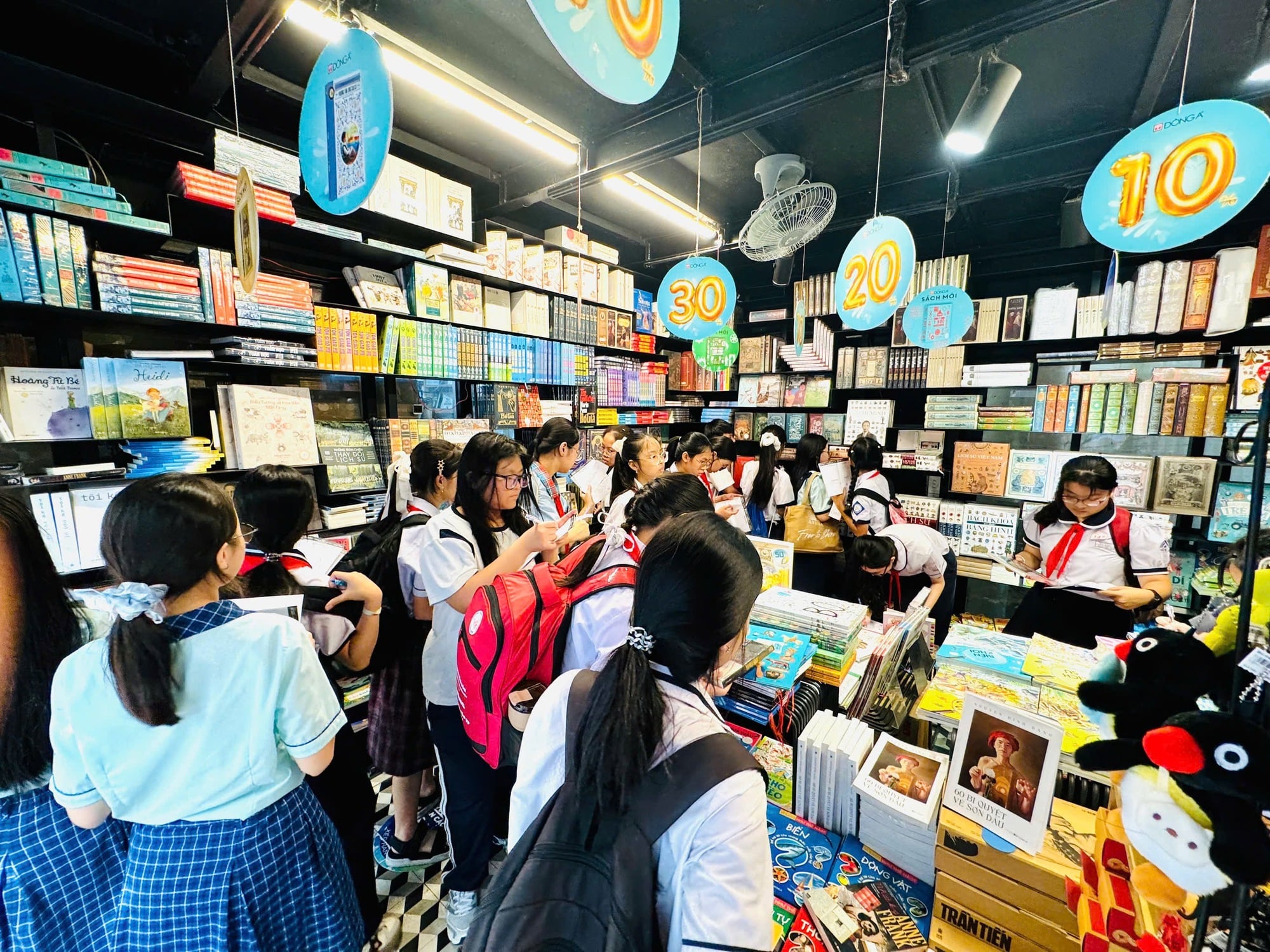
Ho Chi Minh City's book street is a popular destination for many young readers.
Photo: QUYNH TRAN
What do you see young people around you reading right now?
Mr. Tran Dinh Ba - Deputy Director of Ho Chi Minh City General Publishing House : What young people around us usually read cannot encompass all of today's youth. Young people themselves have differences in gender, interests, occupation, place of residence… and many other factors that influence reading trends and book genres. However, observing young people around us and publishing trends, book buying needs, and book sales volume…, I see that young people currently prefer healing books, self-help books, and economic books… Another genre that attracts young people is memoirs, autobiographies, and historical novels, thanks to the effect of these events that spark curiosity.

Mr. Tran Dinh Ba - Deputy Director of Ho Chi Minh City General Publishing House
Photo: QUYNH TRAN
Writer Nguyen Mai Phuong : I don't have enough data to conclude how today's "young people" differ from those of the past in their reading habits; I've only observed myself and those around me. I believe that in any era, any generation, any country, young people are always enthusiastic about embracing literary works, including books, as long as they are good. Good books have a place. Of course, communicating with readers is important, and nowadays, young people's reading habits are heavily influenced by media and compete with electronic devices, which is also a difficult problem.

Writer Nguyen Mai Phuong
Photo: Provided by the interviewee
In your opinion, what is the "biggest competitor" to books today?
Associate Professor Pham Xuan Thach, School of Interdisciplinary Sciences and Arts (Vietnam National University, Hanoi) : Books currently face too many competitors. Social media is the platform for spreading audiovisual cultural products and consuming short-form image content, including many half-minute and one-minute videos … This is the biggest competitor to books.
Journalist Trung Nghia, Ambassador of Reading Culture in Ho Chi Minh City 2023-2024 : I often go to the Ho Chi Minh City Book Street on weekends and frequently invite a large number of students to book launch and discussion events to encourage them to take an interest in reading and reading culture. It's a fact that, in this era of booming digital technology, the image of young people holding a physical book in their hands seems to be becoming increasingly rare. Instead, we see smartphones with countless features from social media, short videos, and online games. This reality raises a thought-provoking question: Why are books increasingly struggling to compete with modern forms of entertainment?
Reading requires concentration, patience, and deep thinking skills—qualities that are gradually being eroded in today's fast-paced life. Not to mention, the pressures of studying, work, and multitasking lead young people to choose quick, easy forms of entertainment. A video lasting a few dozen seconds can provide instant relaxation, while a book takes hours, even days, to finish. This disparity puts books at a disadvantage in the fierce competition for time and attention.

Ambassador of Reading Culture of Ho Chi Minh City 2023 - 2024 Trung Nghia
Photo: QUYNH TRAN
Do young people tend to "read quickly and discard quickly"? How does this affect the publishing industry?
Associate Professor Pham Xuan Thach: I believe there's a trend of reading quickly and discarding quickly. The consumption of content on social media platforms leads to a lax attitude towards content. The same applies to reading books; people read less and don't have the same profound experience when reading a book. They prefer video content that can be immediately applied to their lives or provides instant entertainment, rather than the long journey of reading a book, which requires deep thought and reflection. Therefore, people are increasingly abandoning the world of books to consume other forms of entertainment.

Associate Professor Pham Xuan Thach
Photo: Provided by the interviewee
Mr. Tran Dinh Ba: The form and type of reading have certainly changed significantly with the strong impact of technology. However, there is an undesirable situation: reading summaries and following trends… This is a trend in the age of technology, with the convenience of technology readily available on personal smartphones, and it suits office workers with limited time. But this leads to the phenomenon of fast, superficial reading, while the value of a book is not just in a few thousand words of summary or review. Not to mention, many technology applications using AI tools integrate information that is difficult to control the accuracy of input data, potentially leading to distorted information received by readers if they lack the ability to properly assess it.
Are young people still loyal to physical books, or are they shifting to other platforms?
Journalist Trung Nghia: Previously, "reading" was often understood as holding a physical book and reading from beginning to end, but with young people today, I see that concept has changed significantly. Young people of Gen Z, students, and schoolchildren still read, even read a lot, but in more flexible ways such as ebooks, audiobooks, or summaries on digital platforms. It can be affirmed that young people are not reading less, but are shifting to a form of "multi-platform reading," where the acquisition of knowledge is no longer limited to the pages of a book.
This shift also brings with it a consequence: reading habits have become fragmented, leaning towards quickly selecting information rather than reading deeply and comprehensively. While this saves them time and allows them to access knowledge faster, it also challenges their ability to think long-term and gain a deeper understanding. Therefore, the issue isn't whether young people read or not, but rather how they are reading, why they are reading, and what benefits they gain in an increasingly information-saturated world.
Mr. Tran Dinh Ba: Paper books, to this day, remain the foundational product, the original source for other types of books. While technological advancements are strongly impacting various book formats, the reading trends of young people are also shifting. Today, young people can hold a smartphone, plug in headphones to read ebooks, listen to audiobooks, watch videobooks… However, books have their own unique value at a deeper level of knowledge, giving them a life of their own and a specific audience. Each book, regardless of genre, always contains new content, creating appeal and leaving a lasting impression on readers, including young readers. The issue here is not just about entertainment, but also about needs – intrinsic needs (the desire to read and learn) and obligatory needs (the need to read to serve learning and work…).
Source: https://thanhnien.vn/nhu-cau-doc-sach-dang-co-su-chuyen-dich-185260421204639646.htm





































































































Comment (0)