

Sowing rice seeds on new land
Having spent more than half of his life working in the fields, Mr. Nguyen Van Hung (63 years old) in Truong Thang hamlet, Truong Long Tay commune ( Can Tho city) still clearly remembers the first time he set foot in this land.
He is from Binh Dinh (old). In 1976, after the South was completely liberated, he and his family went to the West to reclaim land and start a business following the new economic movement.
Rice farming was the main livelihood of his family at that time with an area of about 8,000m2. In those years, people still worked hard with hoes and sickles, without pumps or dikes; when the water rose, the fields were flooded, and when the water receded, the fields were dry and cracked. Each year, people could only grow one rice crop lasting 8-9 months, with an estimated yield of only about 3.5 tons/ha.
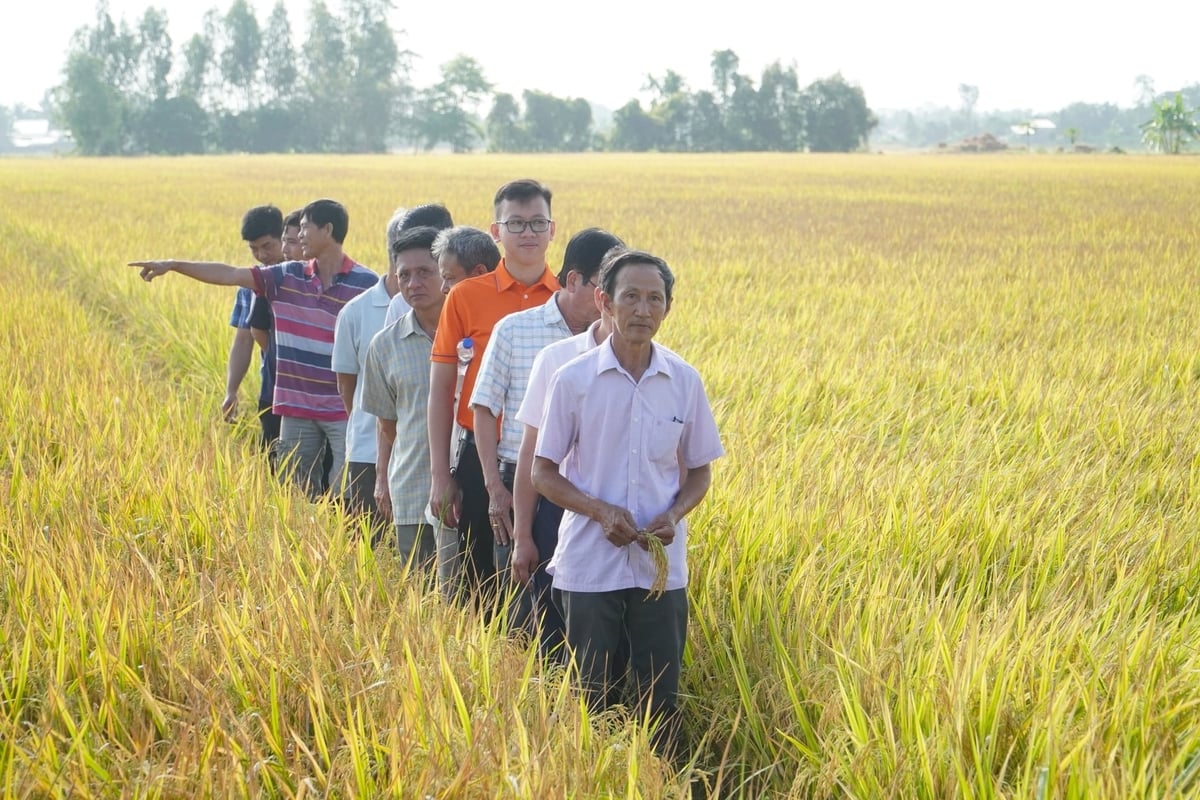
Farmers in Truong Thang hamlet, Truong Long Tay commune (Can Tho city) choose rice as their main livelihood. Photo: Kim Anh.
In addition to growing rice, people work all year round for households with large fields. Young people can go weeding, digging ditches, planting sugarcane, while the elderly stay home to look after the fields.
“At that time, the land was fertile, rich in alluvium, and no fertilizers or pesticides were used. However, the land was not flat, some places were high and some were low. When growing seasonal rice, the higher areas had food, but the lower areas were flooded,” Mr. Hung recalled.
By 1990, when the old cooperative was dissolved, people were given land, granted land use rights and actively decided on production methods. From then on, dykes and irrigation were invested. Double-crop, then triple-crop rice fields were formed one after another, helping farmers increase productivity and income.
However, when productivity increases, the cost of investment for the crop also escalates. From a few kilograms of fertilizer used for each hectare of land (1,000m2/hectare), it has now increased to 50kg. Plant protection drugs have also become a mandatory "companion" in the rice fields. "The land is no longer the same as before, if you keep fertilizing and spraying pesticides, you will not see any benefits, but only see the environment getting more and more tired. Intensive cultivation of 3 crops/year, the land is rotated and rotated so it loses its fertility," said Mr. Hung.
When new farming technology transfer programs such as IPM, "1 must 5 reductions" were implemented, Mr. Hung was one of the first to participate. At first, it was simply limiting the use of fertilizers and pesticides, proactively controlling pests, sparse sowing and protecting natural enemies. Gradually, when production became effective, many farmers in the hamlet believed in it, thought that their neighbors were more progressive and followed suit.
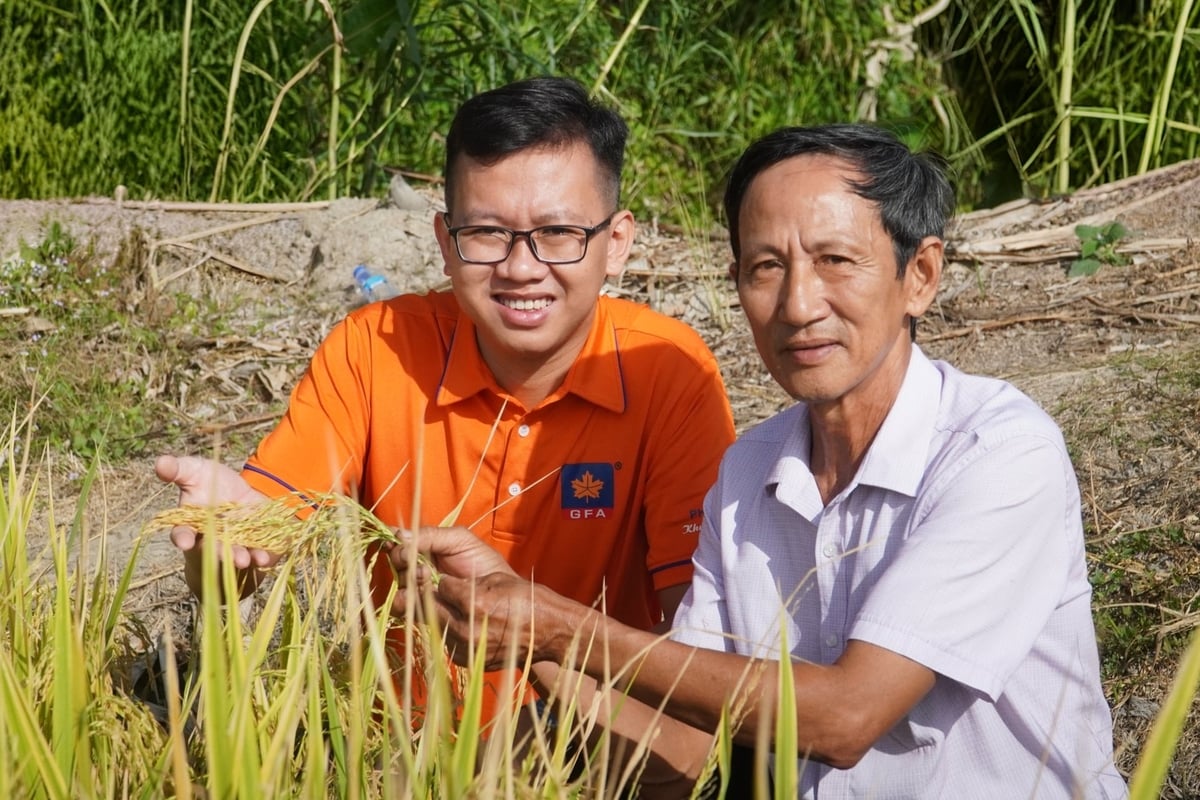
Mr. Nguyen Van Hung (right) - a pioneer in encouraging rice farmers to reduce emissions many years ago. Photo: Kim Anh.
Mr. Hung acknowledged that in the past, people had not thought about reducing emissions in production, but everyone was struggling to find ways to reduce costs. Because 5-7 years ago, rice productivity was no longer increasing, profits were getting lower and lower, requiring people to reduce costs to increase profits and reduce pest pressure.
From this advantage, when the Project of 1 million hectares of high-quality rice, reducing emissions was launched, farmers in Truong Thang hamlet unanimously agreed and became the pioneer locality to participate in the Project. Mr. Hung affirmed that up to now, people in the hamlet have mastered the farming process of the Project. Especially the issue of collecting straw from the fields to reduce emissions, becoming a good farming habit.
Now, Truong Thang hamlet has become a bright spot in Truong Long Tay commune with nearly 150 households participating in building a 170ha high-quality rice material area, reducing emissions. The hamlet has also established 3 cooperative groups to produce according to the project's process. The fields after harvest are no longer covered with smoke from straw as before. People collect straw to sell or reuse as fertilizer.
Rice cultivation must reduce emissions
In Tan Phuoc area, Thoi Long ward (Can Tho city), Mr. Dong Van Canh - Director of New Green Farm Cooperative is also creating a movement to compete in growing rice to reduce emissions.
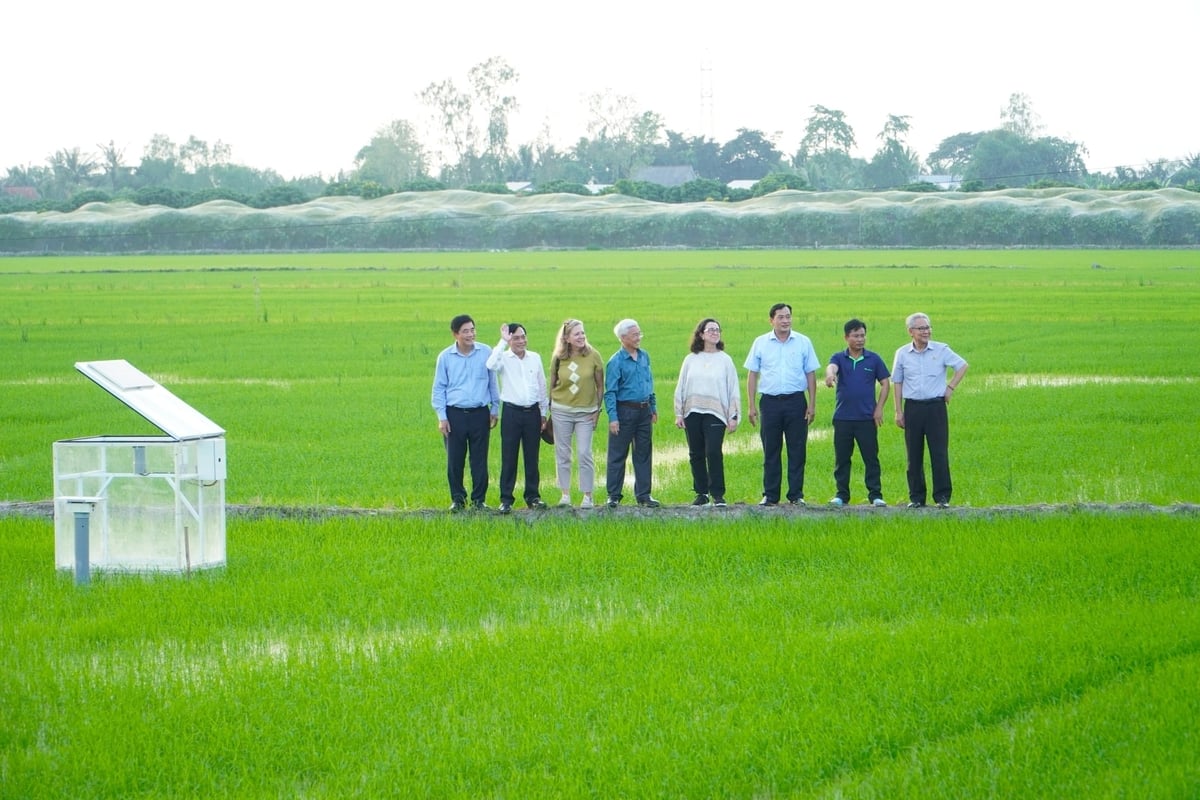
The New Green Farm Cooperative's emission-reducing rice fields welcome World Bank (WB) leaders and businesses to visit. Photo: Kim Anh.
In 2018, he approached the “1 must 5 reductions” technique from the Vietnam Sustainable Agriculture Transformation Project (VnSAT). He realized that reducing seeds, fertilizers, and pesticides does not reduce productivity but on the contrary helps the rice grow healthy, the soil revives, and rice farmers make more profit.
Mr. Canh confided that at first, it was very difficult to persuade people to change their farming habits and reduce emissions: "No one believed what we said, so we had to do real models. When people saw that our fields were effective, they followed." From a few experimental hectares, now the entire 148 hectares of the cooperative have applied the emission reduction process, and even the households that have cooperated with us from outside voluntarily follow.
He cherished: "If we collect straw, grow mushrooms and then use mushroom residue as organic fertilizer, it will create a closed chain." From this idea, he started making organic fertilizer from straw, initially only 400m2, now expanded to 2,000m2, supplying about 100 tons of organic fertilizer/year. Not only serving the cooperative internally, the product is also sought after by people in the surrounding area because it is "cheap and good".
Thanks to this, straw is no longer burned, reducing emissions and increasing income. The cooperative is also considering expanding mushroom greenhouses, creating more jobs for farmers. The new production mindset helps people cross the boundary from “farming for a living” to “farming for development”.
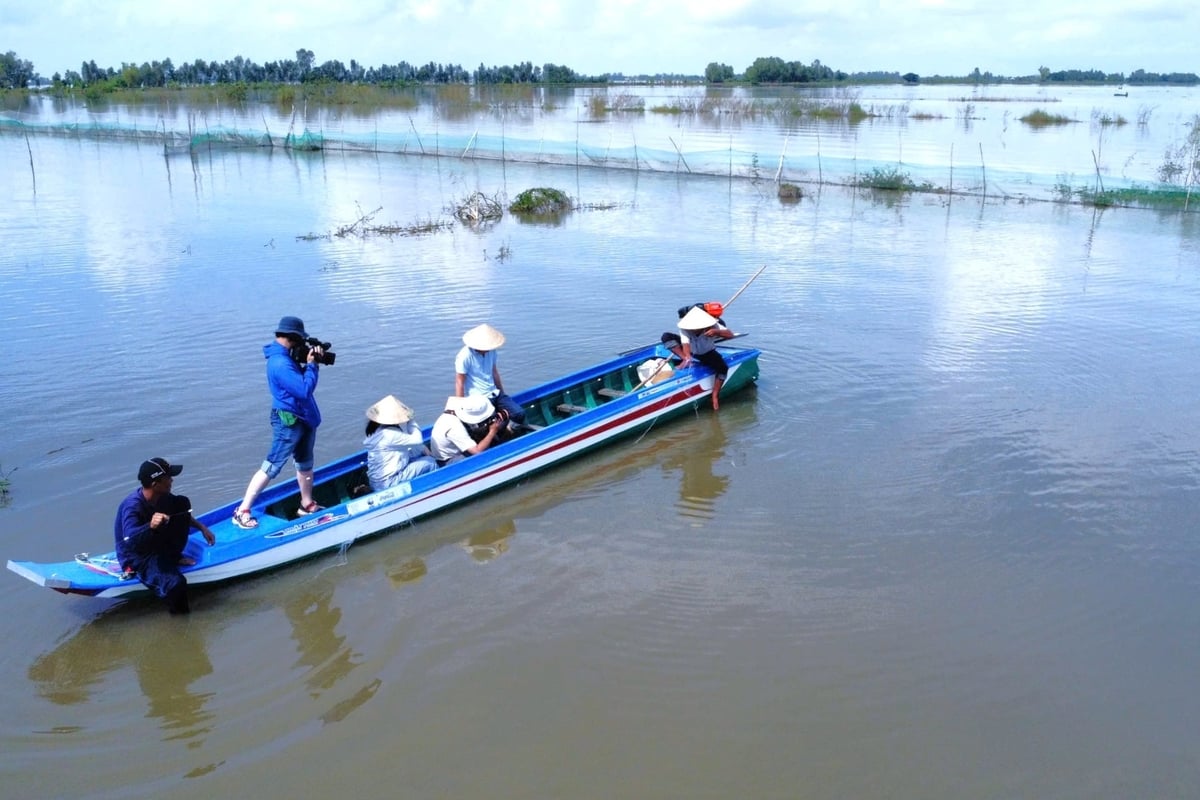
Rice cultivation in the dry season reduces emissions, and fish are stored in the flood season. That is how Quyet Tien Cooperative protects the natural ecosystem. Photo: Kim Anh.
In Dong Thap province, Mr. Nguyen Thien Thuat - Deputy Director of Quyet Tien Ecological Agricultural Production Cooperative, sought a different direction by combining rice cultivation to reduce emissions, organic rice with fish farming during flood season and community tourism.
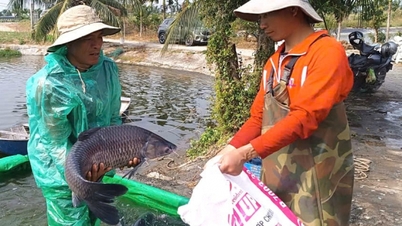
In the vast fields of water in Long An A hamlet (Phu Tho commune), this season farmers have a bumper crop thanks to the abundant amount of freshwater fish stored in their own fields. When the water rises, the fish come back to breed, and people spread nets to store them. When the water recedes, the fields become organic, clean and healthy rice fields. Just like that, "the land rests, the water nourishes, the people are full", Mr. Thuat assessed that this model not only helps preserve aquatic resources but also increases farmers' income.
A year before the reporter visited the model, the scale was only about 20 hectares. At that time, some households fishing freely still objected, but when the model was successful, with many large fish, selling for a good price, people all asked to participate, expanding the model to 170 hectares as it is today.
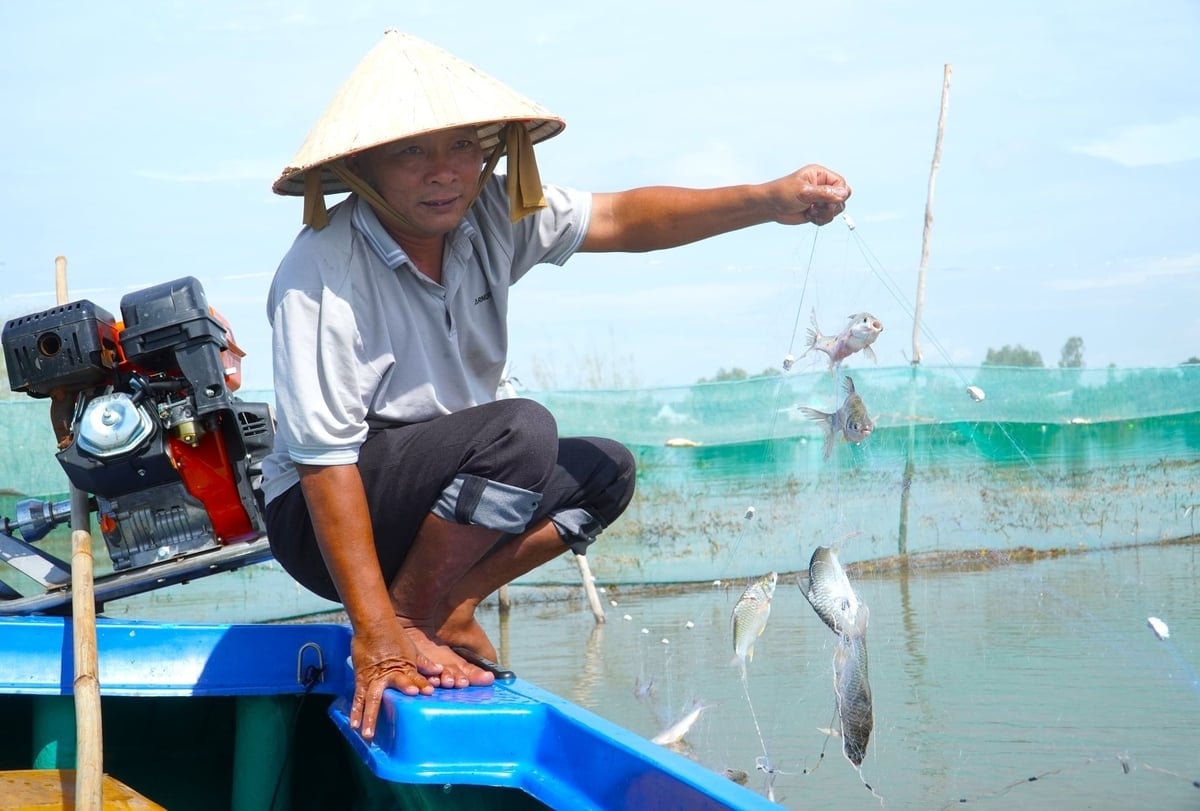
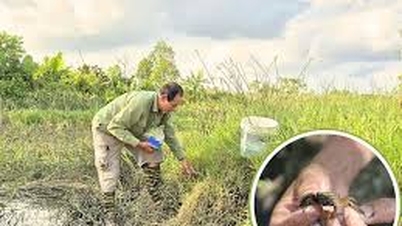
When rice fields are cultivated safely and emissions are reduced, wild fish have conditions to grow, bringing higher income to farmers. Photo: Kim Anh.
Mr. Thuat excitedly said that this year, community tourism has developed unexpectedly, with visitors doubling compared to the first two years, estimated at 500-600, mainly families and young people who want to experience the river area. Although the cooperative is still small, has few human resources, and cannot officially connect with travel companies, these signals show that this direction is "reaping" more trust.
Quyet Tien Cooperative is currently cultivating 100 hectares of rice in the 1 million hectares of high-quality rice project, reducing emissions. In addition, there are 20 hectares of organic rice in association with Tan Dat Cooperative (in Vinh Long province) and Bach Moc Agricultural Products Company Limited (Vinh Long province).
During the flood season, more and more tourists come to experience setting traps, picking water mimosa flowers, catching fish, etc. The cooperative is considering linking up with travel companies to develop eco-tourism, creating additional revenue to reinvest in the clean raw material area.
More importantly, the model of combining rice cultivation to reduce emissions and fish storage has mobilized the consensus of the people, demonstrating responsibility for the environment. “As long as the people are united, anything can be done. If everyone does it on their own, it will be difficult,” said Mr. Thuat.
Source: https://nongnghiepmoitruong.vn/nhung-nong-dan-tien-phong-nghi-khac-lam-khac-de-trong-lua-giam-phat-thai-d782004.html
![[Photo] Urgently help people soon have a place to live and stabilize their lives](/_next/image?url=https%3A%2F%2Fvphoto.vietnam.vn%2Fthumb%2F1200x675%2Fvietnam%2Fresource%2FIMAGE%2F2025%2F12%2F09%2F1765248230297_c-jpg.webp&w=3840&q=75)






































![[Photo] General Secretary To Lam works with the Standing Committees of the 14th Party Congress Subcommittees](https://vphoto.vietnam.vn/thumb/402x226/vietnam/resource/IMAGE/2025/12/09/1765265023554_image.jpeg)





















Comment (0)