

Shorten the waiting time for unemployment benefits
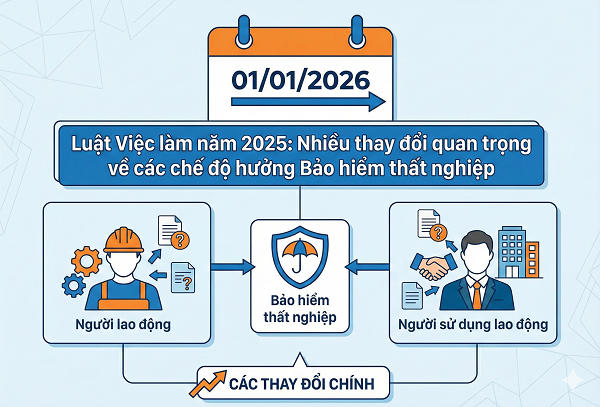
One of the changes that directly benefits workers is the shortening of the time to receive benefits. According to the 2025 Employment Law (Clause 3, Article 39), the time to receive unemployment benefits is calculated from the 11th working day from the date of submitting a complete application, instead of the 16th working day as prescribed in the 2013 Employment Law. This helps workers access financial support more quickly during difficult times when they lose their jobs.
Agree on a ceiling for unemployment benefits
The 2025 Employment Law (Clause 1, Article 39) has unified the maximum unemployment benefit level. Accordingly, the monthly benefit level is still equal to 60% of the average monthly salary for social insurance contributions of the 6 consecutive months before unemployment as in the 2013 Employment Law, but the maximum level is not more than 5 times the monthly regional minimum wage announced by the Government .
This provision replaces the distinction in the 2013 Law which stipulated a ceiling based on the basic salary for the state sector and a regional minimum wage for the enterprise sector.
Supplementing the meal allowance when participating in vocational training
In the 2025 Law on Employment (Article 37), the previous "Vocational Training Support" regime has been renamed "Support for workers participating in training and improving vocational skills". A notable new point is that in addition to tuition support, workers participating in training courses will receive additional meal support during the training period. This regulation aims to encourage unemployed people to actively participate in retraining and return to the labor market soon, instead of focusing only on receiving cash benefits.
Create conditions to support employers in training and development
The new law focuses more on unemployment prevention solutions through supporting businesses. Specifically, the 2025 Employment Law (Article 42) has removed the condition that employers must "not have enough funds to organize training" to be supported. At the same time, the condition "Facing difficulties due to economic downturn or other force majeure reasons, forcing changes in production and business structure or technology" has been regulated in more detail and specifically as follows: Changes in structure, technology or for economic reasons as prescribed in the Labor Code; Natural disasters, fires, enemy attacks or dangerous epidemics; Implementation according to the decision of competent state agencies on relocation or reduction of production and business locations; Other cases as prescribed by the Government.
This regime will contribute to maintaining jobs for workers, thereby helping to stabilize workers' lives, contributing to social stability. At the same time, when workers' jobs are maintained, it will contribute to reducing the number of people receiving unemployment benefits.
Stricter regulations on conditions for not receiving benefits
The 2025 Employment Law (Clause 1, Article 38) amends the provisions on cases of not being entitled to unemployment benefits related to the retirement regime. Specifically, employees who quit their jobs when they are eligible for pension benefits will not be entitled to unemployment benefits, instead of the provision of "having received pension" as in the 2013 Employment Law. In addition, the Law also adds provisions on termination of benefits at the request of employees.
Source: https://baotintuc.vn/xa-hoi/nhungthay-doi-quan-trong-ve-cac-che-do-huong-bao-hiem-that-nghiep-tu-nam-2026-can-luu-y-20251206164614430.htm

















![[Photo] National Assembly Chairman Tran Thanh Man attends the VinFuture 2025 Award Ceremony](/_next/image?url=https%3A%2F%2Fvphoto.vietnam.vn%2Fthumb%2F1200x675%2Fvietnam%2Fresource%2FIMAGE%2F2025%2F12%2F05%2F1764951162416_2628509768338816493-6995-jpg.webp&w=3840&q=75)



























































Comment (0)