

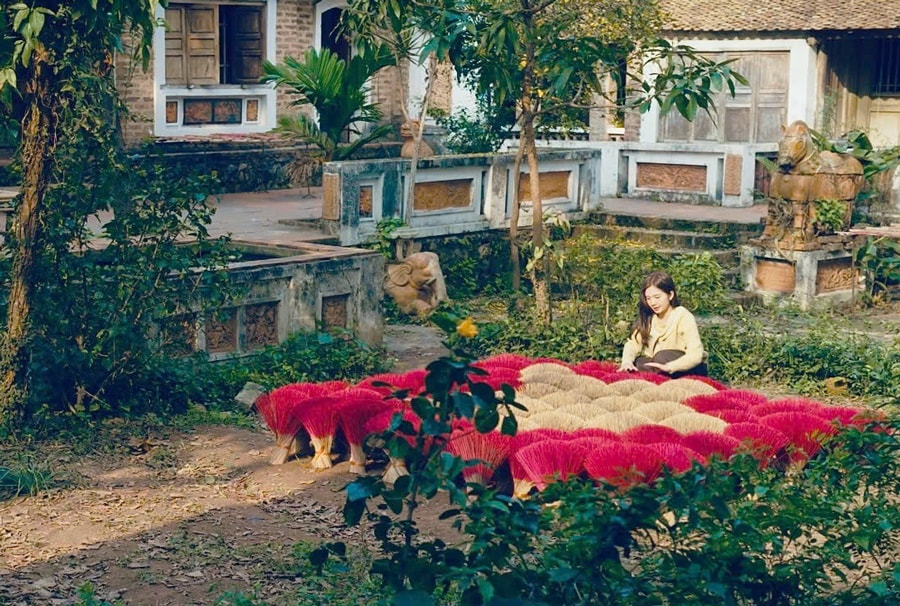
Captivating viewers with a simple yet compelling story.
After nearly 20 episodes, "Against the Current, Against the Sun" has gradually made its mark in the genre of television dramas exploring rural life and traditional crafts. With its rhythmic storytelling, the series allows everyday conflicts to lead viewers to larger stories about family, love, reconciliation, and the aspiration to preserve traditional crafts.
Set against the backdrop of a traditional incense-making village in Northern Vietnam, bathed in vibrant colors under the sun, director Vu Minh Tri's film revolves around the family of Mr. Phuc, the owner of the renowned Tam Phuc incense factory. After the tragic loss of his wife, he single-handedly raises his two daughters. While Van is a calm, principled village official who always prioritizes responsibility, Mai represents the younger generation with a spirit of innovation and a willingness to take risks.
After graduating with a degree in marketing, Mai gave up opportunities in the city to return to her hometown and begin the journey of reviving her family's traditional incense workshop. This decision stemmed not only from family affection but also from a desire to restore the Tam Phuc incense brand. For Mai, incense making is not simply a means of livelihood, but also a memory and a source of pride for her entire family lineage.
Mai's journey home is far from easy, as she faces old prejudices and long-standing conflicts between Mr. Phuc's family and Mr. Truc and Mrs. Dien's family. In this context, the relationship between Mai and Trung – the son of the "rival family" – becomes a captivating highlight. From confrontation and arguments to gradually finding common ground in their desire to preserve their profession with a new mindset, their love story embodies the film's title: Going against prejudice to find one's own path. "Against the current, against the sun" is therefore a beautiful metaphor for the journey of choice – stepping out of one's comfort zone, accepting challenges to grow, and preserving core values.
Through the episodes aired so far, viewers have experienced a different nuance of television drama. Instead of chasing dramatic situations or unexpected twists, the series captivates audiences with its simple story about village life, familiar yet relatable conflicts that gradually sink in naturally. This persuasiveness is achieved thanks to the restrained and nuanced performances of the cast.
In particular, the two real-life couples, Ngoc Huyen - Dinh Tu and Meritorious Artist Nguyet Hang - Anh Tuan, bring a natural synergy to the characters. In addition, the participation of experienced artists such as Meritorious Artist Thanh Quy, Meritorious Artist Thanh Binh, Tu Oanh, along with young actors Minh Thu, Anh Duc... creates a multi-dimensional and vibrant cast of characters.
Beyond just a love story and family drama, "Against the Current, Against the Sun" also paints a vivid picture of modern rural life – where ordinary people strive to balance preserving tradition with adapting to change. Meritorious Artist Thanh Quy (playing the role of Mr. Chinh) shared that the film's most valuable aspect is its return to the countryside, recreating the beauty and rhythm of traditional craft villages. Through this, not only the audience but also the artists have the opportunity to better understand today's younger generation – those who are trying to preserve heritage with a new mindset.
When cinema contributes to the spread of culture
The appeal of films about traditional crafts lies not in the novelty of the subject matter, but in how the films allow viewers to connect with the depth of the culture. With "Against the Current, Against the Sun," this is achieved through meticulous research into traditional crafts, the setting, and a serious filmmaking approach.
Artist Trung Anh – who was in charge of art design and set design – said that the team didn't recreate the countryside in an illustrative way, but aimed for a space with temporal depth, where the old and the new coexist. Tiled roofs, brick courtyards, rows of betel trees, workshops, concrete roads, newly built houses... appear side by side, accurately reflecting the rhythm of rural life today. The two workshops in the film – Tam Phuc's workshop and Mr. Truc's workshop – are designed as two opposing value systems: one warm and preserving tradition; the other practical and functional. Even small details like the earthenware jar, the woven tray, the altar, the window frame, or the old chair were intentionally chosen, contributing to the "realistic feel" that makes the audience believe in the film's world .
To authentically recreate the incense-making craft, the film crew not only surveyed the location but also thoroughly researched the production process, the daily life, and the work of the local people. This is a crucial element for films about traditional crafts, as even a superficial approach can distort the true identity. The vibrant red incense drying yards, the bundles of incense sticks arranged in layers, the lingering scent of cinnamon and sandalwood, and the simple life of the people are vividly portrayed on screen. Beyond creating an aesthetic effect, these details also evoke associations with craft village tourism and the potential for integrating this heritage into contemporary life.
Actor Dinh Tu (playing Trung) shared that simply finding a realistic setting for a traditional craft village was a huge challenge. The film crew had to survey many locations and even transport hundreds of bundles of incense sticks to arrange and create the most natural setting on screen.
On social media, many photos of young people "checking in" at the incense stick making village have appeared, linked to the effect of the film. The appeal of vividly recreated glimpses of village life through each frame is contributing to inspiring young viewers to think new ways about career choices and how to preserve heritage. When cinema achieves this, it is not only an artistic success but also a cultural dissemination.
Source: https://hanoimoi.vn/nhung-thuoc-phim-lan-toa-tinh-yeu-di-san-748062.html


























































































Comment (0)