


Intensive mechanization
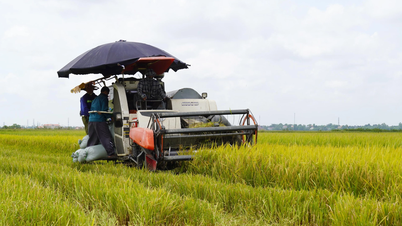
This May, traveling across the rice paddies of the province, a rich golden hue stretches as far as the eye can see. This year's weather has been favorable, with plenty of sunshine helping the spring rice crops ripen evenly, each ear of rice heavy with grain, bending downwards, each grain plump, bright golden. Everywhere, the bustling atmosphere of harvest season permeates the villages. The rumbling of combine harvesters blends with the lively laughter and calls of the farmers.
A 3-hectare demonstration field showcasing new rice varieties in Lien Minh commune this season has attracted significant attention from farmers, with one variety yielding up to 3.5 quintals per sao (approximately 350 kg) when harvested fresh directly in the field.

Mr. Bui Xuan Binh, a local farmer directly participating in the model, said: "These rice varieties have shown excellent adaptability to the local soil and weather conditions. All three new rice varieties, Dong A2, TBR88, and TBR97, have strong tillering, thick leaves, and compact plants, making them much more resistant to pests and diseases than the older varieties. In particular, the Dong A2 variety has large, long panicles with tightly packed grains, and a dry yield of up to 75 quintals/hectare. As soon as the rice was harvested, traders came directly to the fields to buy it all."
At Van Tra Cooperative (Yen Thang ward) - one of the leading cooperatives in applying technology - this season they planted 310 hectares, mainly with high-quality rice varieties such as Bac Thom, Nep 97, LT2, and Dai Thom. The biggest difference is the "advanced cultivation technique package" model applied to the Gia Loc 516 rice variety on a scale of 5 hectares, implemented by the cooperative in coordination with the Institute of Food Crops and the Department of Science and Technology. The model is a completely closed system using machinery from seedling tray sowing to machine transplanting, alternating water management, fertilization, spraying pesticides using drones, and harvesting.

As a direct beneficiary of the model, Ms. Bui Thi Hue (Van Du Ha village, Yen Thang ward) excitedly shared: "My family has 8 sao (approximately 0.8 hectares) participating in this model, and we are very happy. To be honest, farming has never been so easy; everything is replaced by machinery. The process from watering to fertilizing and spraying pesticides is done meticulously according to the instructions of the technical staff. Thanks to the correct procedures, the rice is healthy, with strong roots, vigorous tillering, and sturdy stems, absolutely not falling over even in rain and wind. Looking at these bright yellow, plump rice grains, the yield will surely reach 2.5 quintals/sao or more. We farmers only hope that this model will soon be replicated throughout the locality."

The emergence of technology not only optimizes productivity but also serves as a "lifesaver" for the current shortage of agricultural labor. Standing on the edge of the field watching the combine harvester smoothly across the land, Mr. Nguyen Van Bui, an elderly farmer from the same village, confided: "Nowadays, the young people in the village have all gone to work in industries and services, leaving only old people like us to farm at home. Like me, I'm over 70 years old and still 'clinging' to 7 acres of rice. Luckily, machinery has been introduced to assist from planting to harvesting; without technology, how could old people like me manage it? We would have to abandon the fields. With the machines, the pressure on labor is reduced, and the harvest is done on time. Everyone is happy and doesn't worry about wasting land."
Towards "green" agricultural production.
According to the preliminary report of the provincial Department of Agriculture, in the Spring 2026 crop season, the entire province planted 132,785 hectares of rice (the largest area in the Red River Delta region). Although the total rice planting area in the province decreased slightly (down 2.2% compared to the Spring 2025 crop season) due to the trend of land-use conversion, the crop structure has shifted very positively towards increasing value. Purebred rice varieties account for up to 85% of the area, especially high-quality rice varieties reaching over 70% of the total planted area. Besides commercial rice, the province also has about 500 hectares producing F1 hybrid rice seeds with high-yield hybrid combinations such as CT16 and Nhi Uu 838... meeting local seed needs as well as increasing income for farmers.
Behind the production scale figures lies a significant shift in farming methods, particularly breakthroughs in mechanization and the development of high-tech supply chains. Currently, the province has put into operation 853 rice transplanters using tray seedlings, handling the planting stage for approximately 20-25% of the area. Remaining stages such as land preparation have achieved 100% mechanization, harvesting by machine has reached 96%, and the area sprayed with pesticides using drones has reached about 5%.
Simultaneously, the mindset of sustainable "green agriculture" is beginning to take root as the entire province expands over 8,300 hectares of water-saving rice cultivation aimed at generating carbon credits, along with 50 product consumption linkage models covering 1,500 hectares with businesses.

Speaking to reporters about these positive aspects, Mr. La Quoc Tuan, Deputy Head of the Provincial Department of Crop Production and Plant Protection, commented: "The Spring 2026 crop basically took place under warm weather conditions with little humidity, which was very favorable for localities to organize land preparation, sowing, and care. The favorable weather helped the rice grow and develop quickly, shortening the growth cycle by 7 to 16 days. As a result, the harvesting progress was pushed forward very early. In previous years, it was basically finished from June 15th to 20th, but this year the entire province is expected to finish the crop before June 10th."
Not only did the less humid weather speed up the planting season, but it also helped reduce pest and disease pressure. For example, rice blast disease was much less severe than last year, affecting only 1,392 hectares, and farmers proactively contained and eradicated it completely.
However, given the somewhat subdued rice prices this season, the agricultural sector has identified a long-term strategy: tightly controlling input costs and improving output quality. The biggest lesson learned this season is the proactive approach in rapidly introducing advanced techniques for disease- and pest-resistant rice varieties, and maintaining sustainable organic farming models such as those effectively implemented with Toan Xuan, Cuong Tan, and Quynh Thanh companies. Only when large-scale commodity production areas are established, labor costs are reduced through machinery, and stable purchasing agreements are secured by businesses, will farmers truly be profitable and feel secure in continuing their farming activities.
The achievements of the Spring 2026 crop season are not limited to just the yield figures in the fields; more importantly, they demonstrate the flexible leadership and management capabilities of the province's agricultural sector during a particularly challenging period. Overcoming initial disruptions following the major administrative boundary mergers, facing the shortage of specialized personnel and the pressure of an aging workforce in agriculture, Ninh Binh's proactive approach to fieldwork and bold adoption of technology and integrated supply chains have helped it successfully overcome difficulties. These positive results serve as a foundation and valuable lesson for the entire sector to continue adapting proactively, aiming for more stable and sustainable harvests in the future.
Source: https://baoninhbinh.org.vn/ninh-binh-vu-lua-xuan-2026-thang-loi-260527101945410.html















![[Photo] General Secretary and President To Lam and his wife begin their official visit to Thailand.](https://vphoto.vietnam.vn/thumb/1200x675/vietnam/resource/IMAGE/2026/05/27/1779881249412_anh-man-hinh-2026-05-27-luc-18-10-51.png)























































Comment (0)