

White clouds still linger over the mountain peaks of the Muong Lat border region. The concrete road winding around the mountainside now extends to the remote villages of Pu Nhi commune, Thanh Hoa province. Amidst the vast green forest, the sounds of children learning to read and write echo from the newly built houses. Red flags with yellow stars flutter in the early morning breeze, bringing a new rhythm of life to this borderland.
These villages were once mired in poverty and outdated customs.
Few people know that, just over a decade ago, this area was one of the most disadvantaged regions in Thanh Hoa province. Poverty, backwardness, lack of literacy, and outdated customs passed down through generations caused many villages to be almost completely isolated in the mountains. Many families lived in constant hardship, facing numerous difficulties both materially and spiritually.
In particular, among some Hmong people at that time, the custom of "not placing the deceased in a coffin" existed as an almost unchangeable tradition. Many funerals lasted for days, involving the slaughter of numerous buffaloes and cows, causing expense, environmental pollution, and leaving many families destitute after the funeral.
But what's even more worrying is not just material poverty, but also the "gap" in awareness. When people lack knowledge, superstition easily creeps in, and distorted and inflammatory rhetoric from malicious forces has the opportunity to infiltrate the lives of people in these border regions, which still face many difficulties.
 |
The Hmong people in Muong Lat are gradually changing their perceptions, realizing that placing the deceased in coffins for burial is necessary. |
This reality necessitates not only economic development, but more fundamentally, strengthening the grassroots political system, raising the people's intellectual level, and building the people's trust in the Party. Because in border areas, if the people's hearts are not firm, the border can hardly remain peaceful for long.
Reaching out to the people through concrete actions.
Since 2013, the Pù Nhi Border Guard Station, Thanh Hóa Provincial Border Guard Command, in coordination with local Party committees and authorities, has implemented a model to eliminate outdated customs among the Mong ethnic group. Following the principle of "no imposition, no administrative orders," border guard officers have chosen a gradual, persistent approach, visiting each household and meeting with village elders and clan leaders to explain to the people which cultural traditions should be preserved and which are outdated customs hindering development.
Some outreach sessions lasted until midnight. Some families required dozens of attempts at persuasion. It was the sincerity, approachability, and responsibility of the border guards that gradually built trust among the local people.
On the first day that the people of Ca Noi village, Pu Nhi commune, agreed to place their deceased in coffins for burial, many border guards were deeply moved. This was not simply a change in a custom, but a major shift in the awareness of the entire community, which had clung to outdated traditions for decades.
Over the past decade, many outdated customs in Pù Nhi have been gradually eliminated. Funerals are now conducted in a more civilized manner, with shorter durations, reduced slaughter of buffalo and cattle, and a significant decrease in the economic burden on the people.
These changes demonstrate that, in order to gain the people's trust, officials must be close to the people, respect the people, and help the people through concrete actions. This is also the core value in the current work of building the political system at the grassroots level; and at the same time, it is a vivid testament to the role of the officials and soldiers who are working day and night to bring the light of the Party to the border regions today.
Defending the border starts from the roots of the people's hearts.
The experience in Thanh Hoa shows that wherever people's lives are cared for, their trust in the Party is strengthened; wherever the grassroots political system is strong, distorted narratives will have no place to thrive. Therefore, many officers of the Vietnam Border Guard today not only perform the task of managing and protecting the border and boundary markers, but also directly participate in local Party committees and governments, especially as the two-tiered local government system is being effectively implemented at the grassroots level.
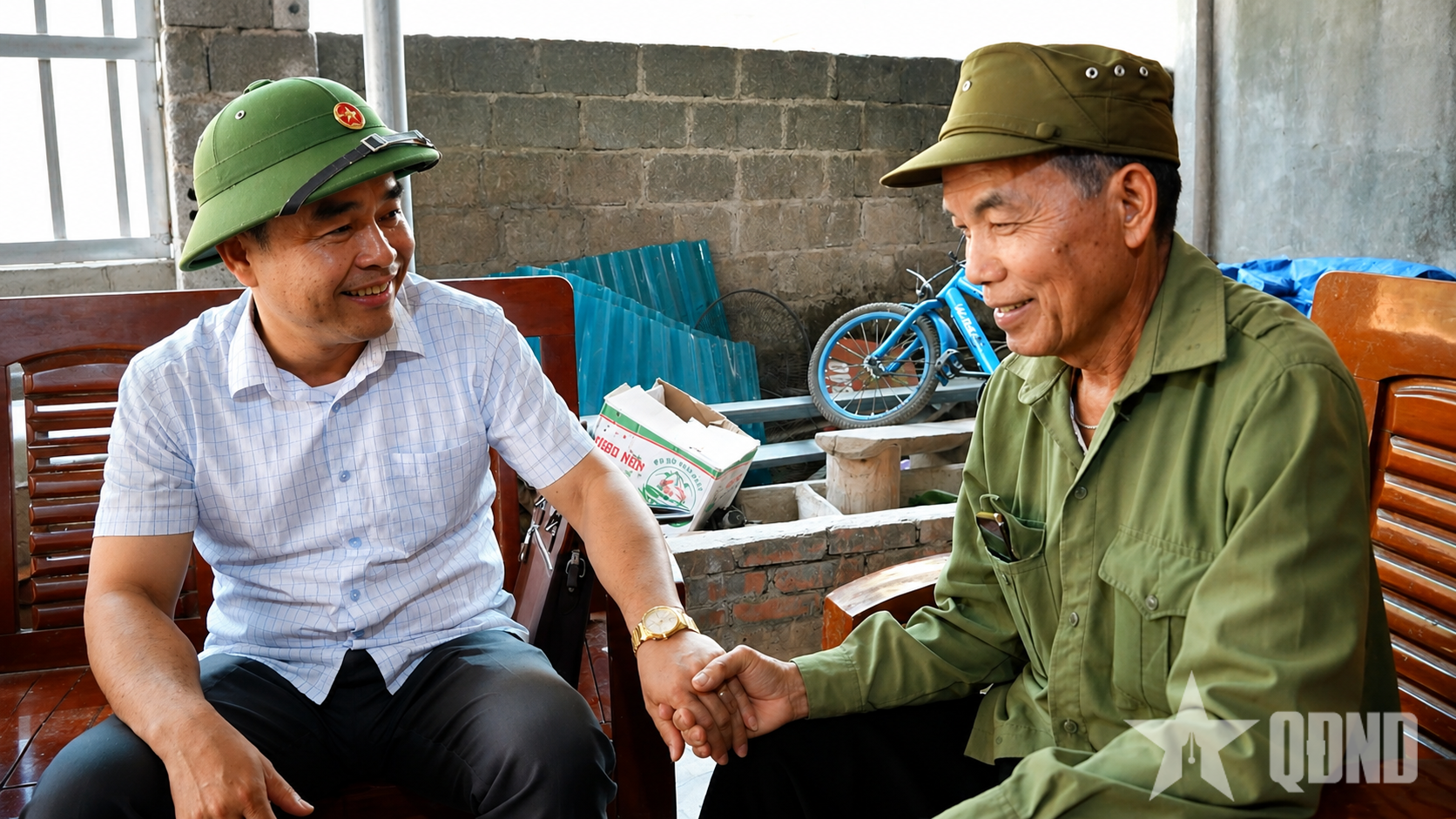
Lieutenant Colonel Le Huu Nghi (an officer at Pu Nhi Border Guard Station, Thanh Hoa Provincial Border Guard Command), who was seconded to serve as Deputy Secretary of the Party Committee and Chairman of the People's Committee of Nhi Son commune, is a prime example.
 |
Comrade Le Huu Nghi, a seconded official serving as Chairman of the People's Committee of Nhi Son commune, Thanh Hoa province, is a shining example of an official who works closely with the people, becoming a solid pillar of support in the border region. |
Immediately after taking up his post, Lieutenant Colonel Le Huu Nghi, along with local officials, went from village to village, knocking on every door to encourage people to abandon outdated customs, develop the economy, and build a new cultural life. At the same time, he actively encouraged people to develop production models and mobilized various resources to implement new rural development projects. From a locality with a low starting point, Nhi Son commune has now achieved 18 out of 19 criteria for new rural development and has become one of the model communes for new rural development in the border area of Thanh Hoa province in recent years.
 |
 |
| Comrade Le Huu Nghi, Chairman of the People's Committee of Nhi Son commune, met with voters in Cat village. |
The local people still fondly remember the image of the border guard officer who spent many nights sleeping in the village, helping the villagers build livestock shelters, guiding them in animal husbandry, and patiently explaining to each household the Party's guidelines and the State's policies.
It is precisely because of this closeness and sincere approach to community engagement that the commune officials and soldiers in green uniforms have gradually become a solid support for the people in the border region.
 |
Sustainable livelihood models are contributing to strengthening the trust of people in border areas in the Party. |
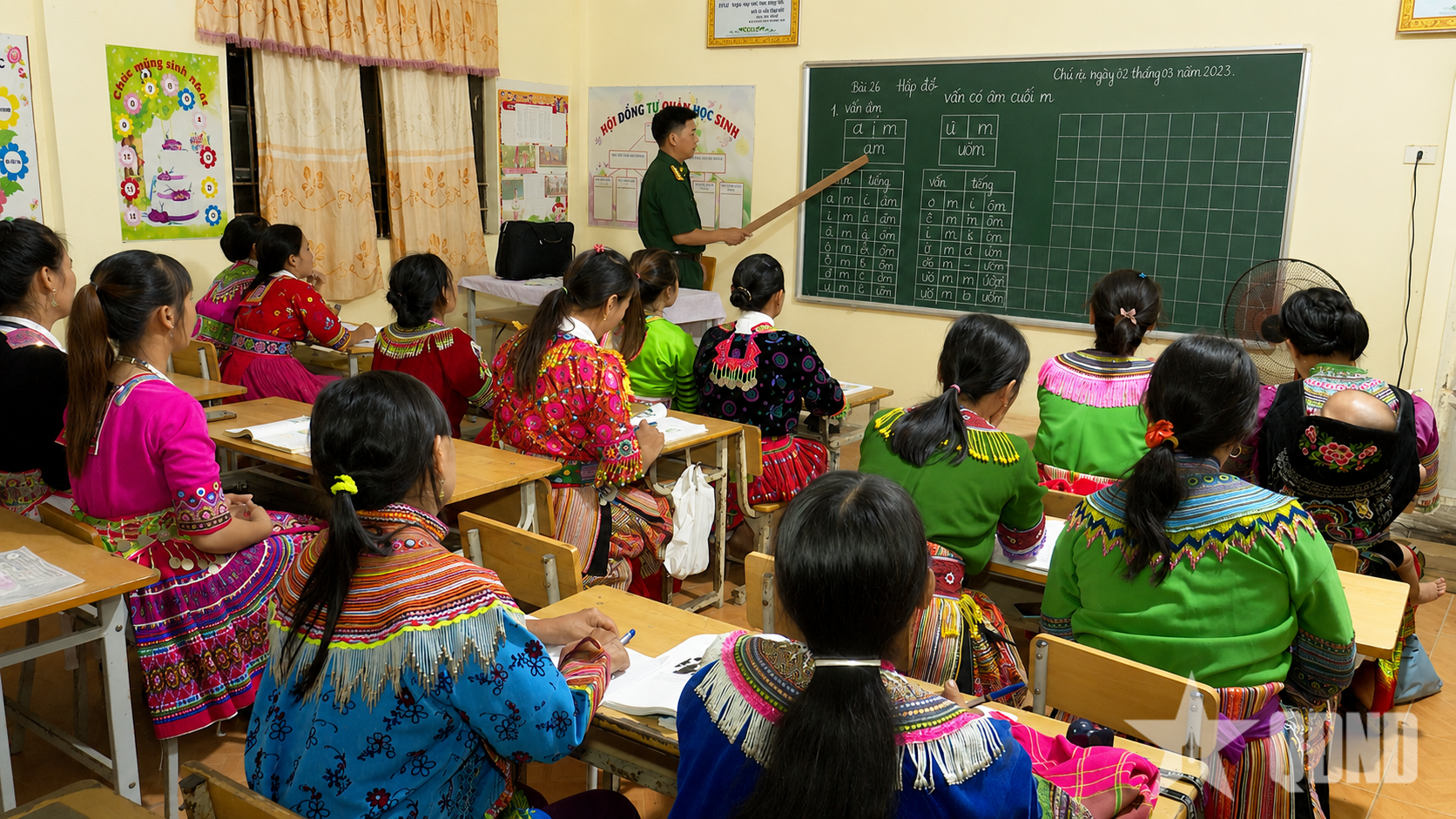 |
| Captain Ho Van Di, a military officer, teaches literacy classes in Ta Com village, Trung Ly commune, Thanh Hoa province, in 2023. |
Light from classrooms in the highlands
If poverty is a barrier to development, then a lack of knowledge is the most easily exploited "gap" in border regions. Therefore, along with economic development, raising the intellectual level of the people is always identified as a strategic task with long-term significance in building "people's support" in border areas.
For many years, in Ta Com village, Trung Ly commune, Thanh Hoa province, the lights of the literacy class have regularly shone every evening amidst the mountains and forests. Standing on the podium are not professional teachers, but Border Guard officers in green uniforms.
Captain Ho Van Di (Pu Nhi Border Guard Post, Thanh Hoa Provincial Border Guard) still remembers the emotional feeling when he first saw an elderly woman, nearly 60 years old, trembling as she wrote her name after many days of learning to read and write. A student in the literacy class once shared simply: "Only after learning to read and write can I understand what the officers are saying and what the Party is helping me with."
That simple statement reflects a profound reality: Protecting the ideological foundation of the Communist Party of Vietnam in remote areas doesn't begin with grand gestures, but with helping people learn to read and write and access accurate information.
These classes in the heart of the mountains therefore not only impart literacy but also open the door to awareness, helping the people understand the Party's guidelines and the State's policies correctly; thereby enabling them to boldly develop the economy and gradually stabilize their lives in the border region.
When sustainable livelihoods build lasting trust.
To gain the trust of the people in the Communist Party of Vietnam, it is essential to first help them stabilize their lives. In recent years, many economic development models implemented in coordination with the Vietnam Border Guard in the Thanh Hoa border region have yielded practical results.
From breeding cattle, cultivating cardamom and hawthorn to raising poultry in concentrated farming, many households in border areas have gradually escaped poverty and gained stable livelihoods. The family of Ms. Giang Thi Sang in Ca Noi village, Nhi Son commune, Thanh Hoa province is a clear example. From a situation of year-round food shortages, her family has now developed a stable flock of chickens and pigs thanks to technical guidance and livelihood support from border guards.
 |
| Ms. Giàng Thị Sáng in Cá Nọi village has developed a livestock and poultry herd of hundreds of animals thanks to a livelihood model guided and supported by the Border Guard. |
Today, Nhi Son commune has seen significant improvements. Families are gradually accumulating wealth; roads leading to the villages have been widened, and the national power grid has reached every household, transforming the lives of the people day by day. These changes are not only the result of infrastructure investment or economic development support, but also the outcome of a people-centered development strategy, using stable living conditions as a foundation to strengthen people's trust in the Party. In reality, wherever people have stable livelihoods, security and order are maintained; wherever living standards are improved, people's loyalty to the Party and local government grows stronger.
Source: https://www.qdnd.vn/chinh-tri/cac-van-de/noi-bien-cuong-sang-niem-tin-dang-1040644





















































































Comment (0)