


Just one year after the FIFA Club World Cup, Mbappe is preparing for another World Cup - Photo: REUTERS
When the World Cup becomes the final straw
When FIFA expanded the World Cup to 48 teams, the number of matches in "the most exciting football festival on the planet" also increased to 104, and the schedule lasted almost two weeks longer than in previous World Cups.
For the first time in history, the World Cup will feature a "round of 32". Players from the teams that advance to the final will have to play a total of eight matches over six weeks during the summer.
Is having more than one match a problem? The answer is yes, and there are actually two problems.
First, the number of matches played is reaching a breaking point. And second, there's the recovery time.
An increasing number of sports medicine experts, coaches, and players are warning that top-level football is entering its most severe overcrowding crisis ever.
The 2026 World Cup not only comes after a longer-than-usual season, but also takes place against the backdrop of an increasingly congested global calendar.
The Champions League has changed its format to include more matches, FIFA has expanded the Club World Cup, UEFA has maintained the Nations League, and major clubs continue their massive summer tours for commercial purposes.

Valverde is one of the most capped players in the world - Photo: REUTERS
Year after year, fans suddenly realize that they themselves are becoming "overwhelmed" by the ever-increasing number and scope of tournaments. And of course, the stars are becoming increasingly exhausted.
According to the Player Workload Monitoring report by FIFPRO – the world's leading players' union – many top players now play more than 70 games per season and often have to play two games a week for extended periods. FIFPRO calls this situation "unsustainable" for human health.
FIFPRO data shows that Luka Modric could play 76 matches in the 2024-2025 season by the age of 40, including both club and Croatian national team games.
Federico Valverde has played over 6,100 minutes in approximately 72 matches, with a total distance covered and high-intensity activity among the highest in Europe.
Meanwhile, Australian goalkeeper Mathew Ryan is recorded as having traveled approximately 169,000km in a single season due to club and national team duties, equivalent to more than four trips around the Earth.
Those numbers reflect a reality: modern football has no breaks.
According to a 2021 study by FIFPRO, some players had to play up to 82% of matches with less than the minimum 5-day rest period recommended by sports science .
A panel of 70 sports medicine experts in FIFPRO's Delphi study subsequently agreed that professional players need a minimum of 28 days of complete rest after each season to reduce the risk of injury and physical exhaustion.
But the reality is the opposite.
In the summer of 2025, FIFA will organize an expanded version of the Club World Cup with 32 teams, leaving many stars with virtually no vacation before the start of the new season. FIFPRO warns that the group of players participating in this tournament are at the highest risk of serious overwork before the 2026 World Cup.
Mbappe is one example of "playing continuously, without a break." In even-numbered years, he always has to participate in the World Cup and the European Championship during the summer. And now, in odd-numbered years, he plays in the FIFA Club World Cup every four years.
From 2024 to 2030, Mbappe will only have one summer break, in 2027. If he is still playing in 2031, the French striker will get a summer break that year – but who knows if FIFA or UEFA will "invent" another tournament.
The risk of injury has skyrocketed.
Professor Simon Chadwick, a sports economics expert at Skema Business School, told Reuters: “Modern football is creating a paradox. Management organizations want to maximize revenue by increasing the number of matches, but this threatens their most valuable asset: the players’ bodies.”
Not only has the number of matches increased, but the intensity of play today is also vastly different from football 20 years ago. An analysis by the Financial Times points out that while the total number of minutes played hasn't increased dramatically compared to the past, the amount of high-speed sprints, pressing, and transitions in modern football has increased significantly.
This puts a much greater strain on the players' bodies compared to the previous generation.
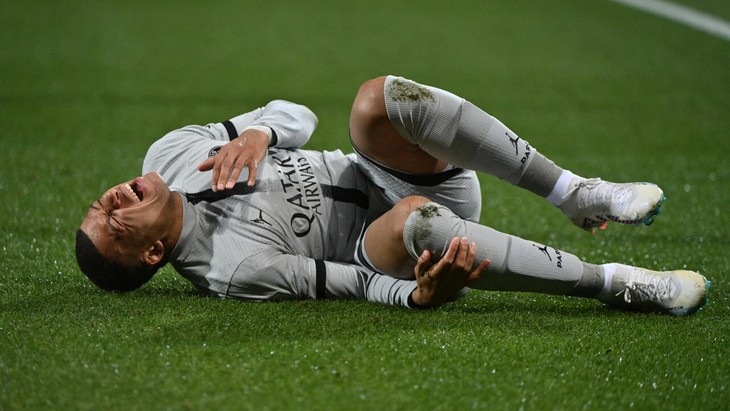
Injury rates are skyrocketing in top-level football - Photo: REUTERS
The Times reports that the number of muscle and hamstring injuries in European football has been steadily increasing in recent years. Sports medicine experts are particularly concerned about the rising trend of anterior cruciate ligament (ACL) tears, an injury that can sideline players for an entire year.
Women's football faces an even more serious risk. According to several sports medicine studies cited by The Guardian, female players are 2-6 times more likely to suffer ACL injuries than men, while the women's football schedule is becoming increasingly congested following the commercial boom in recent years.
Many top coaches have publicly criticized FIFA and UEFA on this issue. Jurgen Klopp once called the current fixture schedule "crazy," while Pep Guardiola has repeatedly warned players that they "are not machines."
Arsenal manager Mikel Arteta stated bluntly: “The volume of matches is the main reason for the current injury crisis. We are demanding that players play at maximum intensity for 11 months every year.”
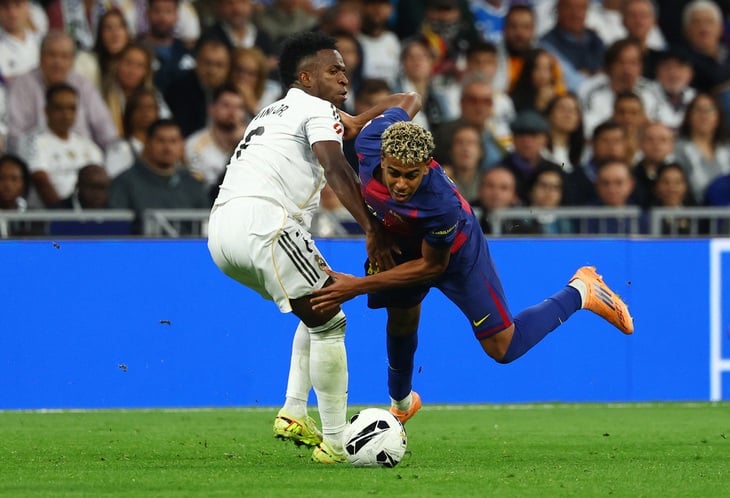
Both Yamal and Vinicius were exhausted after a long and arduous season - Photo: REUTERS
Even Harry Kane, England's captain, admitted that players have almost no voice as FIFA continues to expand tournaments. He told the English press that players "want to be heard more" before football continues to increase in scope even further.
One of the biggest concerns ahead of the 2026 World Cup is the risk that many stars will enter the tournament exhausted or not fully recovered from injuries. This happened at the 2022 World Cup, when a number of big names such as Karim Benzema, Sadio Mane, and N'Golo Kante had fitness issues before the tournament.
Dr. Vincent Gouttebarge, medical director of FIFPRO, warned that football is becoming “an industry that is exceeding the biological limits of human beings.”
He said, "No top-level team sport in the world operates with such a packed schedule and a lack of health protection for athletes as football does today."
Source: https://tuoitre.vn/noi-lo-kiet-suc-o-world-cup-2026-20260523171921749.htm

























































































Comment (0)