

2023 was considered a historic year for the development of artificial intelligence (AI). After the launch of ChatGPT and its global impact, large-scale AI models became one of the most talked-about topics today.
Beyond simply interacting through text, large-scale AI models have brought about significant changes to human production and daily life over the past year.
AI is predicted to continue to have a disruptive impact, both in improving human productivity and in posing unpredictable risks.

The emergence of ChatGPT has ignited a race to develop AI technology. (Photo: Sutthiphong)
ChatGPT sparked a boom in large-scale AI models.
In late November 2022, the American company OpenAI released its artificial intelligence chatbot application ChatGPT, based on the GPT-3.5 big language model.
ChatGPT was launched quite quietly. OpenAI didn't hold a press conference or conduct any promotional activities to launch it. No one could have predicted that within just two months of its release, ChatGPT's monthly active users would exceed 100 million, making it the fastest-growing consumer application in history.
With its fluent language skills, powerful problem-solving abilities, and massive database, despite flaws like "nonsense," ChatGPT still allows people to experience firsthand what modern artificial intelligence is like.
The New York Times called ChatGPT "the best artificial intelligence chatbot ever released to the public."
Bill Gates has publicly stated that the creation of ChatGPT is of immense historical significance, no less than the creation of the Internet or the personal computer.
The emergence of ChatGPT has profoundly impacted the trajectory of the global AI industry, with large-scale AI models attracting a significant number of tech giants, startups, and scientific research institutions.
The Global Times, citing statistics from the "White Paper on the Application of Innovation of Large-Scale Models in the Artificial Intelligence Industry in Beijing (2023)" recently published by the Beijing Municipal Science and Technology Commission (China), shows that from a global perspective, all parts of the world are actively promoting the development and application of large-scale AI models.
Of these, the total number of large model kits released by the US and China accounts for 80% of global releases, making them the leading countries in the large model kit technology field.
In the US, Microsoft has used its investment and partnership in OpenAI to integrate GPT features into its Office software and other products.
Meanwhile, Google is set to launch its new Gemini large-scale multimodal model later this year, which is seen in the industry as launching a direct confrontation with GPT.
Most recently, Amazon is also training its second-largest language model. This model has 2 trillion parameters and could become one of the largest models currently being trained in the world.
In addition, a number of startups are also focusing their efforts on large-scale models, such as Anthropic, founded by former OpenAI CEO Dario, and Cohere, with a strong founding team.
In China, since GPT-4 went online in March, large-scale models from domestic technology companies such as Baidu, Alibaba, Huawei, JD.com, 360, Tencent, etc., have continuously emerged.
In addition, renowned universities and research institutes such as Tsinghua University, Fudan University, and the Chinese Academy of Sciences are also extensively developing large-scale modeling.
As of October, at least 238 large-scale AI models had been launched in China.
Zhou Hongyi, founder of 360, shared: "Objectively speaking, there is still a certain gap between China's large-scale AI models and GPT-4, but this gap does not prevent us from building our own large-scale modeling industry."
Internet analyst Yu Siyuan believes that although China still has some shortcomings in basic research and development technology, its large market size and diverse application scenarios can provide ample space and conditions for the country to deploy large-scale models.
In 2023, although not receiving investments on the same scale as China and the US, other countries and regions were not far behind in the field of artificial intelligence.
In May, the large-scale Falcon model from the Abu Dhabi Institute for Scientific and Technological Innovation in the United Arab Emirates was unveiled.
In September, the Japanese government partnered with major technology companies such as NEC, Fujitsu, and SoftBank to invest hundreds of millions of dollars in developing large-scale Japanese language learning models.
South Korean internet company Naver has launched HyperClova X. Meanwhile, the Bhashini platform, funded by the Indian government, has also been put into use.
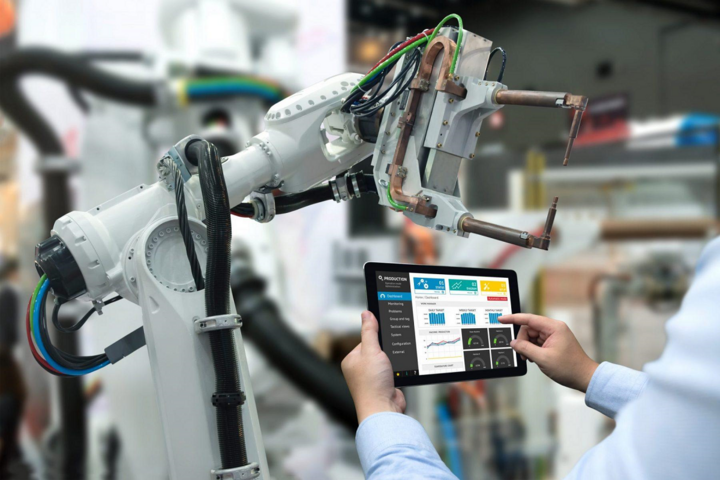
Artificial intelligence has brought about major changes to production and human life over the past year. (Image: iFactory)
Based on large-scale models, generalized artificial intelligence (AIGC) is also developing rapidly. A report published this month by the international research organization IDC predicts that global businesses will invest $16 billion in generalized artificial intelligence solutions in 2023.
By 2027, spending is projected to exceed $140 billion, with a compound annual growth rate of over 70%, nearly 13 times the compound annual growth rate of global IT spending during the same period.
Also this past year, the AI tool Midjourney, capable of generating images from text descriptions, and the Gen-2 AI video creation software have amazed users worldwide. The phrase "AI is changing the world" is becoming a reality.
Convenience comes with risks.
Over the past year, the development and application of large-scale AI models have reached new heights, not only achieving significant technological advancements but also demonstrating broad application potential across many fields.
Zhao Zhiyun, Director of the Chinese Academy of Science and Technology Information, stated that the biggest breakthrough in large-scale AI modeling technology lies in its flexibility. Large-scale models have significantly enhanced flexibility and generalization through the path of “big data, big computing power, and powerful algorithms.” This propels artificial intelligence from a “manual era” based on custom training of small, specialized models to an “industrialization era” based on pre-training of large models, thereby ushering in a new wave of AI development.
The rapid development of large-scale AI models will usher in a new revolution in productivity and inject new energy into the global economy as it strives for recovery. However, it also brings a host of problems and concerns.
From students using AI to write dissertations, to exploiting AI's image capabilities for fraud, and then to issues of intellectual property, ethics, and "how humans and AI coexist," all of these must be addressed through a global effort.
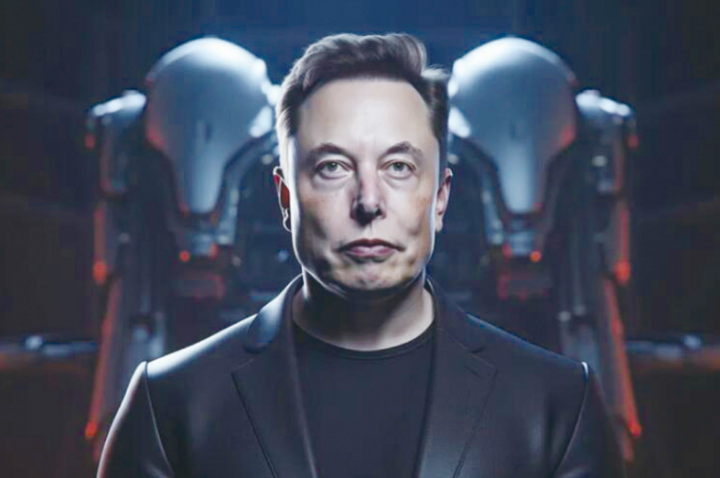
The image of billionaire Elon Musk was created by AI in the Midjourney app. (Photo: Global Times)
The recent internal turmoil within OpenAI reflects the intense conflict and clash between different development concepts for AI. The Washington Post then reported that the "internal struggle" revolved around the differences between two viewpoints: OpenAI founder Altman wanted to push for the rapid development and commercialization of AI technology, while others were increasingly concerned about potential security issues.
Previously, on May 30th, more than 350 international artificial intelligence leaders and experts, represented by Tesla CEO Elon Musk, issued a joint statement emphasizing that the artificial intelligence crisis should be considered a global priority. The statement said: "Artificial intelligence could lead to the extinction of humankind, posing a danger no less significant than large-scale epidemics and nuclear war."
In November, the world's first AI security summit was held in the UK, with 28 countries participating and the EU jointly signing the "Bletchley Declaration".
The statement believes that issues related to the intentional misuse or unconscious control of advanced artificial intelligence technology could pose significant risks, particularly in areas such as cybersecurity, biotechnology, and as the spread of misinformation continues to increase.
To address the enormous challenges posed by AI, many countries and organizations around the world have introduced initiatives or regulations, unanimously calling for enhanced safety oversight.
Analyst Yu Siyuan believes that the development trend of AI is irreversible and should be actively embraced. "What needs to be done is for the world to work together to build a responsible and trustworthy artificial intelligence system."
Hua Yu (Source: Global Times)
Source









































































































Comment (0)