

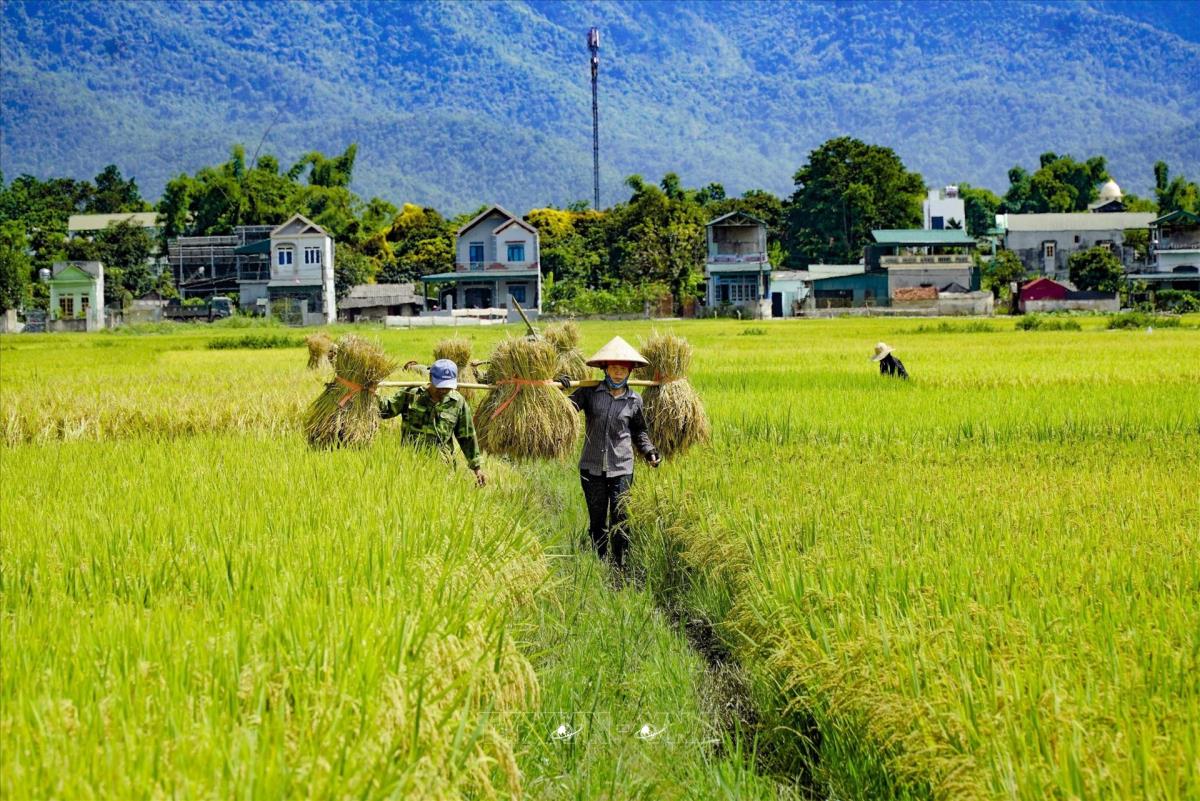
The 2020 - 2025 term ended with comprehensive marks for the Ministry of Agriculture and Environment , when all 8/8 political targets were completed and many targets far exceeded the plan. The GDP growth rate of the entire agricultural sector during this period is estimated at over 3.5%, exceeding the target of 2.5-3%. The export turnover of agricultural, forestry and fishery products increased by an average of 8.4%/year - an impressive increase compared to the target of 5-6%. The rate of communes meeting new rural standards is expected to reach 80.5-81.5%, while the environmental infrastructure of industrial parks has been upgraded with the centralized wastewater treatment rate reaching 92.3%.
Agricultural and rural infrastructure continues to be invested in synchronously and modernized. Digital infrastructure and national databases are formed, directly connected to e-Government. Remote sensing and mapping technology are strongly applied, serving resource management and border protection. Agricultural production is restructured towards multi-value, organic, and circular; Vietnam becomes a model in green and low-emission agricultural development with the highlight being the Project "Sustainable development of one million hectares of high-quality and low-emission rice cultivation associated with green growth in the Mekong Delta by 2030".
In livestock farming, high-tech vaccines, especially the African swine fever vaccine, have been successfully produced and exported. The fisheries sector has promoted offshore exploitation in association with sovereignty protection; the forestry sector has earned 1,200 billion VND from selling forest carbon credits. The average income of rural people has increased from 43 to 55 million VND/person/year, the multidimensional poverty rate has decreased to 1.93%. The 2024 Land Law creates a transparent legal corridor for socio-economic development. The marine economy contributes 50% of GDP, the income of coastal people reaches 97 million VND/year. Achievements in environmental protection, biodiversity and climate change response have contributed to enhancing Vietnam's international position.
In the aquaculture sector, the industry has successfully created many key breeds such as white-leg shrimp, disease-resistant pangasius, salt-tolerant tilapia, yellowfin pomfret, and fast-growing milk oysters. New technologies in feed, environmental treatment, disease warning, electronic traceability, and digital ecosystems for farming, exploitation, and preservation have been developed. Some green, circular economic models have become the core for sustainable innovation. Marine aquaculture has developed strongly, reducing pressure on coastal exploitation and creating a strategic direction associated with sea and island security, climate change adaptation, and livelihood development for coastal communities.
In environmental management, Director of the Department of Environment Hoang Van Thuc said that in the past term, the environmental sector has made important changes, creating a solid foundation for sustainable management in the new development stage. The Pareto principle has been applied - focusing on managing 20% of facilities with high risk of pollution to control 80% of environmental risks. Thanks to that, the industry has moved from being passive to proactive in preventing and responding to incidents.
The environmental monitoring system has been invested synchronously from central to local levels, with 135 air monitoring stations, 145 automatic surface water monitoring stations and more than 2,000 stations of direct data transmission facilities. In industrial zones, 94.1% are operating with centralized wastewater treatment systems; 31.5% of industrial clusters and 16.6% of craft villages have invested in qualified treatment systems.
To manage waste, many solutions to reduce landfill and increase recycling have been deployed. Large-scale treatment complexes in Hanoi, Ho Chi Minh City and some localities have come into operation; seven waste-to-energy incineration plants are operating stably. In 2024, the urban solid waste collection rate will reach 97.26%, the landfill rate will decrease to 64%, and hazardous waste will be treated at 98.06%. Control of scrap imports will be tightened.
Mr. Hoang Van Thuc emphasized: The results of the past term are the premise for the environment to continue to innovate and create for a sustainable Vietnam, contributing to the implementation of international commitments and protecting the right to live in a clean environment.
In the context of climate change, food security, environment and water resources facing many challenges, entering a new phase, the agriculture and environment sector is expected to continue to play a pivotal role in developing a green economy, a circular economy and ensuring ecological security.
Agriculture will focus on restructuring towards multi-value, increasing added value, promoting deep processing, perfecting logistics chains, promoting startups and developing rural economy associated with ecology and digital transformation.
In terms of natural resources and environmental management, the new term will be a period of strong reforms, from land laws, water resources, minerals to the environmental standards system. Conservation areas and natural heritages will be expanded; monitoring mechanisms will be improved, and the principle of not trading the environment for growth will be firmly adhered to.
Regarding climate change response, key policies include building carbon markets, managing carbon credits, investing in multi-purpose irrigation infrastructure, improving disaster forecasting and promoting socialization in the field of hydrometeorology. Decentralization and delegation of power will be promoted to promote the role of localities - the places closest to reality and the people.
Entering a new development stage, Minister of Agriculture and Environment Tran Duc Thang emphasized: The industry's overarching goal is to develop ecological agriculture, modern countryside, civilized farmers; exploit and use resources sustainably; proactively adapt to climate change, ensure environmental security, and contribute to building a country that develops rapidly, sustainably, prosperously, and happily.
To realize this goal, the Ministry of Agriculture and Environment determined that there must be an institutional breakthrough. This is a prerequisite to remove “bottlenecks”, create modern and transparent governance, promote green economy, circular economy and deep international integration.
Regarding science, technology and innovation, the industry aims to have total factor productivity (TFP) contribute over 50% to growth by 2030 - marking a shift from extensive to intensive development, developing ecological agriculture, green and circular economy. Along with that is the effective and sustainable management and use of national resources, with the exploitation and economical use of land, water, forests, minerals, and seas for long-term development. Strong investment in agricultural and rural infrastructure, environmental treatment systems, natural disaster prevention, irrigation, and hydrometeorology to proactively respond to risks and improve development quality.
In the context of digital transformation, climate change and globalization, high-quality human resources will be the driving force to lead the industry into a new growth phase.
With the achieved foundations and clear orientation for the coming time, the agricultural and environmental sectors are expected to continue to play a pivotal role in green economic development, ensuring ecological security and contributing to Vietnam's sustainable development goals.
Source: https://baotintuc.vn/kinh-te/nong-nghiep-va-moi-truong-tren-hanh-trinh-kien-tao-kinh-te-xanh-20251209084102656.htm



![[Photo] Urgently help people soon have a place to live and stabilize their lives](/_next/image?url=https%3A%2F%2Fvphoto.vietnam.vn%2Fthumb%2F1200x675%2Fvietnam%2Fresource%2FIMAGE%2F2025%2F12%2F09%2F1765248230297_c-jpg.webp&w=3840&q=75)
















































![[Photo] General Secretary To Lam works with the Standing Committees of the 14th Party Congress Subcommittees](https://vphoto.vietnam.vn/thumb/402x226/vietnam/resource/IMAGE/2025/12/09/1765265023554_image.jpeg)





























Comment (0)