 |
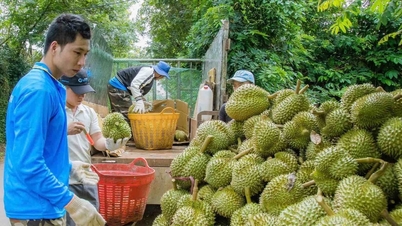
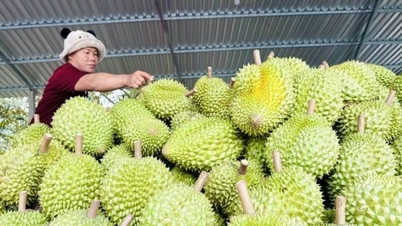
| Durians are being gathered at a warehouse in Long Khánh ward for packaging and export. |
The shortage of testing facilities, which overloads the process during peak durian export season, is a major bottleneck and the main reason for the recent sharp drop in durian prices.
A new season with many changes.
According to the durian harvesting season in each region, the peak season in the Mekong Delta usually runs from March to May, so many provinces and cities in the Mekong Delta are currently in the peak of durian harvesting and export. The Southeast region, including Dong Nai city, usually has a durian harvesting season from May to July. However, this year's harvest is delayed due to unusual weather conditions. Many durian-growing areas in Dong Nai city are currently only producing early-season fruit. It is expected that in about 1-2 months, durian-growing areas in Dong Nai city will enter the main harvest season with large yields.
As the 2025 durian harvest season begins, many provinces and cities in the Mekong Delta are experiencing a sharp drop in durian prices, sometimes falling below production costs and causing losses for farmers. Specifically, in some provinces and cities in the Mekong Delta, the price of Ri6 durian sold at the farm gate is only 20-25 thousand VND/kg, a decrease of about 50% compared to the previous harvest season. One reason for this is the overloaded state of testing laboratories, which negatively impacts the export of this product.
A representative from Thinh Bach Import-Export Co., Ltd. ( Ho Chi Minh City) stated: This year, businesses are limiting durian exports due to numerous difficulties and risks. These include stricter regulations on planting area codes and export packaging facilities. Furthermore, inspection processes, especially testing for cadmium and Yellow O, are overloaded, leading to prolonged testing times and negative consequences such as unsold durian, affecting quality and causing losses, while storage and transportation costs increase. These are major bottlenecks affecting durian exports and are the reason for the sluggish durian market and the sharp drop in durian prices during the peak harvest season.
The "bottleneck" in the testing process needs to be removed.
According to data from the Department of Quality, Processing and Market Development ( Ministry of Agriculture and Environment ), there are 30 cadmium and Yellow O testing laboratories nationwide, mainly concentrated in Ho Chi Minh City. Of these, as of May 2026, 5 laboratories have temporarily ceased operations, leaving only 25 active laboratories.
According to Mr. Duong Duc Trong, Deputy Director of the Department of Agriculture and Environment of Ho Chi Minh City, there are 15 laboratories in the city testing for cadmium and Yellow O in durian, but currently only 13 are operational, while the rest have temporarily ceased operations. The difficulty in the inspection process, especially testing for cadmium and Yellow O, stems from a shortage of testing facilities. However, attracting investment in additional local testing laboratories is not easy because these laboratories must be recognized by the General Administration of Customs of China to operate.
The total durian cultivation area in Dong Nai city is currently around 25,000 hectares, ranking among the top in the Southeast region in terms of area and production. Many localities within the city have established large-scale durian specialized farming areas, meeting export market standards.
In fact, in recent years, durian exports to China have been required to undergo 100% testing for cadmium and Yellow O residues. If a testing laboratory determines a shipment is free of these substances, but violations are later discovered upon arrival in China, the laboratory may be suspended from operation. The demand for durian exports is increasing rapidly each year, while the number of testing laboratories is slow to increase, or even decreases due to violations resulting in suspensions. This is the main reason why the overload in durian export testing has remained unresolved for many years.
A representative from Thinh Bach Import-Export Co., Ltd. added: Testing laboratories for durian exports are mainly concentrated in Ho Chi Minh City, Hanoi, and Can Tho City… Localities with durian growing areas almost completely lack testing laboratories. Therefore, the company currently has the need and capacity to invest in testing laboratories in Dong Nai City and Dak Lak Province, which are major durian growing regions. The company hopes that local authorities and the Ministry of Agriculture and Environment will create favorable conditions in terms of mechanisms and policies to support the company in investing in testing laboratories right in the growing areas.
According to Nguyen Van Thang, Deputy Director of the Department of Agriculture and Environment of Dong Nai City: The agricultural sector of Dong Nai City is committed to and always creates favorable conditions to attract businesses to invest in testing laboratories right in the growing areas. Having testing laboratories in the growing areas offers many advantages for durian exporting businesses, such as reduced transportation costs for testing. Furthermore, testing products before export helps minimize the risk of damage to entire shipments due to long-distance transportation for testing. Investing in testing laboratories in growing areas is also essential for promptly announcing and warning farmers about quality issues so they can adjust their production processes to meet safety standards. However, in investing in testing laboratories, Dong Nai will also select investors who not only meet professional capacity requirements but also ensure adequate facilities and infrastructure to support testing.
Plains
Source: https://baodongnai.com.vn/kinh-te/202605/nut-that-trong-xuat-khau-sau-rieng-f0402b3/






























































































Comment (0)