 |
| A view of Nhon Trach 5 Industrial Park, Phuoc An commune. |
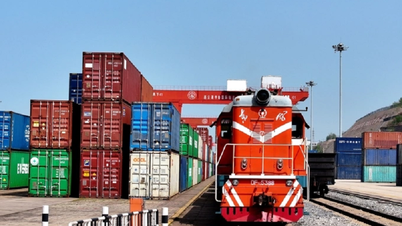
Strategically located and with comprehensive infrastructure, boasting outstanding advantages in transportation, logistics, seaports, and international border gates (Long Thanh International Airport, Phuoc An Port, Hoa Lu International Border Gate), Dong Nai city is emerging as an important growth hub for the nation.
The industrial "capital" of the country.
Dong Nai City has long been known as the industrial "capital" of the country. Currently, Dong Nai has 89 planned industrial parks (IPs) covering an area of over 39,000 hectares. Of these, 58 IPs have been established, and 44 are operational, with an occupancy rate of 76%. Large industrial parks in the southern part of Dong Nai City have high occupancy rates, while IPs in the northern part of the province still have ample room to attract investors.
With its comprehensive transportation infrastructure – road, rail, inland waterway, seaport, and air – Dong Nai is leveraging its advantages to become a key hub connecting domestic and international investors. To date, 51 countries and territories have invested in Dong Nai, with a total investment capital exceeding US$45 billion across more than 2,200 projects. In terms of attracting domestic investment, the city has a total registered investment capital of nearly VND 605 trillion across over 2,500 projects.
Dong Nai City is aiming to develop more new industrial parks, targeting high-tech industries that are trending in the future.
Economic experts believe that Dong Nai is a region rich in potential, with diverse economic characteristics and a strong desire for development. In particular, the convergence of "capitals" in various economic sectors will help Dong Nai move towards becoming a modern, civilized, and livable city.
"Headquarters" for fruit trees
Dong Nai is also the "headquarters" of fruit trees in the Southeast region of Vietnam.
To date, Dong Nai city has over 90,000 hectares of fruit trees, with mangoes, rambutan, durian, and dragon fruit accounting for more than 60%. Long Khanh rambutan and Tan Trieu pomelo are two types of fruit that have been granted geographical indications for quite some time. During the peak fruit ripening season (May-July every year), many farmers in the city have taken advantage of the beautiful countryside scenery during the fruit ripening season to develop eco-tourism in their orchards. Accordingly, tourists can explore, visit, and experience the fruit orchards, learn modern planting techniques, and enjoy the green space.
To maintain and develop efficient fruit-growing areas, at the end of 2025, the People's Committee of Dong Nai province (now the People's Committee of Dong Nai city) issued Plan No. 206/KH-UBND on the development of key fruit and industrial crops in Dong Nai province for the period 2025-2030. Accordingly, by 2030, the total area of fruit trees in the city is projected to reach approximately 126,000 hectares with a production of 3.15 million tons/year. Specifically for the five key fruit crops (grapefruit, durian, jackfruit, mango, and banana), the total area by 2030 will reach over 94,000 hectares and the production will exceed 2 million tons/year.
The largest exporter of cashew products in the country.
In the agricultural sector, alongside fruit trees, Dong Nai is also home to industrial crops such as pepper, rubber, cashew nuts, and coffee, covering a total area of over 500,000 hectares. According to the city's development plan, by 2030, the entire city will have over 420,000 hectares dedicated to these industrial crops. The city also aims to develop specific crop types, focusing on establishing concentrated production zones.
Cashew trees are one of the crops with the largest planted area in Dong Nai province in the country. Furthermore, Dong Nai also has the highest cashew export volume in the country (accounting for nearly 50% of the country's total cashew exports). With the distinctive quality of its cashew nuts, in 2018, Dong Nai cashew products (formerly Binh Phuoc province) were granted geographical indication status. This demonstrates that cashew nuts have had a strong position in the international market for quite some time.
Currently, the city has nearly 150,000 hectares of cashew trees, producing over 247,000 tons per year. For this crop, the city is still planning to expand the planted area, aiming to reach 163,000 hectares by 2030, increasing production to over 293,000 tons per year. Production is concentrated in 14 communes and wards within the city, including Xuan Hoa, Xuan Loc, Dinh Quan, La Nga, Bu Gia Map, Phu Rieng, and Dong Phu.
To enhance the export value of cashew nuts, businesses continue to invest in upgrading equipment and technology for processing cashew kernels, strengthening deep processing, and improving the value chain; diversifying processed products from cashew trees such as: refining oil from cashew shells, producing alcohol from cashew fruit juice, plywood from cashew wood and cashew shell residue... gradually increasing the deep processing rate of cashew kernels to 25-30%.
The land of "white gold" in the East
With a total area of over 285,000 hectares and an annual production of over 468,000 tons, rubber trees in Dong Nai are leading the country, concentrated in communes and wards such as Hon Quan, Dong Phu, Loc Ninh, and Xuan Duong...
In Dong Nai, rubber trees are not only an industrial crop but also considered a symbol of vitality and prosperity in the Southeast region of Vietnam. For decades, rubber trees have sustained generations of people and created jobs for tens of thousands of workers.
If you have the opportunity to visit Dong Nai province, or travel along routes such as National Highway 20, National Highway 13, or other inner-city roads, you will be able to admire the vast rubber forests stretching across the red basalt soil. Especially during the rubber tree leaf-shedding season, the forests undergo a period of leaf color change, creating a unique and unforgettable scene for those who witness it.
Livestock farming "capital"
If Dong Nai's industrial parks, rubber plantations, and lush fruit orchards are considered the "capital" of the country, then in the livestock industry, Dong Nai is equally competitive in terms of large-scale production, application of high technology, and plays an important role in the national food supply chain.
 |
| A model of high-tech application in egg-laying chicken farming in Tan An commune. Photo: Binh Nguyen. |
Following the merger, Dong Nai City has gained even greater advantages, continuing to maintain its position as the "livestock capital" of the country. The city boasts one of the largest pig populations nationwide, with nearly 4.2 million pigs and approximately 36.5 million poultry. Dong Nai also has the advantage of attracting investment in animal feed production; the production and trading of various livestock breeds; and veterinary medicine retail outlets. These not only meet the needs of the city's livestock industry but also supply many provinces and cities nationwide. To date, the city has established integrated supply chains for safe livestock products, achieving strong domestic sales and participating in exports.
When visiting Dong Nai city, tourists can experience and learn more about the unique features of its "capitals" and enjoy unforgettable local specialties.
Ngoc Lien
Source: https://baodongnai.com.vn/dong-nai-cuoi-tuan/202605/ong-nai-thanh-pho-cua-nhung-thu-phu-5b23dad/


























































































Comment (0)