

The lucrative business of scavenging construction waste.
Looking at the modern and prosperous Phan Dong village today, few would guess that just a few decades ago, it was still a purely agricultural village. Back then, the people of Phan Dong struggled to cultivate a few acres of rice, and during the off-season, they busied themselves trading aluminum household goods or catching shrimp and fish on the Cau River to supplement their income.
But the transformation began with the shift of the industrialization era, with factories, construction sites, and high-rise buildings springing up all over the country. As the country became a giant construction site, the demand for formwork and scaffolding surged. The people of Phan Dong saw a "gold mine" in the discarded old materials from large construction projects. They traveled far and wide to collect used formwork for recycling.
 |
Formwork is being manufactured at a household in Phan Dong village. |
In the processing plants of Phan Dong, the "life cycle" of wood planks is miraculously revived. Old planks are sorted and cut to the dimensions ordered by contractors, transforming waste into useful materials at a much lower cost than new ones. This helps save costs for tens of thousands of construction projects, from residential houses to high-end apartments.
| Currently, Phan Dong village has over 200 households engaged in the supply and processing of formwork and scaffolding. The craft village provides employment for thousands of local and out-of-province workers; the average income ranges from 400,000 to 700,000 VND per person per day. The total revenue of the entire craft village is estimated at hundreds of billions of VND annually, making a significant contribution to the socio-economic development of the locality. |
Mr. Hoang Dac Doan, a native of the village, shared: "The country is undergoing rapid development, and the demand for formwork and scaffolding is endless. We just need to work diligently and durably to have a market."
From a small 100 m² workshop located deep in a narrow alley, Mr. Doan's establishment has now grown into a large enterprise with warehouses spanning over 800 m² , becoming a trusted partner of major construction companies both within and outside the province.
The rise of this industry has not only brought billions of dong in wealth to factory owners but also created many stable jobs. Workers from Thai Nguyen and Tuyen Quang have flocked here, blending in with the local people to create a modern industrial lifestyle right in the heart of the countryside, with incomes ranging from 400,000 to 700,000 dong per day.
Aspiration for sustainable development
However, behind the booming revenue figures of hundreds of billions of dong each year, Phan Dong is facing the difficulties of rapid development. The once peaceful embankment on the right bank of the Cau River has become congested, struggling to bear the weight of hundreds of trucks and containers passing by every day.
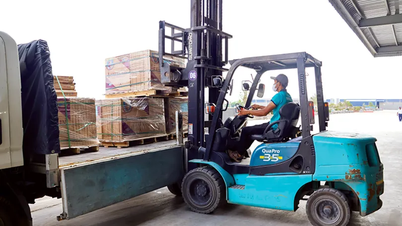
The rural markets in Phan Dong and Dai Lam, held right on the only road leading to the area, coupled with the unloading of bulky goods using forklifts right at the roadside, have created dangerous "bottlenecks." The blaring car horns, the noise of production machinery, and the wood dust emanating from the factories into the air are becoming a major concern for the environment and safety of the elderly and children every time school ends.
 |
Vehicles loading and unloading goods are obstructing traffic. |
Furthermore, many businesses, despite having capital and large orders, are unable to expand their warehouses due to a lack of space. The dream of a centralized production area, where machinery is operated professionally and waste is properly managed, is a shared aspiration of the entire craft village.
According to Mr. Nguyen Gia Thanh, Head of Phan Dong village, the village has 838 households and over 3,500 people. From just one household initially engaged in this profession (in 2010), more than 200 households have now switched to providing services, manufacturing, and supplying formwork and scaffolding.
To address the difficulties faced by the craft village, the Tam Da commune government has taken concrete steps. Mr. Nguyen Huu Quan, Chairman of the Commune People's Committee, said that the Commune People's Committee is seeking the opinion of the Standing Committee of the Commune Party Committee on the policy of researching a land area (5 hectares) for production and services other than rice cultivation to create a space for the people of Phan Dong village to establish a concentrated production and service area.
According to the Chairman of the People's Committee of Tam Da commune, the commune has also requested the higher authorities to build a new inter-commune road to facilitate the flow of goods. In the meantime, the local government will deploy functional forces to regularly remind business owners and implement operational measures to ensure that the road through Phan Dong village is not congested during peak hours.
From the perspective of local households, proactively investing in dust collection systems, minimizing noise pollution, and complying with traffic safety regulations are prerequisites for preventing the occupation from becoming a burden on the social environment.
Source: https://baobacninhtv.vn/phan-dong-giau-len-tu-cung-ung-cop-pha-gian-giao-postid445350.bbg































































































Comment (0)