

The M'nong and Stieng ethnic women in the border commune of Bu Gia Map ( Dong Nai ) work day and night at their looms. They not only weave fabrics imbued with ethnic identity, but also quietly light the fire of passion for the younger generation.
* Following the previous generation to preserve the profession
The brocade weaving craft of the M'nong people in Dong Nai province has been recognized as a National Intangible Cultural Heritage, but the journey to preserve and promote the beauty of this heritage still faces many obstacles.
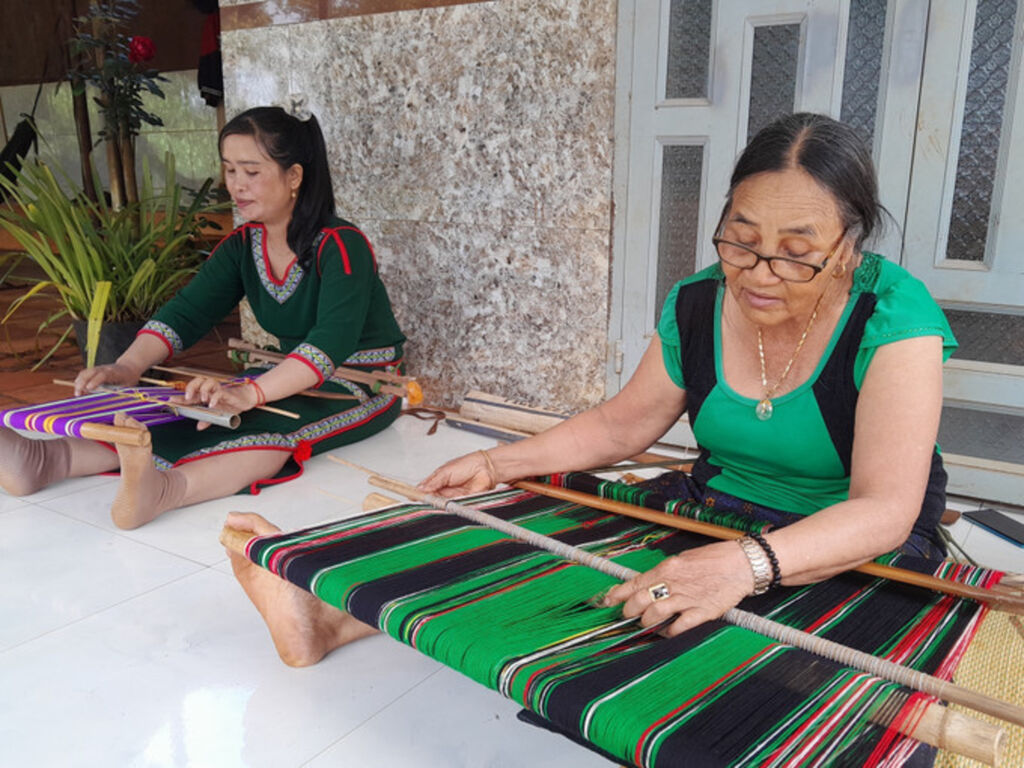
Mrs. Thi Pi Ot and Ms. Thi Tuc weave brocade.
Photo: K SEND - VNA
As one of the few dedicated women who silently "keep the fire" of traditional brocade weaving, Ms. Thi Pi Ot (66 years old, M'nong ethnic group in Bu Dot village) inherited her talent from her mother and started to get acquainted with the loom at the age of 12. She recounted: "At first, I watched my mother weave, then slowly followed suit. After hours of housework, I took the time to sit and watch my mother weave. I loved the colorful and shaped brocade patterns, so I approached them very quickly, just by watching my mother and grandmothers, I could do it." She is known by many people as one of the "multi-talented" generations with many traditional occupations such as brocade weaving, knitting, and making rice wine...
“For traditional crafts of the nation, those who are eager to learn will know. Personally, I can do crafts like weaving, making baskets, winnowing baskets... now. Before, whatever my parents did, I learned from the age of 12-13. I often watched my mother weave, and gradually I mastered the craft” - Mrs. Pi Ot shared.
In the past, the Stieng and M'nong people could only weave one or two pieces of brocade each year because the process of growing cotton and spinning thread was very time-consuming. Brocade was made mainly for family use and not for sale. In the past, three pieces of brocade were put together to make a blanket. A buffalo could be exchanged for a blanket.
In the past, Stieng and M'nong ethnic girls all knew how to weave, but the younger generation today is no longer interested in this profession. If there is no one truly passionate to pass on the craft, the brocade weaving profession will gradually disappear. Mrs. Pi Ot herself feels proud because she knows how to weave and do this profession. When she is still healthy, she hopes to pass on the craft and for her children to follow it. She said: "To preserve the traditional craft, I hope that the authorities at all levels will support silk thread so that they can gather a number of passionate young people and open weaving classes, helping them to develop the ethnic craft through many generations."
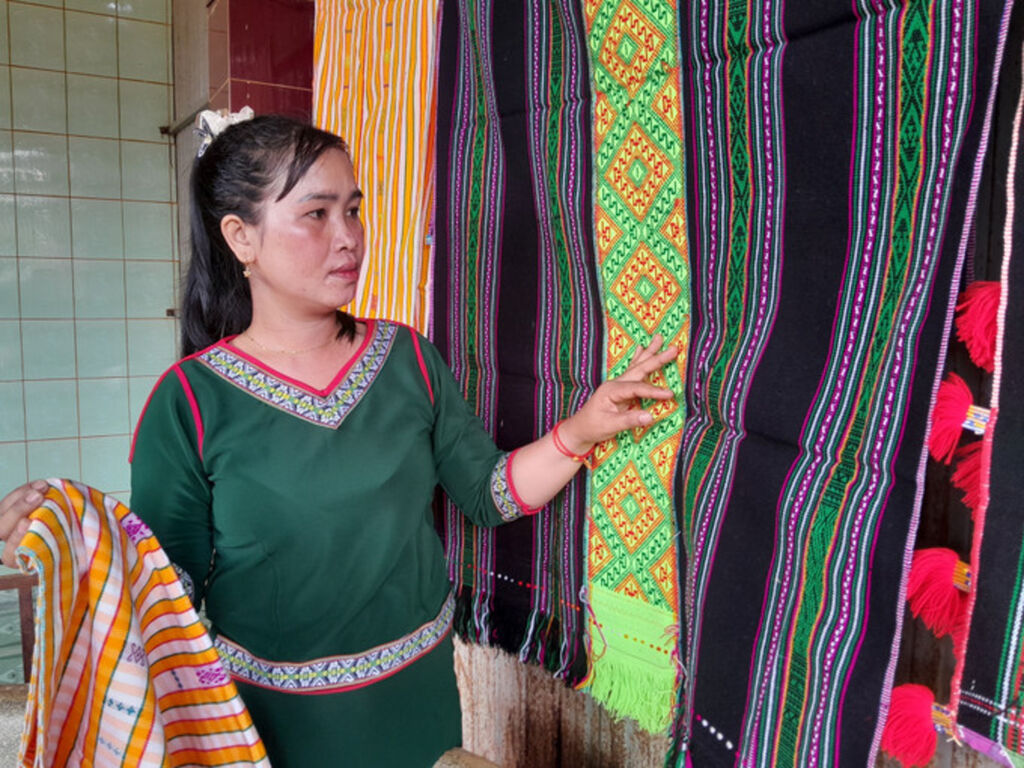
Ms. Thi Tuc in Bu Dot village, Bu Gia Map commune (Dong Nai) is one of the people who still preserves the traditional profession.
Photo: K SEND - VNA
Similarly, Mrs. Thi Y Ro (75 years old, Bu Dot village) has taught brocade weaving to her two daughters and daughter-in-law. Currently, although she is not as agile as before, Mrs. Y Ro still weaves brocade whenever her health is stable and actively passes on her experience to her children and grandchildren. She shared: “I don’t remember when I learned to weave brocade. Influenced by my grandmothers and mothers, my passion for brocade has been passed down to my children until now. I hope that my children will pass on this craft to their grandchildren so that it will not be lost.”
Currently, the younger generation is following in the footsteps of the previous generation to preserve the brocade craft, that is Ms. Thi Tuc (39 years old) of the Stieng ethnic group. After marrying into Bu Dot village in 2012, seeing her mother-in-law weaving brocade, she "fell in love" with the passion and decided: "At first, learning to weave brocade was not easy. Personally, after completing my family work, I always learned from my mother-in-law and the women in the village. With passion, love and perseverance, I have now woven many complete and diverse brocades," Ms. Thi Tuc shared.
Worried that today's young generation is no longer interested in traditional crafts, in addition to constantly learning from previous generations, she called on the young generation to preserve and promote the beauty of their ethnic brocade.
* Promoting the traditional beauty of the nation
Belonging to a remote border commune, Bu Gia Map has more than 75% of its population being ethnic minorities, mainly the M'nong and Stieng people with many unique cultural features and exchanges. Vice Chairman of Bu Gia Map Commune People's Committee Tran Quang Binh said that among traditional occupations, brocade weaving is a prominent cultural feature of the M'nong and Stieng people. Recently, the local government has been gradually preserving and maintaining the brocade weaving profession. Through the National Target Program on Ethnic Minority Areas, the commune has organized performances and opened classes to encourage M'nong and Stieng youth to learn and preserve traditional occupations.
Individuals like Ms. Thi Pi Ot, Thi Tuc... are the "bright spots" who are quietly preserving and developing the brocade weaving craft in the Dong Nai border area. With the support from national programs and resolutions of local Party Committees, the brocade weaving craft is not only preserved through teaching classes for the younger generation, but is also oriented to become a tourism product, contributing to sustainable economic development.
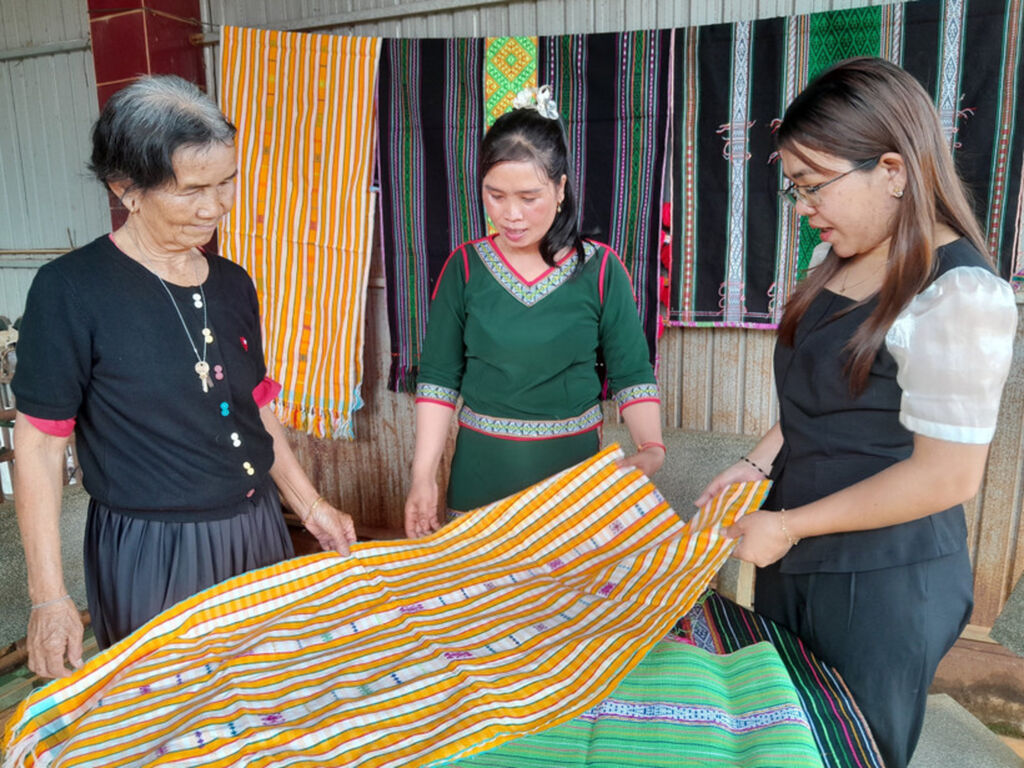
Ms. Thi Tuc and Ms. Thi Y Ro introduce brocade products to tourists.
Photo: K SEND - VNA
In the recent Resolution of the Bu Gia Map Commune Party Congress, the maintenance and development of brocade products has been identified as a solution to promote tourism , thereby developing the economy for the people. In the market economy, traditional brocade weaving products of the local M'nong and Stieng people are having difficulty competing with cheap, mass-produced goods. Currently, the commune has had programs to promote and promote digital economic development for this product.
“Brocades of the M'nong and Stieng ethnic groups still face difficulties in accessing online sales, especially through online sales channels such as Shopee or Youtube. In the coming time, local authorities will continue to have solutions to digitize these products, helping traditional brocades to enter the digital commerce market,” Mr. Binh shared.
In fact, the brocade weaving products of the Stieng and M'nong people are currently mainly consumed within the village, hamlet or with acquaintances, which significantly limits their income. Finding outlets for these products still faces many difficulties, not only in the border commune of Bu Gia Map but also in many other localities in Dong Nai. Although there are still many challenges in accessing digital commerce, the efforts of local authorities in digitizing products will open up new opportunities, helping traditional brocade to reach further./.
Source: https://chinhsachcuocsong.vnanet.vn/phat-huy-net-dep-di-san-nghe-det-tho-cam-cua-nguoi-mnong-o-dong-nai/73688.html


![[Photo] Worshiping the Tuyet Son statue - a nearly 400-year-old treasure at Keo Pagoda](/_next/image?url=https%3A%2F%2Fvphoto.vietnam.vn%2Fthumb%2F1200x675%2Fvietnam%2Fresource%2FIMAGE%2F2025%2F12%2F02%2F1764679323086_ndo_br_tempimageomw0hi-4884-jpg.webp&w=3840&q=75)
![[Photo] Parade to celebrate the 50th anniversary of Laos' National Day](/_next/image?url=https%3A%2F%2Fvphoto.vietnam.vn%2Fthumb%2F1200x675%2Fvietnam%2Fresource%2FIMAGE%2F2025%2F12%2F02%2F1764691918289_ndo_br_0-jpg.webp&w=3840&q=75)

















































































Comment (0)