

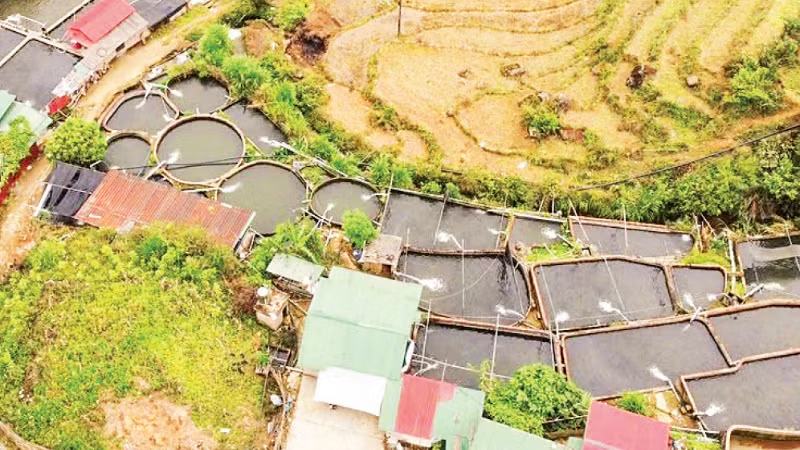
By effectively exploiting that advantage, the province has become one of the country's important centers for the production, farming, and supply of cold-water fish.
Maximizing potential and advantages.
According to Pham Ba Uyen, Chairman of the Lao Cai Coldwater Fish Association, in recent years, coldwater fish aquaculture has become a potential and advantageous industry for Lao Cai province, making an important contribution to the restructuring of the agricultural economy , increasing income and improving livelihoods for people in the highlands.
The scale of cold-water fish production and farming is constantly developing: The entire province has 1,197 cold-water fish farming facilities, mainly concentrated in communes and wards with suitable ecological conditions such as Sa Pa, Bat Xat, Bac Ha, Ngu Chi Son, Tu Le… In 2025, the total farming volume will be 440,000 m³ , with a production of 950 tons; in the first quarter of 2026, the total farming volume will reach 436,000 m³ , with a harvest of 374 tons, and the estimated total harvest for 2026 could reach 1,170 tons…
Coldwater fish farming has made a positive contribution to the economic development of highland agriculture , creating jobs and increasing income for local people. The life of Mr. Chảo Duần Mìn's family in Ngũ Chỉ Sơn commune previously depended mainly on single-crop hillside farming, with income barely enough to cover living expenses. Recognizing the potential of coldwater fish farming, he boldly researched and invested in a trial. From a few small initial ponds, his family has now expanded to 7 ponds raising sturgeon and salmon, with approximately 6,000 fish. According to Mr. Mìn, if all goes well, in about 7-8 months, all the fish will be ready for sale, expected to bring in an income of 800 to 900 million VND.
Mr. Min shared: “Coldwater fish farming requires considerable technical expertise and initial investment, but if done correctly, the economic efficiency is relatively stable, because this species is only suitable for living in cold climates. Thanks to this coldwater fish farming, my family has earned a comfortable income, and our lives have improved significantly.”
Besides commercial fish farming, the production and supply of fish fry is also a strength of the cold-water fish farming industry in Lao Cai. Established in 2004, the Coldwater Fisheries Research Station, under the Institute of Fisheries Science (Ministry of Agriculture and Environment), located in Sa Pa ward, covers an area of 1.36 hectares, with approximately 2,000 m³ of water in the fish tanks. Currently, the station maintains more than 2,500 pairs of broodstock, mainly sturgeon, salmon, and whitefish. Each year, the unit supplies about 1 million fry to the market, of which half are produced domestically, and the rest are imported eggs from Europe for incubation.
In addition, the station supplies approximately 10 tons of commercial fish annually, generating revenue of about 2 billion VND.
Comrade Nguyen Thanh Hai, Head of the Coldwater Fisheries Research Station, said: "In the past period, the station has coordinated with local authorities to implement aquaculture, transfer technology, and provide breeding stock, thereby supporting thousands of households to open up new economic development directions, bringing clear results."
Lao Cai province currently has 8 facilities for producing and breeding cold-water fish (salmon, sturgeon) fry, located in the communes and wards of Sa Pa, Tu Le, Gia Hoi, and Viet Hong. The total designed capacity of these facilities is approximately 6.47 million fry per year, with an estimated annual production of around 3 million. The quality of the fry is generally stable, meeting the needs of aquaculture within the province and supplying some other localities.
Lao Cai province currently has 8 facilities for producing and breeding cold-water fish (salmon, sturgeon) fry, located in the communes and wards of Sa Pa, Tu Le, Gia Hoi, and Viet Hong. The total designed capacity of these facilities is approximately 6.47 million fry per year, with an estimated annual production of around 3 million. The quality of the fry is generally stable, meeting the needs of aquaculture within the province and supplying some other localities.
Challenges and solutions
In response to the need for sustainable development of the fisheries sector, adapting to climate change, the Chairman of the Lao Cai Coldwater Fish Association, Pham Ba Uyen, believes that accurately assessing the current situation, from advantages to difficulties, and setting directions for the management and development of coldwater fish is necessary and serves as a basis for building mechanisms and policies for implementation in the future.
Despite the potential for developing cold-water fish farming, due to the specific requirements for cold, clean, oxygen-rich water, most farming facilities are built near rivers and streams. Many facilities have not fully completed the procedures for changing land use purposes as required by regulations.
The exploitation and utilization of cold water resources have not fully realized their potential and efficiency. There is a lack of comprehensive solutions for managing cold water resources in conjunction with water resource protection, and there is still wasteful use of cold water, especially in aquaculture facilities located upstream, leading to disputes over water resources in cold water fish farming.
Coldwater fish farming faces numerous disease outbreaks, including fungal, parasitic, and bacterial diseases, posing a significant risk of widespread transmission and severely impacting productivity and efficiency. Furthermore, natural disasters such as flash floods and landslides pose a high risk in many localities. Mr. Phan Dao Quay from Muong Bo commune stated: "Coldwater fish farming is fraught with risks, with natural disasters being the most worrying. Fish ponds are often built along streams for easy water access, so during heavy rains and floods, overflowing water can easily cause the pond walls to break, sweeping the fish away and resulting in substantial losses."
Nguyen Thanh Hai, Head of the Coldwater Fisheries Research Station, further proposed: It is necessary to strengthen state management in coldwater aquaculture in accordance with the Fisheries Law and related regulations. Encourage economic entities to invest in the construction of coldwater fish breeding and production facilities, promote socialization in breeding production, and attract and incentivize organizations and individuals with production scales of 1,000 m³ or more.
It is necessary to develop forms of linkage, cooperation, and mutual support in economic and technical aspects in cold-water fisheries production, business, and service activities, in order to improve productivity, quality, food safety and hygiene, and economic efficiency for members...
Sustainable development, the application of high technology, and enhanced state management will contribute to increasing production value and promoting local economic development in the coming period.
Source: https://nhandan.vn/phat-trien-ben-vung-nghe-nuoi-ca-nuoc-lanh-post961976.html






































































Comment (0)