

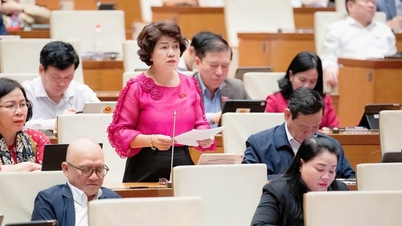
After the milestone of provincial merger, Vinh Long is facing the opportunity to reshape its development strategy. At the third session of the 10th Provincial People's Council, on the afternoon of December 9, delegate Vu Thanh Hai participated in a speech discussing core issues on enterprise development and household business conversion - key factors to exploit new growth potential.
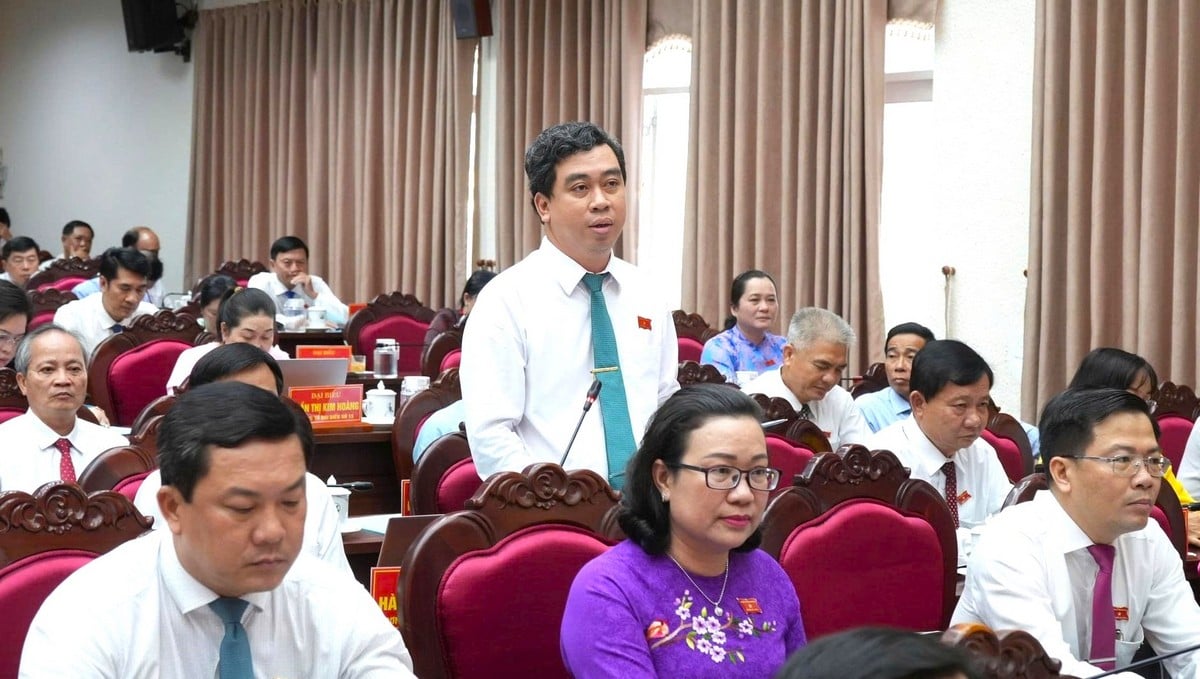 |
| Delegate Vu Thanh Hai spoke at the 3rd session of the 10th Provincial People's Council. |
New context – new requirements for development
The private economy has long been identified as one of the important driving forces of the economy. Resolution No. 68-NQ/TW (May 4, 2025) of the Politburo continues to clearly affirm the role of the private sector in the development of the country in general and Vinh Long province in particular. In the context of the new province after the merger, the requirements for enterprise development and promoting the transformation of household businesses into enterprises are more urgent to form new growth drivers.
July 1, 2025 - a historic milestone has opened: the three provinces of Ben Tre, Tra Vinh and Vinh Long officially merged into the new Vinh Long province. With an area of over 6,200 km², a population of over 3.3 million people and 124 communes and wards, the development space is many times more open than before.
This strategic decision is not only about arranging administrative boundaries but also initiating a new development model, more modern in thinking, more effective in organization, deeper in regional connectivity and stronger in competitiveness.
Vinh Long is facing a rare opportunity to reposition its development strategy. It is also the time for the government, businesses and people to join hands to create a new “shape” – a land that both maintains its identity and rises in the era of digital transformation, green economy and international integration. In that context, developing enterprises and promoting the transformation of household businesses into enterprises should be identified as one of the important pillars to realize the goal of rapid and sustainable growth in the coming period.
Achievements and bottlenecks to be removed
After the Government issued Resolution No. 138/NQ-CP of the Government on the Government's Action Plan to implement Resolution No. 68-NQ/TW dated May 4, 2025 of the Politburo on private economic development and Resolution No. 139/NQ-CP of the Government on the Government's Plan to implement Resolution No. 198/2025/QH15 dated May 17, 2025 of the National Assembly on a number of special mechanisms and policies for private economic development, Vinh Long province also issued Plan No. 06/KH-UBND dated July 23, 2025 to implement Resolution No. 138/NQ-CP dated May 16, 2025 and Plan No. 07/KH-UBND dated July 23, 2025 to implement Resolution No. 139/NQ-CP dated May 17, 2025 of the Government.
At the same time, to effectively implement, on the basis of the plan of the Provincial People's Committee, departments, branches and People's Committees of communes and wards have urgently reviewed, developed and issued implementation plans according to assigned functions and tasks, demonstrating the spirit of initiative, responsibility and high determination of the entire political system in bringing Resolution No. 68-NQ/TW of the Politburo into life.
Thanks to the drastic direction and synchronous implementation, the private economic sector in the province continues to have positive developments, making important contributions to socio-economic growth. The number of newly developed enterprises in the province from January 1, 2025 to October 20, 2025 is 2,410, reaching 147.85% of the plan (the new development plan for 2025 is 1,630 enterprises). As of October 20, 2025, the whole province has 12,278 operating enterprises with a total registered capital of VND 197,886 billion, creating jobs for 293,821 workers and contributing more than 67% of the province's GRDP. Along with that, there are over 97,000 individual business households actively operating in many fields, especially trade, services, small industry and agriculture.
Developing enterprises and promoting the conversion of household businesses into enterprises is of special importance:
Firstly , it helps to foster a more sustainable source of budget revenue through transparency in production and business activities, expanding the tax base, and reducing the informal economy.
Second , create conditions for the HKD themselves to improve their competitiveness. When becoming enterprises, they have the conditions to access official credit, participate in supply chains, expand scale, apply science and technology and gradually standardize management.
Third , contribute to gradually reducing the informal economic sector, building a more transparent, fair and healthy business environment among entities.
Fourth , create more jobs, improve labor productivity, promote professionalization and modernization of production and business activities in the area.
Fifth , create a "new wave of enterprises" suitable to the scale and development space of the province after the merger; thereby, forming a strong enough enterprise force to exploit the advantages of the three economic regions.
However, with the existing scale and advantages after merging with the province, the above figure is still not really impressive. Regarding enterprises, among more than 12 thousand enterprises operating in the province, more than 80% are small and medium enterprises and micro enterprises. And among tens of thousands of HKD, the majority are still small-scale, scattered, and their potential has not been fully exploited. Besides the initial positive results, the enterprise sector and private economy of the province are still facing many difficulties and challenges:
Firstly, most enterprises are small in scale, with limited financial, technological and management potential; their ability to deeply participate in inter-regional and inter-industry value chains, especially to compete regionally and internationally, is still modest.
Second , although the province has issued many mechanisms and policies to encourage private economic development and support enterprises and business households, the effectiveness is not high. Budget resources for support are still limited; some regulations and instructions are not really clear and easy to understand; the policy access process is still complicated, making it difficult for many enterprises and business households to access incentives.
Third , some procedures are still delayed, especially in the fields of land, investment, and construction; the time to process documents at some stages and in some areas is still prolonged, causing additional costs in terms of time and opportunities for businesses.
Fourth , in some communes, there is still a lack of specialized civil servants in areas such as finance-accounting, justice-civil status, and economics; this directly affects the quality and progress of procedures for people and businesses. A number of officials, civil servants, and some localities have not been proactive in monitoring, grasping, and promptly supporting the difficulties and problems of businesses.
Fifth, in the context of limited state budget, the need for investment in infrastructure, digital transformation, development of industrial zones and clusters, and logistics infrastructure is huge. Although attention has been paid to mobilizing social resources for development investment, it is not commensurate with the potential.
Solutions to promote businesses in the new period
Enterprise development is not only the task of the Planning and Investment sector or the Industry and Trade sector, but also the common task of the entire political system from the province to the grassroots. To overcome difficulties and maximize the driving force role of enterprises and the private economic sector, in the coming time, the province needs to focus on the following groups of solutions:
Firstly , continue to improve the mechanisms and policies to support enterprises and business households in a clearer, more transparent, feasible and more accessible direction. Prioritize policies on credit, production premises, support for digital transformation, innovation and startups; ensure that the issued mechanisms and policies are actually implemented.
Second , further improve the investment and business environment; accelerate administrative procedure reform, especially in the fields of land, investment and construction. Strengthen decentralization and reasonable authorization; shorten the time, publicize and make transparent the process of handling documents, effectively apply online public services, creating the most favorable conditions for businesses and people.
Third , develop enterprises according to 3 economic zones with 3 main pillars: Agriculture - processing (in the old Ben Tre); Industry - logistics - energy (in the old Tra Vinh) and Urban - trade - services - education (in the old Vinh Long), in order to exploit the unique strengths of each locality in the past, not to let them be forgotten. Accordingly, it is necessary to adjust the provincial planning to effectively serve these economic pillars. At the same time, it is also necessary to consider moving departments and branches to the old localities to serve the people and businesses more deeply and closely.
Fourth , promote the role of socio-political organizations in developing enterprises and promoting the start-up movement, linked to the natural advantages and traditions of each region after the merger.
Fifth , improve the responsibility and quality of the staff, especially at the grassroots level. It is necessary to consider the work of supporting and accompanying businesses as an important criterion in assessing the level of task completion, associated with the responsibility of the leader. Timely commend collectives and individuals who do well; at the same time, rectify and handle cases that cause trouble and harassment, affecting the investment and business environment of the province.
Sixth , promote the mobilization of social resources for development investment, especially in the fields of industrial park and cluster infrastructure, logistics infrastructure, digital infrastructure and essential works serving production and business. Build reasonable, public and transparent mechanisms and policies to ensure the harmony of interests between the State, investors and people, thereby creating confidence for economic sectors to confidently invest long-term.
Seventh , strongly promote the spirit of entrepreneurship and develop the private economic sector. Have specific programs and projects to support household businesses in converting to enterprises; support information, training in management, accounting, and market connection; encourage the formation of innovative startup business models, businesses associated with the agricultural-industrial-service value chain of the three economic regions.
Eighth , remove the "fear of conversion" mentality of business households. Reality shows that many business households are still afraid of conversion, so it is necessary to organize well the consultation, propaganda and support for the conversion of business households into enterprises through local support groups and units; set up information channels, hotlines, and websites to answer questions and guide procedures for enterprises and business households in a timely and convenient manner. At the same time, it is necessary to have specific policies and mechanisms of the province to encourage business households to become enterprises.
Ninth , strengthen information and propaganda work to raise awareness among people, businesses and staff about the role of the private economy and the significance of converting business households into enterprises. Timely introduce and replicate advanced typical models and success stories to create positive spillover effects in society.
After the merger, Vinh Long province has more space and greater opportunities, but also requires a new, stronger growth engine. Enterprises - especially those formed from household businesses - are that engine. Doing well in converting household businesses into enterprises means increasing sustainable budget revenue, increasing the province's competitiveness, increasing labor productivity, increasing economic scale and increasing the trust of people and businesses in the government.
Therefore, it is necessary to renew thinking, unify awareness and action, arouse the belief and aspiration of the entire political system, economic sectors and the people, create new impetus and new momentum for private economic development. This is the key task for the province to make a breakthrough in the new development stage.
| The 1st Congress of Vinh Long Provincial Party Committee, term 2025-2030, set a target of striving for GRDP growth of 10% or more. To achieve this target, the contribution of the private economic sector, specifically enterprises and business households, is indispensable. |
VU THANH HAI
Source: https://baovinhlong.com.vn/kinh-te/202512/phat-trien-doanh-nghiep-va-chuyen-doi-ho-kinh-doanh-dong-luc-tang-truong-moi-cua-tinh-d7a4b14/




![[Photo] Urgently help people soon have a place to live and stabilize their lives](/_next/image?url=https%3A%2F%2Fvphoto.vietnam.vn%2Fthumb%2F1200x675%2Fvietnam%2Fresource%2FIMAGE%2F2025%2F12%2F09%2F1765248230297_c-jpg.webp&w=3840&q=75)























































![[Photo] General Secretary To Lam works with the Standing Committees of the 14th Party Congress Subcommittees](https://vphoto.vietnam.vn/thumb/402x226/vietnam/resource/IMAGE/2025/12/09/1765265023554_image.jpeg)
































Comment (0)