

Part 1: Making policies "reach" the people
The Government's issuance of Decree No. 261/2025/ND-CP, amending and supplementing many regulations related to the development and management of social housing, is considered an important and timely adjustment to address long-standing bottlenecks. Not only does it expand the scope of beneficiaries, relax income requirements, and reduce preferential loan interest rates, the new decree also aims to increase transparency in the approval process and tighten management to ensure that the policy truly reaches those in need. In Phu Tho , positive developments from the new mechanism are opening up opportunities for housing for thousands of low-income workers, officials, and employees.

The Minh Phuong low-rise social housing project in Nong Trang ward has been invested with comprehensive infrastructure, meeting the housing needs of residents in the area.
Removing barriers to make social housing more accessible to the public.
For many years, the demand for housing among low-income earners, workers, and young professionals in urban areas has remained high. However, many people, despite having a genuine need, still find it difficult to access social housing due to income requirements, verification procedures, or limited supply. Decree No. 261/2025/ND-CP, effective from October 10, 2025, has supplemented and adjusted many regulations to be more flexible and practical, creating conditions for people to more easily access housing policies.
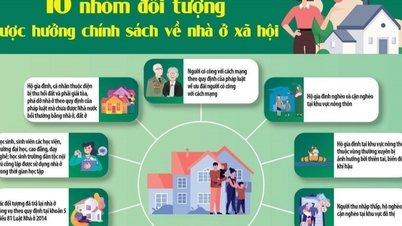
According to the new regulations, the eligibility criteria for purchasing social housing have been further expanded to include people with meritorious service to the revolution; poor and near-poor households in rural and urban areas; workers and laborers in and outside industrial zones; armed forces; cadres, civil servants, and public employees; and cases where land has been confiscated or houses demolished but compensation in the form of houses or land has not yet been provided...
Notably, income requirements have been adjusted to better reflect real-life situations. Single people in low-income urban areas, civil servants, and employees with an average income not exceeding 20 million VND/month are eligible to purchase social housing, an increase of 5 million VND compared to before. For those raising children under 18, the maximum income has been raised to 30 million VND/month. For married couples, a combined income of 40 million VND/month is sufficient to qualify for social housing, an increase of 10 million VND compared to the previous regulations.
Ms. Pham Thi Thu Hien, a worker in Viet Tri ward, shared: “Previously, my income exceeded the regulated threshold, so even without owning a house, I was not eligible to buy social housing. Now that the income level has been adjusted to be more suitable, I have more hope of registering to buy a house to stabilize my life.”
In addition to easing income requirements, Decree 261/2025 also removes obstacles for self-employed workers and those without labor contracts. According to the new regulations, within 7 days of receiving a request, the commune-level police where the applicant resides are responsible for verifying income based on the population database, reducing the manual verification procedures used previously.
Another positive point is that the preferential interest rate for social housing loans has been adjusted down from 6.6% to 5.4% per year. This is considered an important leverage to help workers reduce financial pressure when taking out long-term loans to buy a house.
Simultaneously expanding the target group, easing income requirements, and reducing loan interest rates not only makes housing more accessible to people but also contributes to stimulating real demand and increasing liquidity for social housing projects. This, in turn, creates further incentive for businesses to invest in this segment.

Residents of Viet Tri ward are searching for information about purchasing social housing online.
Transparent processes, stricter management.
Besides expanding opportunities for beneficiaries, it is essential to strengthen management to ensure that policies reach the intended recipients and prevent exploitation for personal gain.
In Phu Tho province, along with the implementation of Decree No. 261/2025/ND-CP, the province is implementing many solutions to enhance transparency in the review and management of social housing. Accordingly, all information related to projects, the number of apartments, review criteria, and the list of eligible buyers will be publicly available on the electronic portal for people to monitor and supervise. This transparency not only helps people easily access information but also limits the practice of "requesting and granting" favors, reducing the risk of corruption.
According to the new regulations, the responsibility for verifying documents rests not only with the investor but also involves coordination with local authorities, the police force, and other relevant agencies. This inter-agency coordination helps increase the accuracy of verifying information regarding residency, income, and housing status of applicants.
In particular, Decree 261/2025 clearly stipulates that investors are not allowed to accept applications through brokers or intermediaries. This is an important solution to prevent the "brokers" of social housing projects, which have caused much public outrage. People can submit applications directly or through the online system as prescribed, ensuring fairness in accessing the policy.
Comrade Nguyen Le Dien Ngoc – Head of the Housing Management and Real Estate Market Department, Department of Construction, said: The Ministry of Construction is coordinating with ministries, sectors and localities to build a database system on social housing, updated on the Ministry of Construction's electronic portal. When the system is completed, the application review process will be digitized, reducing reliance on manual verification, thereby limiting errors and corruption.
Promoting digital transformation is considered a fundamental step in improving the efficiency of social housing management. Through an interconnected data system, authorities can quickly cross-reference information about housing properties, residences, income levels, and insurance participation status of applicants, limiting instances of dishonest declarations to benefit from the policy.
Not only are the entry requirements being tightened, but post-housing management is also being emphasized to ensure proper and targeted use. Simultaneously, inspection and monitoring efforts are being strengthened. In 2026, the Department of Construction will coordinate with the Provincial Inspectorate and local authorities to develop a comprehensive inspection plan for the buying, selling, management, and use of social housing in the province.
The implementation in Phu Tho shows that the management of social housing is undergoing a clear transformation towards a more systematic and substantive approach; shifting from manual management to digital data-driven management, and from case-by-case inspections to regular and continuous monitoring.
It is evident that, along with expanding support policies, tightening management is becoming a mandatory requirement to ensure the fairness and transparency of the social housing development program. These positive developments not only help policies reach the right target groups but also contribute to creating a foundation for the stable and sustainable development of the social housing market, thereby strengthening people's trust in the social welfare policies of the Party and the State.
Le Oanh
Source: https://baophutho.vn/phat-develop-nha-o-xa-hoi-ben-vung-254566.htm



































































































Comment (0)