

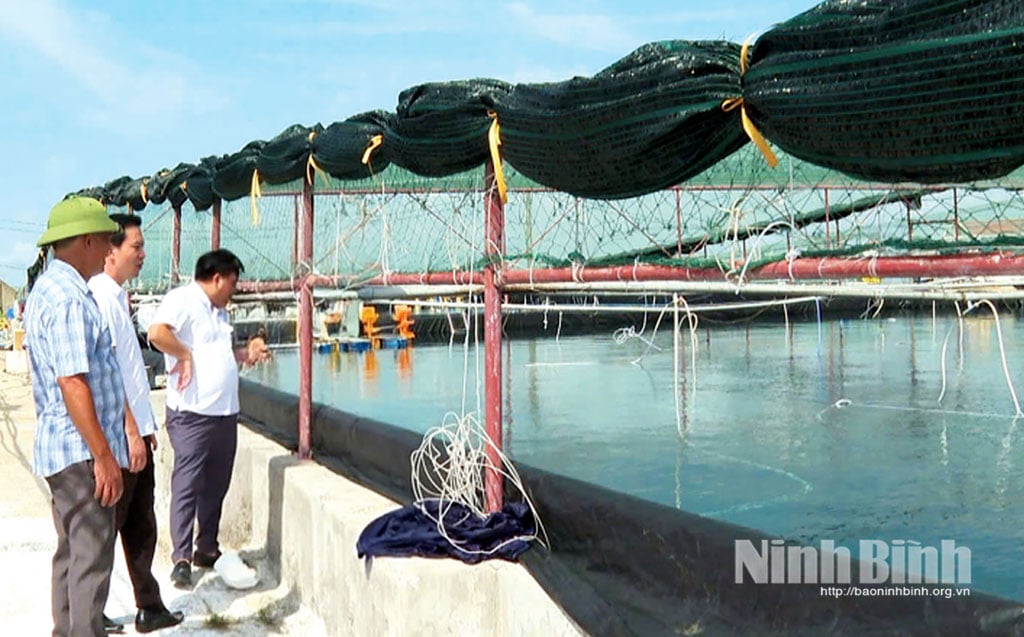
Coming from a poor family, Mr. Cao Van Ba, from Giao Ninh commune, always yearned to escape poverty and achieve legitimate wealth in his homeland.
He has been involved in whiteleg shrimp farming since 1998, but the results were not good due to traditional farming methods with low efficiency. Therefore, Mr. Ba proactively learned new techniques and boldly borrowed capital to invest in building a high-tech pond system according to VietGAP standards.
To date, he has over 5 hectares of high-tech whiteleg shrimp farming. The ponds are raised above ground, with lined bottoms and roofs to regulate temperature, creating a stable environment. Importantly, this allows for off-season shrimp farming, something impossible with traditional ponds during the winter in Northern Vietnam. Each season, 1,000 square meters of pond yield 5 to 6 tons of marketable shrimp. With this high-tech model, his family earns billions of dong annually.
After many years working as an electrical engineer, Nguyen Dai Duong from Giao Hoa commune returned to his hometown, determined to become wealthy right on his native land.
After visiting aquaculture farms run by experienced farmers, Mr. Duong decided to switch to raising clam seedlings. Utilizing the available pond area, he initially invested in raising natural shrimp on an area of over 10 hectares.
However, due to low economic efficiency and frequent shrimp losses, after several years of persistently pursuing the profession, he decided to abandon the model to find a more suitable direction. After some research, Mr. Duong boldly renovated the pond and bought clam seedlings to raise.
Besides developing and supplying oyster spat, his family also invested in modern facilities, machinery, and equipment for high-tech whiteleg shrimp farming. This has helped increase the family's income.
To date, with a 25-hectare aquaculture farm, his family sells tens of tons of clam seedlings and whiteleg shrimp annually. After deducting all expenses, his family earns a profit of 1.5-2.5 billion VND per year, creating stable employment for about 10 local workers with a basic salary of 6-8 million VND per month and about 30 seasonal workers with wages of 250-300 thousand VND per day.
The province currently has approximately 35,000 hectares of aquaculture area. In recent years, the focus on developing concentrated aquaculture zones with synchronized infrastructure has enabled farmers to apply scientific and technological advancements to production, improving yield and quality, and bringing the province's aquatic and seafood products to domestic and international markets.
In 2025, the province's aquatic product production growth rate is projected to reach 5.07%; total aquatic product output will reach 310,252 tons, an increase of 3.7% compared to 2024 (of which aquaculture accounts for over 76%); the value of aquatic product production is estimated at VND 9,522.7 billion, an increase of 5.07% compared to 2024. In the first four months of 2026, total aquatic product output is estimated at 95,183 tons, an increase of 4.8% compared to the same period last year. Of which, aquaculture output will reach 74,644 tons (an increase of 5.1%).
Hatcheries have been actively repairing, renovating, and disinfecting ponds and lagoons; to date, the total number of brackish water shrimp larvae produced is estimated at 9.423 million. Thanks to favorable conditions, the vast alluvial plains, and abundant sediment, local people have effectively managed and exploited the aquaculture area, while minimizing the use of chemicals to protect natural seawater resources.
The farming methods have shifted from extensive and improved extensive farming to intensive and super-intensive farming, applying VietGAP standards and high-tech farming techniques.
The range of farmed aquatic species is quite diverse and is gradually forming a local specialty aquatic product.
High-tech, concentrated aquaculture areas are located in brackish water areas such as the communes of Hai Xuan, Hai Thinh, Giao Ninh, Giao Minh, Rang Dong, Kim Dong, and Binh Minh…
Besides traditional aquaculture species, in recent years the province has placed special emphasis on developing whiteleg shrimp, bivalve mollusks, and specialty fish species.
The province's commercial clam farming areas are strictly controlled to meet European standards, satisfying domestic consumption needs and providing raw materials for processing plants, as well as exporting clam products to the EU market.
Scientific and technological advancements are being applied by farmers, such as 2- and 3-stage shrimp farming technology, biofloc technology, low-water-exchange farming, recirculating aquaculture, and the application of microbial technology instead of antibiotics and chemicals in aquaculture.
Aquaculture farming that focuses on applying science and technology not only boosts the quantity and quality of aquatic and marine products but also forms cooperatives and associations for aquatic and marine production, building value chains from production to consumption, linked with management and traceability, and combined with building product brands.
In order to develop a modern and sustainable fisheries industry, linked to environmental protection and improving the lives of people in coastal areas and areas involved in aquaculture and fisheries exploitation, on December 27, 2025, the Provincial People's Committee issued Plan No. 120/KH-UBND on the development of fisheries in the province until 2030.
Accordingly, the plan aims to proactively produce and meet the demand for marine fish and freshwater aquatic species; meet 100% of the demand for bivalve mollusk seeds; minimize post-harvest losses to below 10% by 2030; build a production, processing, and consumption chain to ensure stable outlets for approximately 25% of farmed aquatic products; and achieve an estimated aquatic production value of VND 51,160 billion during the 2026-2030 period (at 2010 constant prices)…
The effective implementation of the Provincial People's Committee's plan will create fundamental changes for the fisheries sector, ensuring development in line with the National Fisheries Strategy, contributing to economic development, ecosystem preservation, and sustainable rural development.
Source: https://baoninhbinh.org.vn/phat-develop-concentrated-aquaculture-area-260520200323647.html























































































Comment (0)