

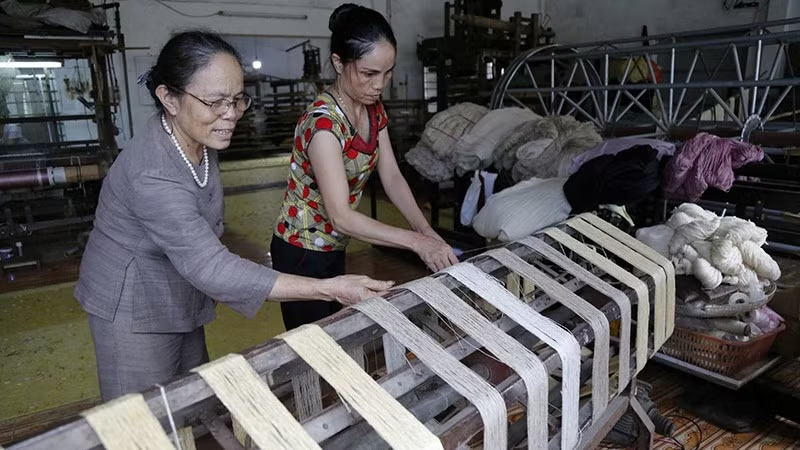
According to the socio-economic report for the second quarter and the first six months of 2025 published by the General Statistics Office ( Ministry of Finance ), in the first half of this year, more than 152,700 businesses were newly established or resumed operations, an increase of 26.5% compared to the same period last year. However, the number of businesses withdrawing remains significant. Specifically, more than 80,800 businesses temporarily suspended operations (an increase of 13.3%), more than 34,000 units temporarily ceased operations pending dissolution (an increase of 18.3%), and more than 12,300 businesses completed dissolution procedures (an increase of 23.3%).
Many barriers and challenges
In the first six months of 2025, an average of approximately 21,200 businesses withdrew from the market each month, while the number of newly established or reactivated businesses averaged around 25,500. The relatively small difference between these two groups reflects a tug-of-war situation, where the number of new businesses entering the economy is just enough to compensate for the number of those withdrawing.
Notably, the number of businesses withdrawing in various forms still recorded an increase compared to the same period last year, indicating that small and micro-enterprises are still facing many obstacles in maintaining business operations. This is a warning sign about the "health" of the business sector, which plays a crucial role in creating jobs and driving local economic growth.
Mr. Mac Quoc Anh, Vice President and General Secretary of the Hanoi Small and Medium Enterprises Association (HANOISME), explained that businesses are "exhausted" due to the immense pressure from rising input costs, with rent, raw materials, transportation, electricity, and water prices increasing by 10-20%. Small businesses, which already have low profit margins, cannot adjust their selling prices accordingly, leading to prolonged losses and financial difficulties.
Furthermore, access to loans is a major barrier, with over 60% of SMEs facing difficulties due to stringent collateral requirements and complex procedures. High interest rates and low disbursement rates of preferential credit programs also make it difficult for businesses to raise capital. In addition, purchasing power and orders have decreased significantly. Finally, digital transformation also faces major obstacles, as SMEs lack the financial and human resources to apply digital technology, while facing fierce competition from FDI enterprises and cross-border e-commerce.
Lawyer Thu Ha (Hanoi Bar Association) added that one of the major obstacles currently is that SMEs still face difficulties in accessing the legal system. In addition, many businesses have not focused on preventing legal risks and have not fully understood the importance of applying legal regulations to protect their legitimate rights.
Furthermore, inter-sectoral legal support programs for businesses have not yet achieved the expected results. In particular, SMEs often do not pay enough attention to legal issues in their business operations, and most still operate based on habit and personal connections.
According to Mr. Le Minh An, the founder of an F&B startup in Ho Chi Minh City, after being forced to withdraw from the market, he sees no opportunity to restart his business. Purchasing power has decreased significantly, and customers are becoming increasingly cautious in their spending, indicating a tightening market demand. In addition, there are barriers from the legal system and increasingly stringent compliance requirements.
Startups lacking a solid operational foundation struggle to survive under the new regulations. The flexible measures that once helped businesses adapt are no longer effective, forcing many to cease operations. He cited examples such as businesses only reporting a portion of their employees' social insurance contributions or using handwritten invoices for transactions. In the current context, businesses wishing to operate must fully comply with regulations and be subject to oversight from regulatory agencies.
Building a transparent business environment.
Mr. An's remarks reflect a noteworthy reality: the economy is undergoing a strong restructuring process, with high demands for legitimacy, compliance, and efficiency. However, not all businesses are capable of adapting. Some argue that too many strict regulations are causing small businesses to become passive and withdraw. However, upon closer examination, regulations concerning labor safety, social insurance, corporate income tax, electronic invoices, and information disclosure have existed for a long time and are frequently renewed.

According to National Assembly representative Phan Duc Hieu, since the beginning of 2024, the National Assembly has strongly promoted legal reform with more than 30 laws and resolutions enacted or open for consultation in the last three sessions. However, Vietnamese businesses often lack experience, especially in new fields or those requiring international standards. Without appropriate mechanisms to test their capabilities, domestic businesses will forever remain "on the sidelines."
For example, some large projects in Hai Phong are often awarded to foreign companies or those with international experience. So when will Vietnamese businesses have a chance to grow? Therefore, the new regulations aim to create a more transparent, favorable, and equitable business environment, but also bring with them increased competitive pressure.
Mr. Hieu believes that young, innovative, and tech-savvy businesses, even those with limited financial resources, will have the opportunity to enter the market. Existing businesses will have to improve their management, efficiency, and customer service capabilities to avoid falling behind.
From a business perspective, Mr. Lai Duc Dung, Chairman of the Board of Directors of VISAFO Food Joint Stock Company, shared that while the pressure from new regulations is undeniable, genuine change is the decisive factor for a business's survival and development. Only in a healthy and fair competitive business environment can small businesses have the opportunity to improve quality, and truly innovative and creative units can rise and maintain their position in the market.
However, this transformation cannot happen quickly. Mr. Dung argues that small businesses currently face inherent weaknesses in human resources, technology, capital, and management thinking. Without practical support, this group of businesses easily falls into a vicious cycle: "not meeting standards - being eliminated - lacking opportunities for development." This not only reduces competitiveness but also makes it difficult to adapt to market changes and the requirements of new regulations.
At a seminar on SMEs, Mr. Nguyen Duy Hung, Vice Chairman of the Dong Nai Import-Export Association, shared that businesses no longer desire simple support as before, but instead want more detailed and in-depth guidance. Businesses are always looking for a transparent and fair business environment and want to operate correctly and efficiently.
During the implementation of support programs, focus should be placed on key legal issues that directly affect businesses, such as land law, credit, taxation, and green transformation. Simultaneously, a team of legal advisors is needed in each region to support businesses and ensure the feasibility and effectiveness of the programs.
In summary, the new game of "doing things according to the rules" is not just a test of legal standing, but a crucial step for the Vietnamese economy in the process of transparency and deep integration. In this context, businesses need to recognize that compliance is what opens up opportunities to access capital, customers, supply chains, and policy incentives legitimately. To achieve this, businesses need to "dare" to step through the open door with a new attitude.
Source: https://nhandan.vn/phep-thu-voi-cac-doanh-nghiep-nho-post895793.html

































































































Comment (0)