

In the recently announced report on the organization and results of the 2025 competency assessment exam, the Center for Testing and Training Quality Assessment, Ho Chi Minh City National University, gave explanations for the "different" score distribution between the two exam rounds.
Analysis of the exam results of candidates who participated in the 2025 exam of Ho Chi Minh City National University shows that the score distribution in each round is close to the standard distribution, the width of the score distribution shows that the exam has a good level of differentiation, suitable for university admission goals.

Distribution of scores for the Ho Chi Minh City National University's capacity assessment exam, round 1 and round 2, 2025 (Source: Ho Chi Minh City National University).
The score distribution of wave 2 tends to be “right-skewed” and more spread out than wave 1, reflecting a higher average score and greater dispersion.
This, according to the Center for Testing and Training Quality Assessment, Ho Chi Minh City National University, could be due to three reasons.
Firstly, among the total number of candidates taking the second round of the exam, there were more than 65,000 candidates (accounting for 71.27%) who had taken the first round of the exam. Analysis of the results showed that this group of candidates had exam scores higher than the average, belonging to the group with good ability or above.
The fact that this group of candidates continued to take the exam in the second round contributed to shifting the score distribution to the right.
Second, the second round takes place about 2 months after the first round, giving candidates more time to review and consolidate their knowledge. At the same time, because of the experience in the first round, candidates have more experience with the structure of the test, time management skills, exam psychology and how to avoid previous mistakes, so their test results are improved.
Third, according to this unit, the second round often attracts a group of highly motivated candidates with clear goals in improving or optimizing their scores for admission.
Meanwhile, many candidates with poor academic performance or who did not really invest in the exam tend not to register or not participate in the second round. This changes the candidate structure, increases the proportion of candidates with good and excellent academic performance, contributing to raising the average exam score.
Previously, last June, after Ho Chi Minh City National University announced the results of the 2025 competency assessment exam, Dan Tri reporter raised the issue of the unusual difference in score distribution between the two exam periods.
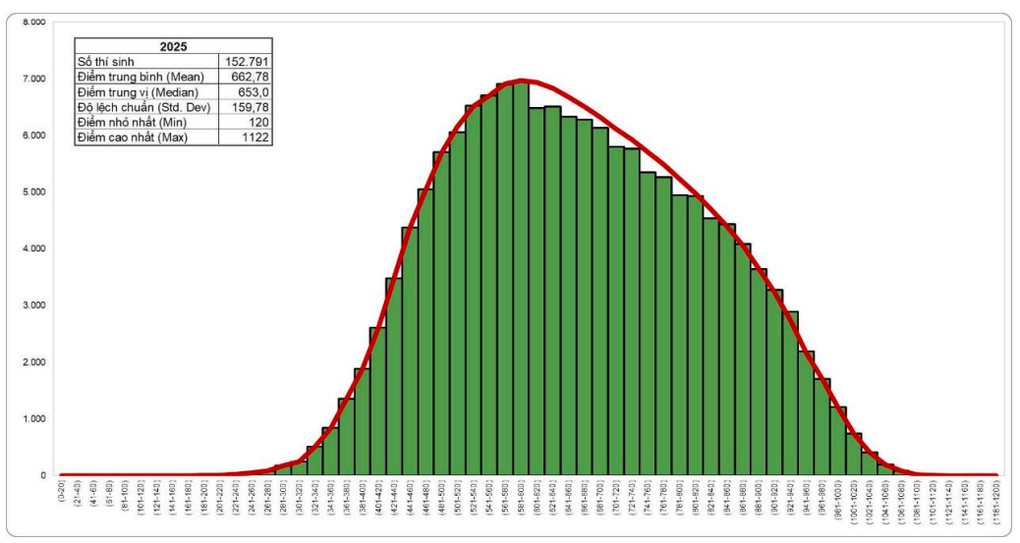
Distribution of scores for the 2025 Ho Chi Minh City National University Competency Assessment Test (Photo: Photo taken from the report).
Specifically, the average score of the second round was 718.7, 100.4 points higher than the first round. This difference is recorded as the highest ever.
Compared to the average score of the 2023-2025 period announced by the organizers to be in the range of 640-665, the average score of the second round is also 53-78 points higher. This fluctuation raises big questions about the stability and standardization of the exam.
From this difference, some admissions experts are concerned about the level of standardization of the exam between the exam periods and the potential risk of fairness in the admission process between the two periods when used for admission consideration.
At that time, the former director of a university testing center with experience in competency assessment exams commented that the large difference between the two rounds could not be explained solely by the factor "maybe due to retaking the exam or practicing".
The second round score distribution shifted to the right, reflecting the possibility that the test was easier, less confusing, or clearer in the way it was set and evaluated.
Because Ho Chi Minh City National University does not publish the exam questions, many experts say it is possible that the exam questions have not been fully standardized between sessions.

Candidates attend the competency assessment organized by Ho Chi Minh City National University (Photo: VNUHCM).
This expert further analyzed that, with the large scale and reasonable time gap between the two exams, the results should ideally be stable and comparable. However, the obvious difference as above raises an urgent need for a serious and comprehensive re-evaluation of the exam and the need to standardize scores between exams through specialized methods such as equating or converting by rank percentage.
In addition, the next measure is to build a standardized test bank and test the quality of questions before and after the test.
Up to now, the Ho Chi Minh City National University's capacity assessment exam is still the largest capacity assessment exam in the country in terms of the number of candidates and the number of schools using the admission results.
In 2025, in both exam periods, there will be more than 152,000 candidates taking the exam, corresponding to more than 218,540 candidates taking the exam, and more than 110 educational institutions will use the admission results.
In 2026, the Ministry of Education will supervise the capacity assessment exams of schools.
According to the decision to issue a plan to implement university and college admissions in 2026 by the Ministry of Education and Training , the Department of Quality Management will implement the content of unifying criteria for assessing the capacity of higher education institutions, before the time the training institutions organize exams.
The Ministry of Education and Training will also monitor the organization of capacity assessment exams of higher education institutions during the time training institutions organize exams.
According to the Ministry of Education and Training, the test assesses capacity, assesses thinking, and serves admission in terms of principles, criteria, content, and expertise, ensuring input quality standards among university admission methods.
Source: https://dantri.com.vn/giao-duc/pho-diem-venh-la-o-ky-thi-danh-gia-nang-luc-lon-nhat-ca-nuoc-20251206181916621.htm
![[Photo] National Assembly Chairman Tran Thanh Man attends the VinFuture 2025 Award Ceremony](/_next/image?url=https%3A%2F%2Fvphoto.vietnam.vn%2Fthumb%2F1200x675%2Fvietnam%2Fresource%2FIMAGE%2F2025%2F12%2F05%2F1764951162416_2628509768338816493-6995-jpg.webp&w=3840&q=75)



























































































Comment (0)