

Old dynasties
There are teams that define entire eras – like Pep Guardiola's Barcelona, or the Real Madrid "galacticos" at the turn of the century. But winning the title two years in a row has now become incredibly rare. In fact, since the league changed its format in 1992, only one club has successfully defended the title: Real Madrid, with a streak of three consecutive titles from 2016 to 2018.
Previously, to find a team with consecutive wins, you had to go back to 1990, when AC Milan won two consecutive European Cups. And even before that? Of course… Nottingham Forest (1979 and 1980) – the team that completed a decade where the champions consistently held the crown against challengers (Ajax 1971-1973, Bayern Munich 1974-1976, and then Liverpool 1977 and 1978).
To complete the collection: Inter defended the European Cup in 1964 and 1965, while in the opening days of the tournament, from 1956 to 1960, Real Madrid created an incredible streak of 5 consecutive titles.
In the era of the European Cup, creating a "dynasty"—whether big or small—was quite common. But in the Champions League era, that's an extremely difficult goal. And in that context, Luis Enrique's PSG is showing signs of threatening to define this era of European football, and may even establish their own dynasty.
Perhaps it's too early to talk about legacy. But one thing is certain: PSG are just one win away from joining the "privileged club" of consecutive European champions.
Perfect power
Watching PSG easily beat Bayern in Munich on Wednesday night, they looked like the most complete team the league had seen since Zidane's Real Madrid – a winning squad with Cristiano Ronaldo, Gareth Bale, and other stars.
Following their unforgettable 5-4 victory in the first leg of the semi-final last week, there has been much talk along the lines of "they only know how to play in one way" - as if the second leg would be another frenzied attacking display.
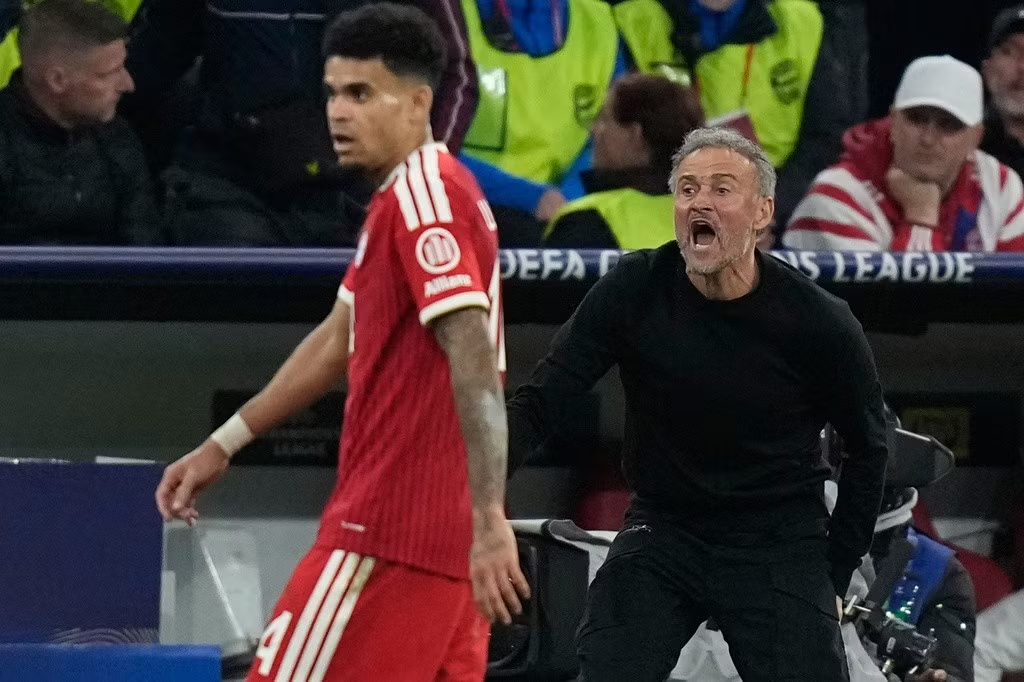
But no. PSG displayed almost the quintessential Champions League away game: they started strongly, launching an all-out attack, scoring early thanks to Ousmane Dembele, and then stifling one of Europe's best attacking lineups – prolific goalscorers like Harry Kane, Luis Diaz, and Michael Olise – for the next 91 minutes.
Bayern, who had scored in all 51 of their matches this season, were at times forced into desperate long-range shots or appeals for penalties due to Joao Neves' handball. Kane's equalizer once again showcased his goal-scoring instinct, but it came too late to change the fate of the tie, as PSG's defense remained generally impenetrable.
But even though PSG spent most of the time defending as a team (there were plenty of moments with 10 men in black shirts behind the ball), the match was no less exciting than the crazy chase in the first leg – when both teams attacked as if whoever reached 10 goals first would win.
The second leg was still very exciting, high-quality, and incredibly captivating.
And the feeling—despite a few controversial handball incidents against Bayern in both legs—was that this was a perfectly logical result. PSG, as Bayern coach Vincent Kompany admitted after the match, have been the best team in Europe for the past two seasons. Except for the autumn period, when they tended to slow down a bit.
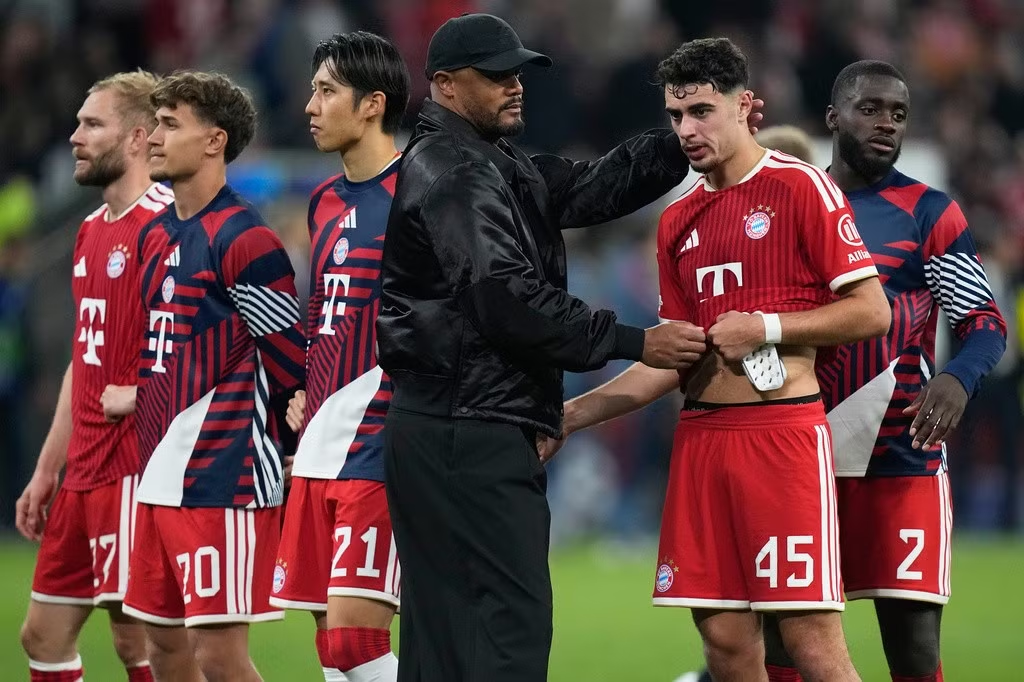
“We have to admit that we faced very strong opponents,” Kompany said. “The level of both teams is very, very high. PSG have a fantastic squad. They are probably the best team in Europe for the last two years. We’ve played them five times – won two, lost two, and drawn one. I have to say we tried our best. Congratulations to PSG, but we will try even harder.”
In a team with virtually no obvious weaknesses, PSG this season seems to have added two more aspects to their playing style: consistency in big matches and stamina.
This stems from the fact that they can still perform at their best after a grueling 12 months: their previous season practically ended on July 13th because they reached the Club World Cup final, and then the 2025-26 season begins exactly one month later.
A new 'dynasty' for European football?
The way PSG reached the final on May 30th reflects their significant increase in maturity.
Last year, they also had their lucky breaks on their journey to Munich, relying on a few outstanding performances from Gianluigi Donnarumma to get past three English teams in the knockout rounds (beating Liverpool on penalties, Aston Villa 5-4 on aggregate, and Arsenal 3-1 in the semi-finals).
This year, their journey was smoother and more certain (this time beating Liverpool 4-0 and crushing Chelsea 8-2 – though at this point, that doesn't say much). They could have – and should have – been more relaxed in the semi-final, allowing Bayern to come back despite leading 5-2 after an hour.
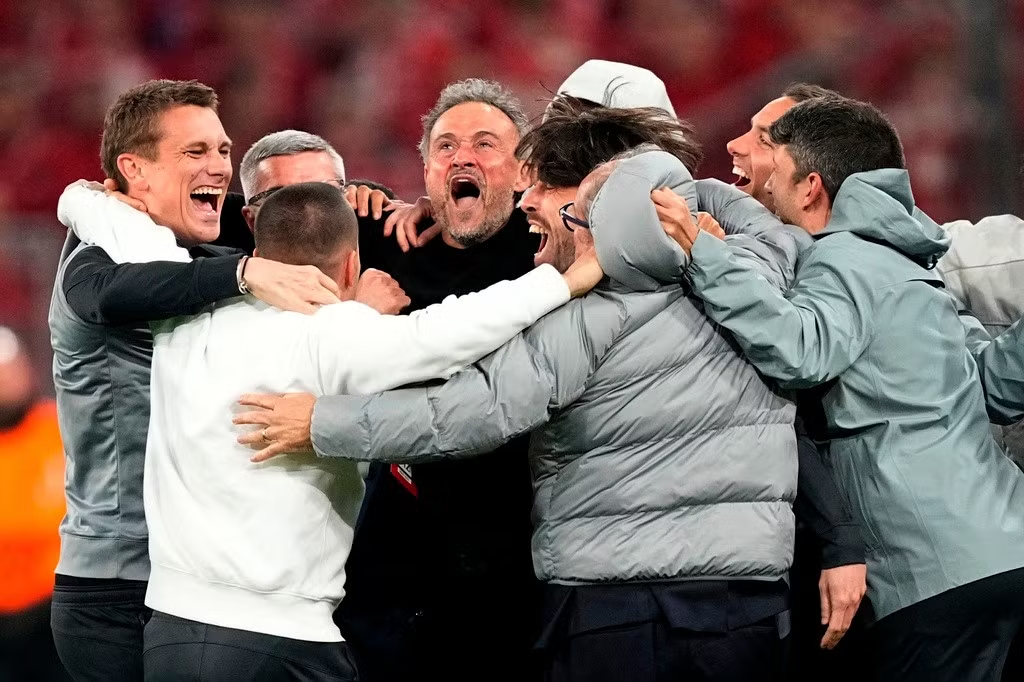
"It's unbelievable," said Luis Enrique. "I think what we showed tonight, and throughout the season, especially in the Champions League, is an unimaginable standard."
“We played against one of the best teams in the world , away from home, and we did it with the necessary maturity and character. It shows what kind of team we are.”
With an average squad age of 24, and only three players over 28 – Fabian Ruiz 30, reserve left-back Lucas Hernandez 30, and Marquinhos 31 – this team can continue to grow and improve together for many years to come.
They have achieved great things. Now it's time to build a dynasty.
Source: https://tienphong.vn/psg-da-den-luc-mo-ve-trieu-dai-o-chau-au-post1841431.tpo














































































Comment (0)