

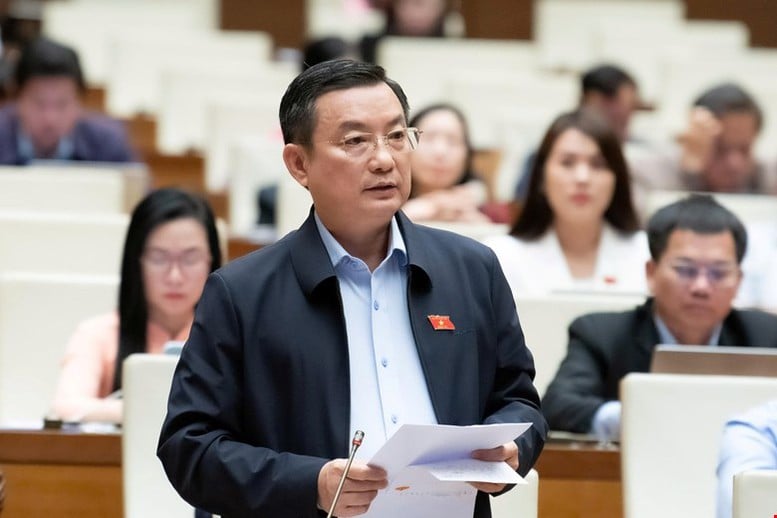
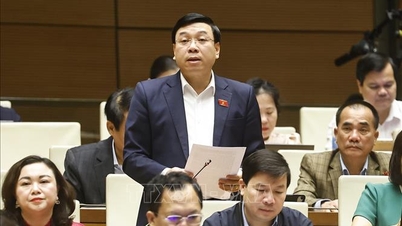
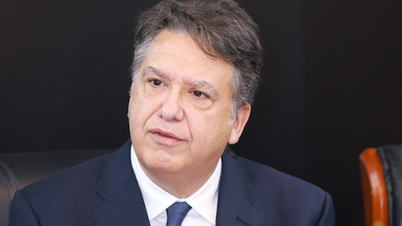
National Assembly Delegate Pham Trong Nhan (HCMC) gave his opinion in the discussion.
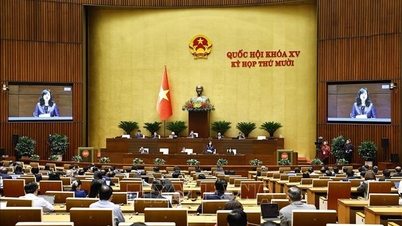
On the morning of December 2, continuing the 10th Session, the National Assembly discussed in the hall the investment policy of the National Target Program on health care, population and development for the 2026 - 2035 period.
Disease prevention is the backbone of national health security.
At the discussion session, delegate Pham Trong Nhan (HCMC) emphasized that what people expect is not only a new program but a more correct mindset about health, a mindset that helps Vietnamese people not only live long but also live healthy, quality and useful lives.
According to him, to exempt hospital fees, we must reduce diseases; to reduce diseases, we must reduce risk factors, and to do that, the institution must be strong enough, management must be strict enough, and responsibility must be assigned from the root. Therefore, the national target program is not only a financial and technical program, but also a reform of thinking about protecting people's health.
The delegate pointed out the current situation that Vietnam is entering a "double burden" phase where non-communicable diseases account for nearly 80% of total deaths, more than 40% of deaths occur before the age of 70 - during working age.
Along with that, risk factors are increasing rapidly such as saltier eating habits, increased consumption of ultra-processed foods, widespread use of tobacco and e-cigarettes among young people, alcohol consumption among the highest in Asia, potentially risky living environments and lack of space for exercise.
"The current law has quite complete regulations but it has not yet become a safe living behavior and leads to the health sector , especially the last line, still having to bear the burden instead of the areas that should have been responsible from the beginning," said delegate Pham Trong Nhan.
Citing international lessons, delegates proposed a number of groups of solutions such as: Making disease prevention the backbone of national health security, all targets and funding must refer to the goal of reducing non-communicable diseases.
At the same time, it is necessary to fully incorporate the WHO Best Buys package into the resolution, including increasing taxes on tobacco, alcohol, and sugary drinks; reducing salt; eliminating trans fat; controlling contaminated food; and clearly labeling nutrition.
Along with that, build a set of national health and lifestyle indexes announced annually, managed by smoking rate, salt and sugar consumption, exercise rate, blood pressure control and healthy life expectancy in each locality.
Breakthrough in primary health care, increase resources for commune health stations to manage chronic diseases, connect electronic health records, reduce overuse of high-tech tests. Consider active aging as a strategic pillar, expand long-term care models, rehabilitation and create health-friendly working environments for the 45-70 age group.
According to the delegate, the program will only be truly meaningful when we shift from a cure mindset to a prevention mindset; from medical spending to investing in health from the root... If we can do this, the healthy life expectancy of Vietnamese people will increase substantially, hospitals will be less overloaded, the health budget will be balanced and sustainable, and the elderly will live happily, healthily, and usefully.
"Every penny invested in the program today will become the most profitable capital for the people and for the future of the nation," delegate Pham Trong Nhan emphasized.
Fundamental support for young families
Contributing to the program, delegate Nguyen Thi Thu Thuy ( Gia Lai ) analyzed in depth population issues in the context of Vietnam entering rapid aging.
Delegates said many factors are affecting marriage, childbirth and workforce regeneration, including economic difficulties, youth unemployment, the influence of social networks, psychological instability when families break up, and post-COVID-19 impacts.
Delegate Nguyen Thi Thu Thuy cited remarkable statistics on divorce when Vietnam has more than 60,000 divorces each year, accounting for about 30% of married couples; 70% of these are young families, especially many cases break up after only a few months of living together.
Divorce not only affects the psychology and physiology of children but also is a burden on society if abandoned children are not properly cared for, raised or educated.
From there, delegates proposed 3 groups of policies that should be included in the program. First, policies to fundamentally support young families: Jobs, psychological counseling at businesses, healthy playgrounds, support for childcare suitable for shift work hours, extending and increasing the level of maternity benefits with post-natal support services.
Second, provide regular psychological counseling and physical care for children from post-divorce families, vulnerable children, and orphans due to COVID-19 or natural disasters, and maintain them until adulthood.
Third, supplement policies to support reproductive technology, considering this an urgent need in the context of declining birth rates and increasing secondary infertility; at the same time, invest in hospitals to conduct in-depth research in this field.
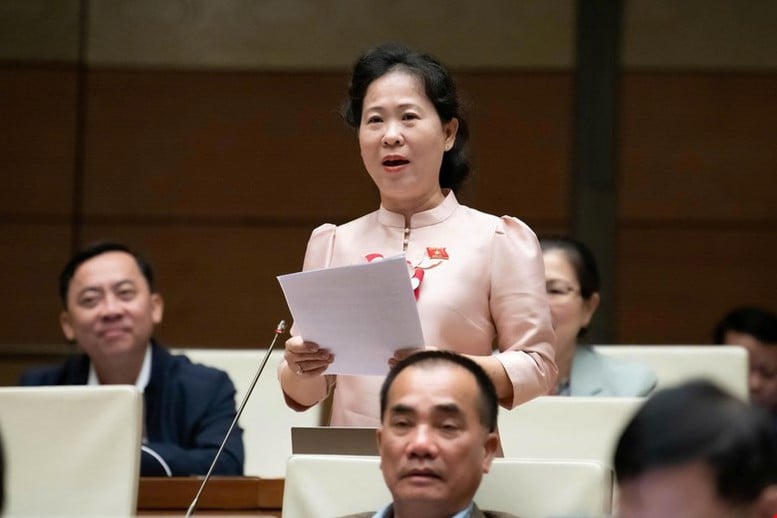
National Assembly Delegate To Ai Vang (Can Tho City) gave his opinion during the discussion.
Delegate To Ai Vang (Can Tho City) mentioned the issue of men's health - a group whose life expectancy and healthy life expectancy are 5 to 7 years lower than women's according to domestic and international data. Some studies by WHO and the United Nations show that this gap tends to increase.
Delegate To Ai Vang pointed out two main causes: biological factors such as the gradual loss of the Y chromosome in men as they age, which can increase the risk of heart failure; behavioral factors - men often smoke, drink more alcohol, eat less healthily, exercise less, are indifferent to health care and tend to suppress their emotions, leading to a decline in physical and mental health.
Delegates proposed adding criteria for specialized men's health care to help solve specific health challenges, improve disease prevention and quality of life for men. Currently, in some specific countries such as Australia and the UK, strategies specifically for men on targeted intervention programs have been issued to help access and change the behavior of society in general and men in particular.
Thu Giang
Source: https://baochinhphu.vn/quoc-hoi-ban-ve-chuong-trinh-mtqg-cham-soc-suc-khoe-giai-doan-moi-dat-phong-benh-len-truoc-10225120213505677.htm
![[Photo] Worshiping the Tuyet Son statue - a nearly 400-year-old treasure at Keo Pagoda](/_next/image?url=https%3A%2F%2Fvphoto.vietnam.vn%2Fthumb%2F1200x675%2Fvietnam%2Fresource%2FIMAGE%2F2025%2F12%2F02%2F1764679323086_ndo_br_tempimageomw0hi-4884-jpg.webp&w=3840&q=75)


![[Photo] Parade to celebrate the 50th anniversary of Laos' National Day](/_next/image?url=https%3A%2F%2Fvphoto.vietnam.vn%2Fthumb%2F1200x675%2Fvietnam%2Fresource%2FIMAGE%2F2025%2F12%2F02%2F1764691918289_ndo_br_0-jpg.webp&w=3840&q=75)













































































Comment (0)