

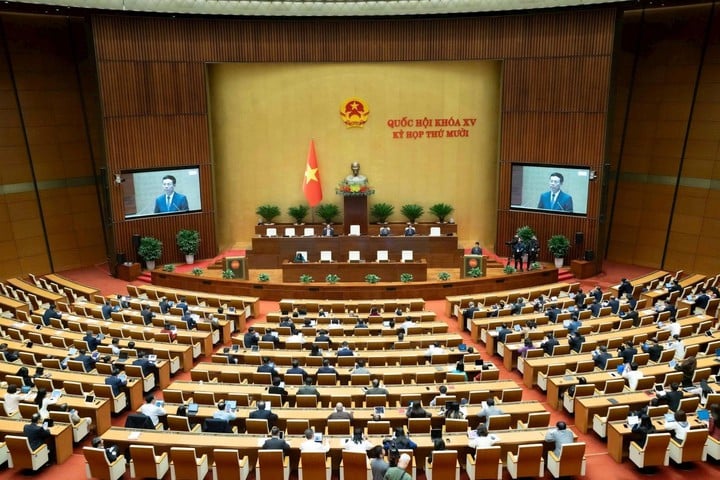
These are draft laws that have been carefully prepared, undergone many rounds of review, acceptance, and revision based on the opinions of experts, scientists , businesses, ministries, branches, and localities.
The simultaneous consideration and approval of five draft laws is not only a regular activity of the National Assembly in legislative work, but also shows a step towards perfecting the overall institution for digital space, high technology and intellectual property, creating a long-term legal framework for growth based on science, technology and innovation.
The Law on Artificial Intelligence sets out for the first time a relatively comprehensive legal framework for the development, application and governance of artificial intelligence (AI).
The bill clearly defines the basic principles in managing and using AI: Putting people at the center; ensuring safety, security, and privacy; enhancing accountability of organizations and individuals deploying AI systems; requiring transparency in the process of training, testing, and operating models, especially large-scale AI models.
An important content of the law is the management orientation according to the level of risk. Accordingly, AI systems are classified according to the level of impact and risk, thereby associated with corresponding legal obligations. Applications with high risks to the rights and legitimate interests of organizations and individuals (in the fields of finance, health, justice, labor, education, etc.) will have to meet stricter standards on data, inspection, supervision and human intervention mechanisms. This approach allows for a balance between two goals: Encouraging innovation in AI and controlling potential consequences for society. At the same time, the bill also initially addresses new issues such as AI-generated content, algorithmic ethics, and the responsibility of platforms when providing cross-border AI services, laying the foundation for Vietnam to proactively integrate with international standards while still maintaining digital sovereignty and national interests.
The Law on Digital Transformation plays the role of "institutional infrastructure pillar" for the entire national digital transformation process.
The bill establishes for the first time legal standards on open data, digital identity, digital transactions, comprehensive online public services and information system security in the digital environment.
Regarding data, the bill more clearly defines the concept and scope of open data, the responsibilities of state agencies in sharing data to promote transparency, social supervision and the formation of a healthy data market.
Regarding digital identity, the bill aims to build a unified, reliable identity platform to serve authentication in all electronic transactions, from administrative procedures, finance - banking to e-commerce and other digital services.
The Law on Digital Transformation also clarifies the requirement for full-process online public services, meaning that people and businesses can carry out the entire procedural process in the digital environment, without having to repeatedly submit information and documents already in the state database.
Along with that is a system of regulations on network safety and security, personal data protection, and prevention of acts of taking advantage of digital platforms to violate the law, disrupt the market, or infringe upon the rights and legitimate interests of organizations and individuals.
In the high-tech industry sector, the Law on High Technology (amended) is expected to create new momentum for the development of core industries such as chips, semiconductors, new materials, biotechnology, and smart automation.
After nearly two decades of implementation, many provisions of the 2008 Law on High Technology, such as incentives, technology categories, and high-tech park models, have revealed limitations in the face of rapid technological development and global competition. The draft law aims to adjust, update, and expand the scope of “high technology” to suit the new context; at the same time, simplify some procedures, and link incentives to criteria of efficiency, innovation, and the ability to spread technology.
Mechanisms to encourage the formation of innovation centers, technology incubators, and high-tech zones integrating research, production, and services are emphasized, thereby creating a favorable ecosystem for domestic technology enterprises to develop, attracting high-quality FDI projects, associated with knowledge and capacity transfer.
A notable point is that the bill strengthens the connection between research institutes, universities and high-tech enterprises, considering this as the “triangle” at the heart of the innovation ecosystem. Incentive and support mechanisms are designed to encourage enterprises to invest in R&D, place research orders and test new technologies right in Vietnam.
Closely related to high technology is the issue of technology transfer and absorption. The Law on Technology Transfer (amended and supplemented a number of articles) focuses on resolving long-standing problems in commercializing research results and transferring technology between domestic and foreign entities.
The draft law is adjusted in the direction of strongly shifting from the mindset of “control” to “promoting innovation”, creating a more favorable environment for technology transactions. Regulations on technology valuation, capital contribution in technology, sharing of benefits from technology exploitation, and risk sharing in research and development cooperation are clarified, aiming to turn technology into an asset that can be valued and traded transparently in the market.
In addition, the revised law also emphasizes the criteria of green technology, clean technology, and energy-saving technology, in line with Vietnam's commitment to net zero emissions, thereby prioritizing the attraction and transfer of environmentally friendly, low-emission technologies, and improving growth quality.
At the "output" of innovation, the Law amending and supplementing a number of articles of the Law on Intellectual Property plays a key role in turning knowledge and research results into assets and development resources.
In the context of intellectual property increasingly accounting for a large proportion of enterprise value and international competition, the requirement is that the legal framework must keep up with the realities of the digital economy, big data and AI technology. This amendment to the Intellectual Property Law aims to: Continue to harmonize domestic regulations with international commitments; clarify the scope and protection regime of some subjects of rights; improve the transparency and feasibility of the mechanism for establishing, exploiting and enforcing rights.
In particular, the contents related to copyright protection, related rights in the digital environment; protection of trademarks, inventions, industrial designs; handling of infringements of rights in cyberspace and in the AI environment are focused on, in order to ensure that creators, scientists, and businesses benefit appropriately from their intellectual achievements. Thanks to that, the connection between the Intellectual Property Law, the Technology Transfer Law and the High Technology Law is strengthened, creating a closed policy chain from research - development, rights protection, transfer - commercialization to expanding production and business based on intellectual property.
The fact that the National Assembly is expected to simultaneously vote on these five draft laws shows a very high political determination in being one step ahead in terms of institutions, creating a "legal runway" for the process of transforming the growth model, improving productivity, quality and competitiveness of the economy in the coming period.
Previously, at the 9th Session, 15th Term, the National Assembly passed: Law on Science, Technology and Innovation; Law on Digital Technology Industry; Law on Product and Goods Quality (amended); Law on Vietnam Technical Standards and Regulations (amended); and Law on Atomic Energy (amended), creating a new legal framework to promote innovation, develop the digital economy and master strategic technology. The continuous improvement of the legal system in these pillars shows the determination of the National Assembly and the Government in creating a synchronous and advanced institutional environment, as a foundation for science, technology, innovation and digital transformation to truly become the main driving force of socio-economic growth in the coming period.
Source: https://mst.gov.vn/quoc-hoi-du-kien-thong-qua-5-luat-lon-hoan-thien-khung-the-che-cho-linh-vuc-khcn-dmstcds-19725120909343488.htm





![[Photo] Urgently help people soon have a place to live and stabilize their lives](/_next/image?url=https%3A%2F%2Fvphoto.vietnam.vn%2Fthumb%2F1200x675%2Fvietnam%2Fresource%2FIMAGE%2F2025%2F12%2F09%2F1765248230297_c-jpg.webp&w=3840&q=75)

































































![[Photo] General Secretary To Lam works with the Standing Committees of the 14th Party Congress Subcommittees](https://vphoto.vietnam.vn/thumb/402x226/vietnam/resource/IMAGE/2025/12/09/1765265023554_image.jpeg)




























Comment (0)