

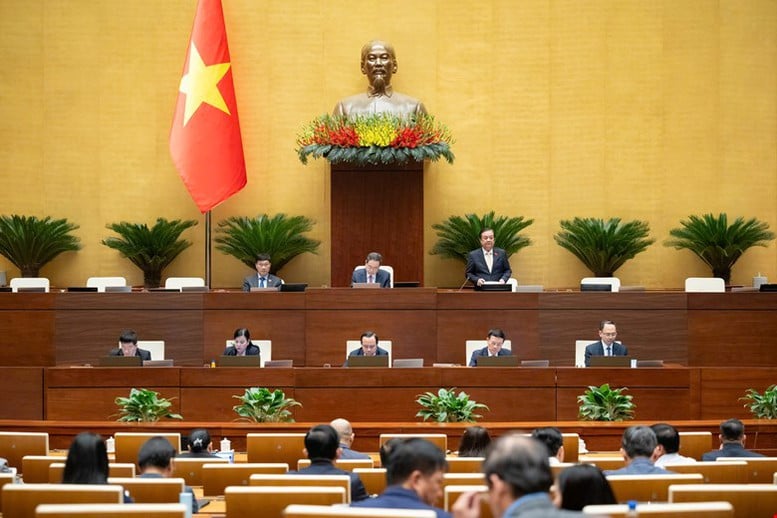
The National Assembly discussed in the hall the draft Law on Digital Transformation.
Participating in the discussion, National Assembly deputies emphasized the need to promulgate the Law on Digital Transformation, a law project of national strategic significance, creating an institutional foundation for the development of digital government, digital economy and digital society.
Commenting on the draft law, delegate Nguyen Tam Hung (HCMC) said that in the direction of developing artificial intelligence technology in the State's policy on digital transformation, the draft law identifies artificial intelligence as a core element to ensure national sovereignty in cyberspace. However, there are no principles of technology governance to minimize ethical risks, algorithmic data bias and impacts on human rights.
Therefore, the delegates suggested that the Drafting Committee consider and supplement principled regulations on responsible, transparent technology governance and AI risk control to create a foundation for future decrees and technical standards, thereby ensuring rapid development without sacrificing ethical safety, privacy and human rights.
Regarding the full online public service, delegate Nguyen Tam Hung noted that the draft law stipulates that state agencies are not allowed to request people to submit documents that are already in the national database, but does not specify legal responsibility when the data system has errors or is not connected, causing delays in processing procedures for people and businesses.
Therefore, Mr. Hung proposed to consider and supplement a clear handling mechanism including regulations on accountability, responsibility for compensation for damages and the obligation to publicly disclose technical causes when the application is delayed or rejected not due to the people's fault.
"This is the key point for digital transformation to go into substance, people truly become the center in the country's digital transformation process," said delegate Hung.
Regarding the State's policy on data economic development, delegate Hung proposed to add regulations: Identify public data as national assets and promote the opening and sharing of data that are not on the list of state secrets, personal data or data that is required to be kept confidential by law, promulgate mechanisms, roadmaps and technical standards for state agencies to systematically publish open data and easily reuse it.
According to the delegate, data held by state agencies is the largest and most valuable data source for the country's socio-economic development. The State's proactive opening of high-quality data will create seeds to stimulate innovation and create a data-based service market with an open data policy, associated with transparency, helping people and businesses to monitor effectively.

National Assembly Delegate Tran Thi Thu Phuoc (Quang Ngai) gave her opinion during the discussion.
Boldly institutionalize specific financial mechanisms
Delegate Tran Thi Thu Phuoc (Quang Ngai Delegation) acknowledged positive changes in the thinking of law-making, such as boldly institutionalizing specific financial mechanisms, shifting from ownership investment to service rental model, budget management focusing on controlling the quality of results instead of input factors, and allowing flexible payment when renting digital transformation services.
The draft is also flexible in testing new business models, referring to laws on science, technology and digital industry. Digital infrastructure is identified as national strategic infrastructure, including telecommunications, data centers, cloud computing, IoT and AI Data Centers, creating a legal corridor to attract investment.
In addition, Ms. Phuoc noted two points that need to be added. First, the draft lacks regulations on social security and support for the workforce that has lost their jobs due to digital transformation, AI and automation.
Therefore, the delegates suggested that the Drafting Committee study and add a provision on policies to support career transition and social security for workers adversely affected by the digital transformation process. This clearly demonstrates the spirit of not leaving anyone behind and anticipating social risks when applying large-scale automation technology.
Second, the current mechanism for evaluating the effectiveness of digital transformation is mainly based on reports from state agencies, lacking the participation of independent units and consulting people and businesses, leading to difficulties in overcoming the situation of "performance reporting".
Delegates proposed to add a mechanism to use independent assessment results from professional social organizations or prestigious international organizations. Measurement results combined with people and business satisfaction index should be considered one of the important bases for ranking, rewarding and deciding to supplement public investment budget in digital transformation, instead of relying only on administrative reports of agencies and units.
Thu Giang
Source: https://baochinhphu.vn/quoc-hoi-thao-luan-luat-chuyen-doi-so-nguoi-dan-va-doanh-nghiep-lam-trung-tam-102251201181112826.htm

![[Photo] Worshiping the Tuyet Son statue - a nearly 400-year-old treasure at Keo Pagoda](/_next/image?url=https%3A%2F%2Fvphoto.vietnam.vn%2Fthumb%2F1200x675%2Fvietnam%2Fresource%2FIMAGE%2F2025%2F12%2F02%2F1764679323086_ndo_br_tempimageomw0hi-4884-jpg.webp&w=3840&q=75)
![[Photo] Parade to celebrate the 50th anniversary of Laos' National Day](/_next/image?url=https%3A%2F%2Fvphoto.vietnam.vn%2Fthumb%2F1200x675%2Fvietnam%2Fresource%2FIMAGE%2F2025%2F12%2F02%2F1764691918289_ndo_br_0-jpg.webp&w=3840&q=75)

































































































Comment (0)