

After more than three years of implementation, Resolution 19 is assessed to have created positive changes in ensuring food security, stabilizing the macro- economy and improving the living standards of rural areas. Many commodity production models have been expanded, processing capacity has been improved, and the rate of communes meeting new rural standards has increased rapidly.
However, agricultural growth is generally unsustainable, productivity and quality of some products are low, application of science and technology is not deep, farmers' income is exposed to many risks from natural disasters and market fluctuations. Some rural environmental issues are slow to be resolved, and in some places, pollution levels are even increasing.
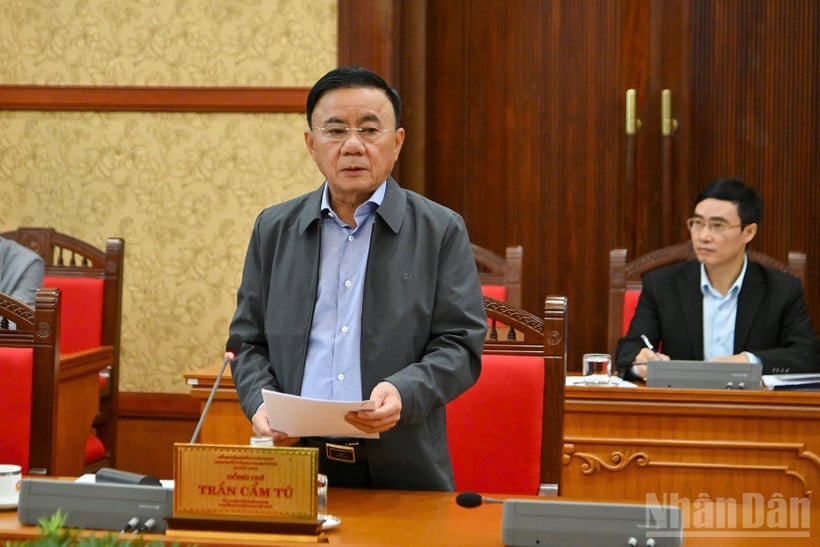
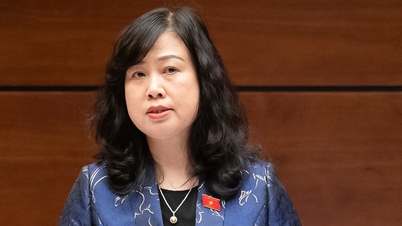
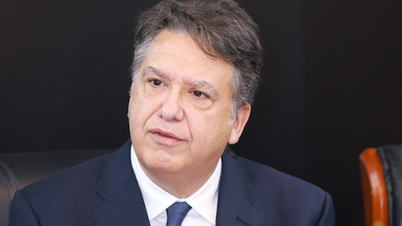
Comrade Tran Cam Tu, Politburo member, Standing member of the Secretariat. Photo: Thuy Nguyen.
In the context of volatile global markets, climate change pressures and rapidly changing technology, the Politburo requires the political system to continue to thoroughly grasp and focus on a series of key tasks.
The conclusion affirms that agriculture, farmers and rural areas continue to play a long-term strategic role. Farmers, including fishermen and salt farmers, are identified as the center and driving force of the innovation process. The restructuring process of the industry must strongly shift to a mindset of large-scale commodity production, based on green, organic, circular and low-emission agriculture; prioritize the application of high technology, digital transformation and optimize regional advantages. Agriculture must ensure food security in all situations, closely linked to urban development and a two-tier local government model.
In 2026, the legal system related to the agricultural and rural sector must be reviewed and institutionalized synchronously, creating a framework to encourage businesses and people to invest in green agriculture, circular economy and strategic areas. The Politburo requested to study the mechanism to promote "agricultural exports", increase market access capacity and added value for Vietnamese agricultural products.
The conclusion highlighted the need to prioritize resources for production models based on science and technology, innovation and climate change adaptation, from production, processing to logistics and trade. This is considered a key driving force for rapid and sustainable agricultural development.
One of the major orientations is to build a multi-sectoral cooperation mechanism and product chain. The agricultural sector must restructure crops and livestock according to market demand; develop a multi-value agricultural economic ecosystem, including processing, services, tourism and low-carbon economy. Planning and protecting high-yield rice land, developing strategic product brands and applying processing and logistics technology in depth are required to be implemented synchronously.
Production is oriented towards specialization and professionalism, with close links between six entities in the value chain. Enterprises, cooperatives and farmers must be connected with the system of schools and research institutes for scientific and technological cooperation; at the same time, enhancing the exploitation of intellectual property rights in agriculture. By 2030, Vietnam aims to have a number of agricultural enterprises leading the region and participating deeply in the global value chain.
In parallel, solutions on data and resource management are required to be promoted, including building databases on land, water resources, forests, biodiversity, meteorology and hydrology. The fisheries sector must develop in a sustainable direction, linking resource control with protecting sovereignty over seas and islands, promoting high-tech marine aquaculture and forming offshore fishing fleets.
The conclusion also requires flexible adjustment of trade policies according to market fluctuations; strengthening the domestic market; upgrading agricultural standards and regulations towards international standards, and taking advantage of free trade agreements to expand exports.
For farmers, the key task is to support training, technology transfer and digital skills to form a mindset of large-scale and professional commodity production. Green credit policies, agricultural insurance, and rural start-ups must be implemented more effectively, especially in remote and ethnic minority areas.
An important focus is to build a new, modern, rich and beautiful countryside with a connection between urban and rural spaces. The new planning needs to open up more space for development, protect the ecological environment and preserve cultural identity. Narrowing regional disparities and increasing access to basic services for rural people are the overarching goals.
The Politburo also requested increased investment in agricultural and rural infrastructure, especially irrigation, disaster prevention and environmental infrastructure. In the 2021-2030 period, the budget for this sector must be at least doubled compared to the 2011-2020 period. National target programs need to be reviewed to avoid overlap and serve rural communities more effectively.
Another focus is to harmonize economic development and environmental protection. Localities must increase garbage collection and treatment, address river and stream pollution; restore mangrove ecosystems; and improve disaster forecasting and warning capacity to minimize damage.
To organize the implementation, the Politburo assigned specific tasks to the National Assembly Party Committee, the Government Party Committee, the Central Propaganda Department, the Fatherland Front and mass organizations. Provincial and municipal Party Committees must develop implementation plans, and regularly inspect, monitor and report results.
Source: https://nongnghiepmoitruong.vn/quyet-liet-thuc-hien-nghi-quyet-19-ve-nong-nghiep-nong-dan-nong-thon-d787697.html


![[Photo] National Assembly Chairman Tran Thanh Man receives First Vice Chairman of the Federation Council of the Federal Assembly of the Russian Federation](/_next/image?url=https%3A%2F%2Fvphoto.vietnam.vn%2Fthumb%2F1200x675%2Fvietnam%2Fresource%2FIMAGE%2F2025%2F12%2F02%2F1764648408509_ndo_br_bnd-8452-jpg.webp&w=3840&q=75)







































![[Photo] General Secretary To Lam and his wife attend the 50th Anniversary of Laos National Day](https://vphoto.vietnam.vn/thumb/402x226/vietnam/resource/IMAGE/2025/12/02/1764644139308_1.jpeg)


















Comment (0)