

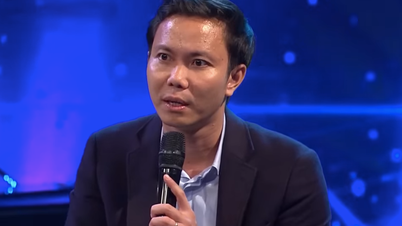
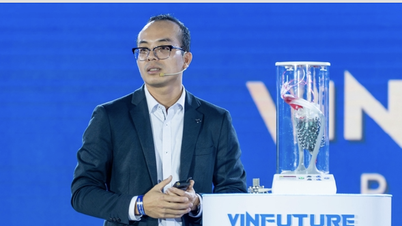
At the "Inspirational Speech: Breakthrough Technology of the Future" - the opening event of VinFuture 2025 Science and Technology Week, Professor Ho-Young Kim (Seoul National University) introduced the new generation of robot research based on "spontaneous physical intelligence".
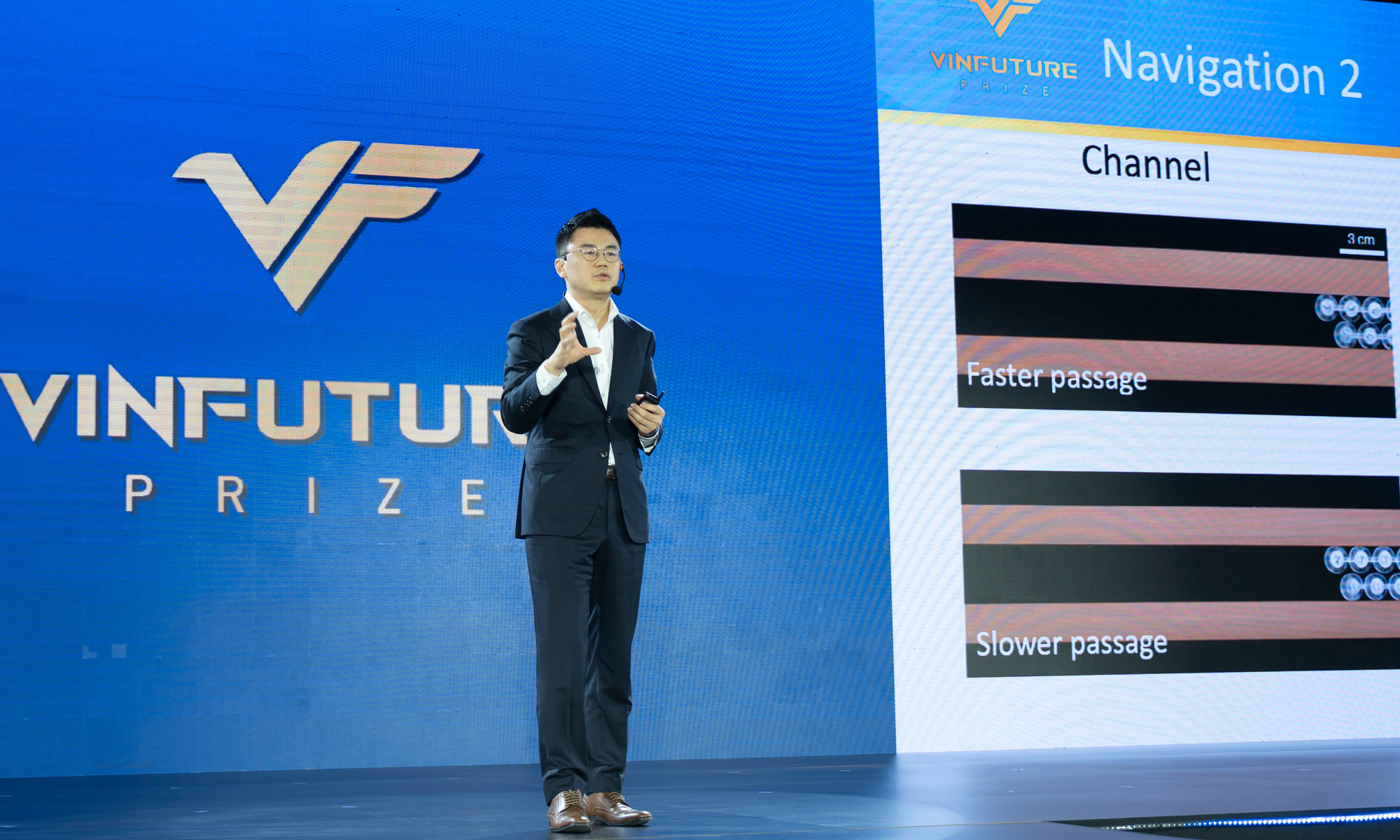
Professor Ho-Young Kim introduces a new generation robot model based on "spontaneous physical intelligence".
As a child, Ho-Young Kim loved looking at the plants in her garden, observing ants and being curious about the rhythm and intelligence of nature.
" These natural events intrigued me and inspired me to become an engineer who researches physical intelligence. Traditional robots consume a lot of energy and materials, while nature has simple but effective intelligence such as birds flying without traffic lights, tree roots finding nutrients without maps... ", said Professor Ho-Young Kim.
According to Professor Kim, future robots do not need massive data stores or complex algorithms to act intelligently. They just need to be designed properly to physically interact with the environment.
Building on the principle that ants can build bridges and rafts through coordinated interactions between individuals, Kim developed Linkbot – a small, finger-sized robot that moves by vibration and has a structure that allows them to link together in chains. When operating alone, they move randomly, but when connected, the collective structure of Linkbots creates a clear and purposeful direction of movement.
" Each robot is like an ant, many robots will have collective intelligence. Just by changing the 'connection angle' between robots, the system can show many different behaviors: blocking gaps, passing through gaps, moving quickly in narrow channels, following the edge of walls or wrapping around objects to pull and push in different directions ," Professor Ho-Young Kim analyzed.
According to the expert, Linkbot's behavior formation mechanism is entirely based on physical interaction, without the need to program a separate route for each robot.
Besides simulating insects, Professor Kim's research also recreates the physical intelligence of plants - creatures without muscles but still have precise growth orientation.
" Many plants create 'tip growth' structures, which only grow at the soft tip of the cell, while the lower part of the stem is rigid. This mechanism helps the plant's roots or pollen tubes to pass through dense environments without breaking, and also redirect themselves when they come into contact with obstacles. From there, we created a robotic material with a core that solidifies when it encounters water, creating a rigid stem but keeping the tip soft to continue growing ," said Mr. Kim.
According to Mr. Kim, this type of robot can "grow" like plant cells, and can get into small gaps that traditional robots can easily get stuck in.
Professor Ho-Young Kim believes that with the recent landslides that have occurred in Vietnam, or earthquakes... this type of robot can be completely applied for rescue and relief work.
" Thanks to its small size and ability to move through small gaps... in many different directions, the robot will provide maximum support to the rescue team. This research has been published, scientists can refer to it ," said Mr. Kim.
Sharing more about future research directions, Professor Ho-Young Kim said that the combination of sciences is the key and Artificial Intelligence (AI), specifically Deep Learning, is the next focus.
" My research is a combination of many different scientific fields, from biology to materials science. What I hope to combine in the future is the field of artificial intelligence ," said Professor Kim.
He admitted that the behavior of swarm robots is difficult to control clearly, often "learning from the robots next to them to be able to move", so AI will play a role in decoding individual behavior.
" AI will help find out the rules that each individual robot navigates. We can connect each activity of individual robots, use that data to analyze for Deep learning ," added Professor Ho-Young Kim.
Source: https://vtcnews.vn/robot-the-he-moi-di-chuyen-nhu-dan-kien-co-the-tham-gia-cuu-ho-thien-tai-ar990637.html
![[Photo] Worshiping the Tuyet Son statue - a nearly 400-year-old treasure at Keo Pagoda](/_next/image?url=https%3A%2F%2Fvphoto.vietnam.vn%2Fthumb%2F1200x675%2Fvietnam%2Fresource%2FIMAGE%2F2025%2F12%2F02%2F1764679323086_ndo_br_tempimageomw0hi-4884-jpg.webp&w=3840&q=75)

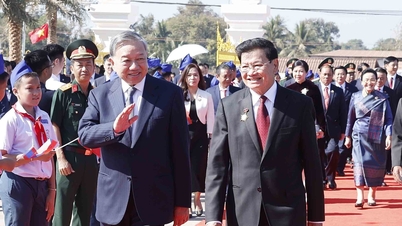
![[Photo] Parade to celebrate the 50th anniversary of Laos' National Day](/_next/image?url=https%3A%2F%2Fvphoto.vietnam.vn%2Fthumb%2F1200x675%2Fvietnam%2Fresource%2FIMAGE%2F2025%2F12%2F02%2F1764691918289_ndo_br_0-jpg.webp&w=3840&q=75)
































































Comment (0)