


The unique ecosystem in U Minh Thuong National Park. Photo: PHAM HIEU
Memories of the Forest Fire
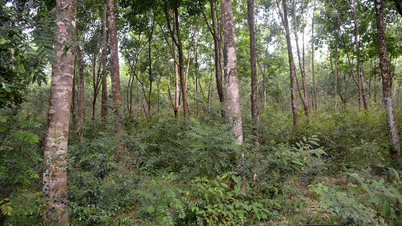
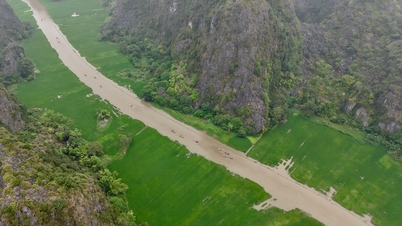
One day in early April, we visited U Minh Thuong National Park, where 24 years ago a historic fire completely destroyed approximately 2,200 hectares of forest. Along the straight concrete road from the entrance deep into the forest, tall melaleuca trees, about 10 meters high and 15-20 cm in circumference, stood tall and lush green, stretching as far as the eye could see. It was hard to imagine that this place had once been desolate for so many years.
Pointing to the vast melaleuca forest, Mr. Nguyen Van Co, Deputy Head of the Forest Management, Protection and Development Department of U Minh Thuong National Park, said that the entire area, stretching across the canal, was within the historical fire zone of 2002. “After the fire was extinguished, only a long stretch of black remained. Uncle Muoi Dodm (Labor Hero Banh Van Dodm - former Director of U Minh Thuong National Park) wept for days because, for him, the U Minh Thuong forest was a part of his very being,” Mr. Co said.
At 97 years old, with his hair completely gray, Mr. Mười Đởm is still sharp-minded, his eyes bright, and his voice full of the distinctive U Minh region. When he talks about the forest fire of yesteryear, his eyes droop, and his voice slows down, as if drawing in a whole realm of sad memories.
Mr. Mười Đởm recounted that in January 2002, the U Minh Thượng Nature Reserve was upgraded to a national park. Just over two months later, at noon on March 24, 2002, in sub-area 138, the area's management discovered a small fire and mobilized members to extinguish it. By about 2 a.m. the next day, the fire was basically put out. However, near noon, the fire suddenly flared up fiercely. Despite all efforts to contain the fire, for nearly 20 days and nights, the blaze spread throughout the forest before being completely extinguished. “At that time, about 4,000 people participated in firefighting day and night, but the fire wouldn't go out, and the smoke filled the sky. Trees were burned to the ground, leaving behind a desolate, gray, black landscape,” Mr. Mười Đởm recalled.
Regarding the reasons for the prolonged fire, Mr. Mười Đởm explained that it was the dry season, coupled with a thick layer of vegetation and peat, so when a fire occurred, the flames smoldered for a long time.

Forest rangers regularly patrol the forest to ensure its safety. Photo: PHAM HIEU
The historic forest fire of 2002 is considered one of the most serious environmental disasters in the wetlands of the Southwestern Mekong Delta. After the fire, thousands of hectares of melaleuca forest were damaged, and the ecosystem was particularly severely affected. At that time, Mr. Mười Đởm repeatedly asked, "I am old now; will I live long enough to see the U Minh Thượng forest revived?"
The color blue is back.
After the U Minh Thuong forest fire, vast areas of the melaleuca forest were left with only charred tree trunks, cracked and dry soil, and the lingering smell of smoke in the wind. Many thought it would take decades, or even be impossible, for the area to recover. However, nature and the people of U Minh Thuong have written a different story – a miraculous journey of rebirth.

The area of mangrove forest that burned in 2002 has now regenerated and is thriving. Photo: PHAM HIEU
Mr. Mười Đởm said that after the fire, he and his colleagues immediately set about protecting the forest and replanting it. However, the peat layer was severely damaged, and the ecosystem was almost completely destroyed, making reforestation a difficult task. One of the boldest initiatives at the time was to use a machine to plow the reeds into large plots for sowing melaleuca seeds. “The days after sowing the melaleuca seeds were the longest, because no one could be sure if the seeds would germinate on the burnt soil or if nature would accept human intervention. So, every morning, we would go to the forest, walking through each reed plot, hoping the melaleuca would sprout. Heaven did not disappoint us. Tiny green dots began to emerge. I was so happy I wanted to cry, exclaiming: 'The forest is not dead! The forest is still alive!'" Mr. Mười Đởm recalled.
Alongside the work of restoring and protecting the forest, at that time, Mr. Mười Đởm embarked on the task of redesigning the forest. For many years, he trekked through the forest and waded through swamps to inspect, measure, and sketch a map of the U Minh Thượng forest with two layers: a core area of over 8,000 hectares and a buffer zone of approximately 13,000 hectares as it is today. Opening the map, Mr. Mười Đởm pointed and explained that the U Minh Thượng National Park area is shaped like a quadrilateral because he wanted to preserve most of the area with peat layers. Because peat is not only a very valuable natural resource but also a characteristic feature of the U Minh Thượng melaleuca forest; losing the peat layer would mean losing the forest…
Not only has the U Minh Thuong forest been restored to an area of up to 2,000 hectares, but it has also formed a unique ecosystem attracting birds, egrets, bats, and many rare species to return and thrive. Among them, there are up to 57 endangered and rare animal and plant species living there… “U Minh Thuong National Park also takes advantage of its strengths, potential, and stunning landscape to effectively develop ecotourism and environmental education for locals, students, and visitors,” Mr. Co said.
As evening falls, the sunlight bathes the entire melaleuca forest in golden light. The calls of birds echo, mingling with the rustling of the wind, creating a gentle symphony in the U Minh Thuong forest. In the distance, the figures of forest rangers can be seen inspecting each patch of melaleuca forest to maintain peace and order.
PHAM HIEU
Source: https://baoangiang.com.vn/rung-tram-hoi-sinh-a481867.html




































































































Comment (0)