

During this period, the French also issued a decree establishing several primary schools in the provinces to teach the Vietnamese language and mathematics.
In the book "Gò Công: Old Scenes and People of the Past" (published in 1969 in Southern Vietnam), Mr. Viet Cuc stated that from the 1870s, the authorities ordered teachers of classical Chinese to learn the Vietnamese Quốc ngữ script and Western script. They had to discard their brushes and replace them with iron pens, learning to pronounce words by tongue twisters: a, b, c, d, đ… a with an accent mark, á, ơ with an accent mark, ớ… Of course, at that time, textbooks were not yet compiled to standardize the curriculum, so village teachers wrote their own textbooks to teach their students.
The pioneers in textbook writing
The book "Modern Vietnamese Education" by Phan Trọng Báu (Education Publishing House - 2006), page 73, states: "Up until the 1880s, Trương Vĩnh Ký and some French people from the Southern Vietnam Education Agency compiled several textbooks for teaching in primary schools." The lessons in Trương Vĩnh Ký's textbooks generally focused on educating children about morality, remembering and being grateful to their parents and teachers, doing good deeds, and living a useful life... For example, the lesson "Encouraging Learning": "Delicious is honey, good fat, gold and splendor / Because of learning, you become wise / Classics, poems, and songs are good things / Literature and words are delicious / The food of your father and the clothes of your mother are as deep as the ocean / The debt to the country and the family is as vast as the land / The two words 'fame and fortune' should be pursued diligently / A righteous person and a filial child will ensure the country's survival."
Besides them, there were also Mr. Truong Minh Ky, Mr. Tran Phong Sac, Mr. Huynh Tinh Cua... In particular, teacher Tran Phong Sac compiled the book Au Vien Tat Doc (1924) for teaching female students: "Female students, do not yield to the aspirations of men, because men and women are the same, perseverance and hard work are better, whatever others can do, you must be able to do too." The book contains Chinese characters, along with transliteration and translation.
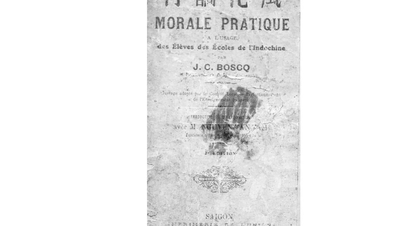
In particular, several other educators compiled and printed textbooks using modern techniques. Here is an example: "Morale pratique à l'usage des Élèves des Écoles de l'Indochine" (Practical Ethics for Teaching Students in Schools in Indochina). Above it is the Chinese phrase "Practical Ethics," measuring 15 x 24 cm, published in 1914 by JCBoscq, a professor of Oriental languages, in collaboration with Nguyen Van Tam, a professor at My Tho High School. The book contains 108 reading exercises, each ending with a concluding sentence: "The book says that" or "It is commonly said that," followed by a Chinese phrase with its transliteration and translation; each lesson concludes with a "Questioning Exercise."
The elementary school textbook, with the inscription on the cover: "New textbooks for use in schools in Indochina - compiled by Henri le Bris, Headmaster of the French-Vietnamese School in Thua Thien. Revised according to the Southern Vietnamese dialect for use in village and district schools." The book, measuring 13 x 21.5 cm and containing 136 pages, was printed in 1916 in Saigon by Imprimerie Commerciale, C.Ardin et Files. It comprises 160 lessons divided into eight sections: The Body and Hygiene; Animals; Plants; Earth, Rocks, and Metals; Sky, Earth, and the Globe; Southern Vietnam and neighboring French territories; Southern Vietnam, Population, and History; and Politics in Southern Vietnam. Each lesson, presented in a concise and easy-to-understand manner, included questions for students; the geography lessons included maps.
The textbook "Morale et lecons de choses a l'usage des élèves des écoles de l' Indochine" (Ethics and Lessons on Morality for Students in Schools in Indochina) by JcBoscq, printed by Imprimerie de l'Union at 157 Catinat Street, Saigon in 1919, is 51 pages thick and teaches filial duties; domestic animals, the earth, the human body, clocks, the sea... The writing style is concise and easy to understand, with beautiful illustrations taken from French textbooks.
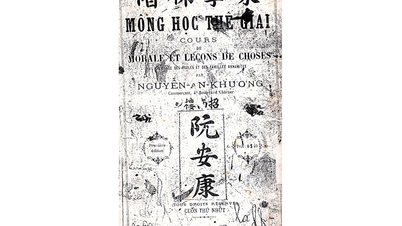
The scholar Nguyen An Khuong, father of the revolutionary Nguyen An Ninh, also compiled the textbook "Mongolian Moral Education and Family Lessons," with the cover bearing the inscription "Cours de morale et lecons de choses à l'usage des écoles et des familles Annamites" (Moral lectures and general knowledge lessons for use in Annamite schools and families), printed by Phat Toan, Libraire - Imprimeur, 55 - 57 - 59 Ormay Street, Saigon, in October 1910.
Learn both practical skills and technical skills.
Besides learning about ethics, students also acquired very new subjects from the French education system: mathematics and practical engineering. For example, the textbook "Practical Electrical Engineering" by Alexis Lân, compiled by Ingénieur Electricien and printed by Imprimerie FH Schneider in Saigon in 1917, stated: "This book teaches essential knowledge for Annamese electricians and students of vocational schools." Printed in both French and Vietnamese, the book provided relatively comprehensive knowledge of electricity that students needed to know. Due to a lack of vocabulary, most of the terminology was in French.
Although the Vietnamese Quốc ngữ script "prevailed," the need to learn Confucianism (Nho script) still existed. This is reflected in Southern folk songs: "Saigon's lamps have green and red lights / My Tho's lamps have bright and dim lights / You should go and learn Confucianism / I will wait for you for nine moons, I will wait for you for ten autumns." According to the General Regulations on Education in Indochina, signed by the Governor-General of Indochina, Albert Sarraut, on December 21, 1917, Confucianism was not a compulsory subject. Schools wishing to teach it had to obtain the agreement of the parents, the village council, and the headmaster. Teachers were only allowed to teach one and a half hours a week, scheduled for Thursday mornings.
On June 14, 1919, the Nguyen dynasty issued a decree declaring the complete abolition of all schools teaching Chinese characters and replacing them with a Franco-Vietnamese education system. At that point, the French colonial "reform" truly completed its mission – albeit only in official and legal terms.
Textbooks in Saigon laid the foundation for the national language textbook. Around the 1920s, the Indochina Education Department commissioned teachers Tran Trong Kim, Nguyen Van Ngoc, Dang Dinh Phuc, and Do Than to compile the National Literature Textbook, intended for elementary, preparatory, and kindergarten classes; and teachers Nguyen Hiet Chi and Le Thuoc to compile the New Chinese Literature Textbook, intended for kindergarten, intermediate, and advanced classes, for official use in Vietnamese schools throughout the first half of the 20th century. Regarding textbooks, this event is recorded as: "At this point, it was completed and put into unified teaching throughout the country" (Modern Vietnamese Education - Phan Trong Bau - Education Publishing House - 2006, p. 166). When compiling the textbooks, these educators followed the style of the textbooks already popular in Southern Vietnam. This means that the reading exercises for students were written concisely and clearly, and the stories in the book occasionally featured dialogue between characters to highlight the educational message. And it's undeniable that such stories profoundly influenced many generations of students. The fact that many people, now gray-haired, still remember the lessons in the National Literature textbook is a testament to this. |
Source: https://thanhnien.vn/sach-giao-khoa-100-nam-truoc-185711904.htm












































































Comment (0)