


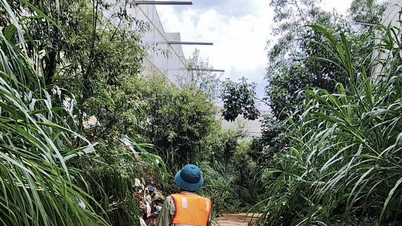
Residents of Tan An commune hope the government will continue to provide support so that they can feel secure. Photo: MINH HIEN
Risk of spreading
The entire province has 20 landslide-prone areas requiring remediation, with a total length of over 27km and an estimated cost of approximately 4,485 billion VND. According to the Department of Agriculture and Environment, among the 56 landslide-prone sections with a total length of 181,450m, there are 12 sections (49,100m) on the Tien River, 29 sections (84,050m) on the Hau River, and 4 sections (14,400m) on the Tan An Canal. Thus, landslides have formed long strips of risk along the main river system, concentrated in densely populated areas and heavily impacted by the water flow.
Notably, three sections of the Hau River have been warned as dangerous to extremely dangerous: the 6,900m section through Chau Phong commune; the 13,200m section in Phu Hiep, Hoa Lac, and Phu Binh; and the 5,000m section in Binh Duc, Binh Khanh, and My Binh. Although the number of sections has not increased, the length and severity of the danger are trending upwards, indicating that the scale and intensity of erosion are exceeding the capacity to be controlled by individual measures.
The paved road along the Xáng canal leading to Tân Hậu A1 hamlet, Tân An commune, is no longer smooth. Long cracks, in some places splitting into chunks, reveal the hollow soil beneath. Each time a motorbike passes, the road surface vibrates slightly, a warning of the unstable soil foundation. Previously, at around 9:00 AM on April 16th, a landslide occurred here from Mười Quảng road to the intersection near Mr. Tư Xã's house. The landslide section is approximately 800 meters long, affecting 96 households with 374 residents. Immediately after the incident, local authorities arrived promptly to help residents relocate to a safe place. Mr. Nguyễn Thanh Bình, Head of Tân Hậu A1 hamlet, Tân An commune, said: “The local authorities actively encouraged residents to sign commitments to relocate to a safe place to ensure the safety of their lives and property and to stabilize their lives in the long term.”
Mr. Le Huu Toan, Director of the Department of Agriculture and Environment, stated that the erosion stems from multiple causes. Firstly, the soil in the Mekong Delta is inherently weak, making riverbanks susceptible to erosion. Secondly, the river's flow is complex, with many intersecting branches and fluctuating tides creating strong eddies. Furthermore, the dense population along the riverbanks, numerous construction projects, and constant boat traffic increase pressure, leading to erosion. These factors interact, accelerating the rate and extent of erosion.
Comprehensive solution
In recent years, with support from the central government and local resources, the province has invested in the construction of 87.77 km of embankments to protect riverbanks, canals, and streams. However, compared to the increasing length of eroded areas, the investment resources have not kept pace with practical requirements.
Landslides not only cause land loss but also directly threaten people's homes, transportation, and livelihoods, potentially leading to the collapse of entire residential areas if not controlled promptly, as in the case of Tan Hau A1 hamlet, Tan An commune. Given this situation, the issue is no longer about addressing individual points but about controlling a widespread and escalating challenge. This requires a comprehensive, synchronized approach with a long-term vision. Without sufficiently strong and timely solutions, landslides will continue to expand, increasing remediation costs and narrowing development space. “In the short term, localities need to continue proactively responding according to the ‘four on-the-spot’ principle, promptly relocating people from dangerous areas, cordoning off areas, posting warning signs, organizing forces to monitor developments, and mobilizing local materials for temporary reinforcement to limit the spread of landslides,” said Mr. Le Huu Toan.
According to Mr. Toan, the fundamental solution being implemented by the province is to conduct a comprehensive survey and assessment of the current state of landslides in the period 2026-2030, as a basis for identifying causes, zoning risks, and prioritizing investments. Based on this, the province will focus resources on building embankments in particularly dangerous areas, coupled with relocating residents in a safe and sustainable manner. Simultaneously, the province encourages localities to continue promoting non-structural solutions such as: controlling sand mining, managing riverside construction, planting trees to reinforce riverbanks, applying technology in landslide warning and monitoring, and raising community awareness.
In the long term, landslide management needs to be integrated into socio- economic development, transportation, and irrigation planning, ensuring a balance between development and the protection of river ecosystems. This is not just a technical or financial issue, but also a requirement to protect livelihoods, preserve land, and ensure long-term stability for people living along the riverbanks. Only with a holistic, interdisciplinary, and sustainable approach can the landslide problem be effectively controlled.
Source: https://baoangiang.com.vn/sat-lo-lan-rong-de-doa-doi-song-nguoi-dan-a484805.html


































































































Comment (0)