


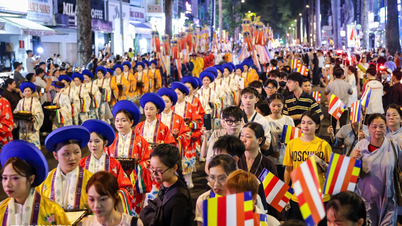
A procession of flags in traditional colors participates in the incense offering ceremony at the Hung Temple historical site.
In the hearts and minds of the Vietnamese people, the Hung Kings are always revered as the ancestors of the nation. Throughout thousands of years of history, the Hung Kings have not only been present in historical records but have also been deeply ingrained in the cultural and religious life of the people.
Every year, on the occasion of the Hung Kings' Commemoration Day on the 10th day of the 3rd lunar month, millions of people from all over the country make a pilgrimage to the Hung Kings' Historical Relic Site to offer incense and commemorate the nation-building contributions of the Hung Kings. According to statistics from the Ministry of Culture, each year this site welcomes approximately 5.5 - 6 million tourists and people who come to pay tribute to their ancestors.
The stream of people respectfully offering incense at the ancestral land not only expresses profound gratitude to their ancestors, but also affirms the enduring vitality of the Hung Kings worship belief in the spiritual life of the Vietnamese people.
Currently, there are nearly 1,500 relics nationwide dedicated to the Hung Kings and figures related to the Hung Dynasty era, with the highest concentration in Phu Tho province . These temples and shrines have become important cultural and spiritual spaces, where people express their faith and reverence for their national origins.
The distinctive features of the worshiping belief
The Hung Kings were deeply rooted in community spirit. Beyond spiritual rituals, this belief system was also intertwined with cultural activities and traditional festivals, contributing to the rich spiritual life of the people.
Tourist Tong Kim Lien from Vinh Phuc ward shared: "As people of the ancestral land, we are always proud and deeply aware of the Hung Kings worship tradition. Every Hung Kings' Commemoration Day, my family goes to offer incense at Hung Temple to remember the nation-building contributions of the Hung Kings and to educate our children about the tradition of 'drinking water, remembering the source.' This is not only a belief but also a bond that connects the community, reminding every Vietnamese person to always look towards their roots."
Mr. Tran The Cong, a tourist from Hung Yen province, shared: "Although we don't live in Phu Tho, every year on Hung Kings' Commemoration Day, my family prepares offerings to bring back and offer incense. For my family, the Hung Kings' worship has become a part of our spiritual life, helping generations in the family to become more connected and to remember their ancestors together. It's also a way to preserve our national cultural identity in modern life."
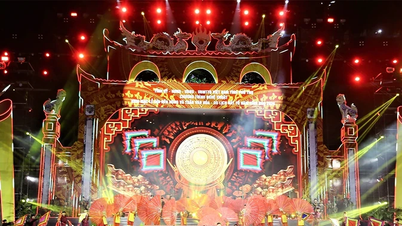
On the occasion of the Hung Kings' Commemoration Day, many localities throughout the country organize activities such as incense offerings, processions, traditional festivals, and folk art performances. Through these events, the spirit of honoring one's roots is strongly spread within the community. In particular, folk cultural forms such as Xoan singing and Gheo singing, associated with the Hung Kings' era, are preserved and promoted in these festivals. These are not only unique artistic values but also a way of transmitting the history and traditions of the nation through generations.
It is the active participation of the community that has helped to sustainably preserve the Hung Kings worship tradition. In each ritual and festival activity, people express their reverence for their ancestors and together cultivate a spirit of unity and community solidarity.
In 2012, the Hung Kings worship belief was inscribed by UNESCO as a representative intangible cultural heritage of humanity. This event affirms the unique value of the belief in the national cultural life, contributing to enhancing Vietnam's cultural standing on the international stage.
In modern society, preserving and promoting traditional cultural values is becoming increasingly important. The Hung Kings worship tradition is not only a spiritual heritage but also a cultural resource that contributes to building a healthy spiritual life in the community.
In recent years, many relics dedicated to King Hung and other figures of the Hung Dynasty have received attention for restoration and preservation. Traditional festivals are organized solemnly, ensuring the preservation of ancient rituals while also being appropriate for modern social life. Alongside this, the work of promoting and educating the younger generation about historical traditions has been emphasized. Through activities such as learning about history and visiting relics, students gain a better understanding of their national origins, thereby enhancing their awareness of preserving traditional cultural identity.
Comrade Pham Tien Dat, Director of the Hung Kings Historical Relic Site, stated: The Hung Kings worship belief has become a cultural identity in the spiritual life of the community. Worshiping the Hung Kings, the ancestors of the nation, is a symbol connecting the past with the present, educating future generations about the tradition of "drinking water, remembering the source," patriotism, and national pride. Preserving and promoting the value of this belief is also a way for us to preserve our national cultural identity in the process of integration and development.
Today, the Hung Kings worship tradition holds a special place in the spiritual life of the Vietnamese people. On each Hung Kings' Commemoration Day, from within Vietnam to the Vietnamese diaspora abroad, people turn their thoughts towards the ancestral land with reverence and pride. The incense offered to the Hung Kings not only expresses gratitude to their ancestors but also reminds each person of their responsibility to preserve and promote the nation's fine traditions. Therefore, the Hung Kings worship tradition is both a cultural heritage and a sacred symbol of the unity and aspiration for sustainable development of the Vietnamese people.
Duong Chung
Source: https://baophutho.vn/soi-day-gan-ket-cong-dong-nguoi-viet-252367.htm





































































Comment (0)