

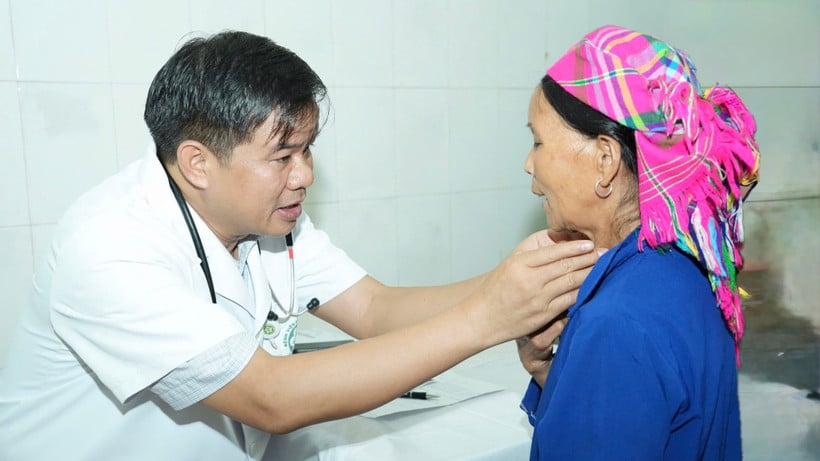
According to the report of the Ministry of Health , Vietnam is highly appreciated by the international community in implementing the United Nations' sustainable development goals on health; Vietnam's essential health service coverage index is higher than the average of countries in the region; many indicators of people's health are superior to many countries with the same level of development. However, the work of protecting, caring for and improving people's health still has limitations, inadequacies, difficulties and challenges.
In order to improve people's health care in the new era, on September 9, 2025, the Politburo issued Resolution No. 72-NQ/TW on a number of breakthrough solutions in protecting, caring for and improving people's health.
The Resolution aims to build a healthy Vietnam, where all people receive health care, live long, healthy, and well, improve their physical fitness, raise awareness of health protection, and proactively prevent diseases throughout society, making an important contribution to promoting the development of a rich, civilized, and prosperous country.
In particular, the Resolution set the goal that "By 2030, people will be exempted from hospital fees at a basic level within the scope of health insurance benefits according to the roadmap". On September 15, 2025, the Government issued Resolution No. 282/NQ-CP, assigning the Ministry of Health to preside over the development of a "Project to gradually implement the hospital fee exemption policy according to the roadmap, priority subjects, in accordance with the increased health insurance contribution level according to regulations".
Although Vietnam's health insurance coverage rate has reached 94.29% of the population; the medical examination and treatment network is widespread down to the commune level; the professional capacity of the specialized, basic and initial levels has been significantly improved; the list of drugs and medical equipment within the scope and benefits of patients with health insurance cards is increasingly expanding... but many challenges must be solved. That is, people's out-of-pocket spending still accounts for more than 40% of the total cost of medical examination and treatment, at a high level according to the recommendations of the World Health Organization; the risk of impoverishment due to illness still exists, especially for the poor, vulnerable groups, people with chronic diseases or long-term treatment. The financial pressure on households will be greater if there is no strong solution from public policy.
Therefore, the policy of gradually moving towards free hospital fees is an objective and urgent requirement, which not only reflects the good nature of Vietnam's social policy system but also ensures the people's right to health care. The free hospital fee policy is not only a financial solution for health care, but also has a humane social meaning, reducing the cost burden for people, especially the poor and vulnerable groups; increasing fairness in access to health services, ensuring "no one is left behind"; promoting the improvement of the health system in a sustainable direction, reducing the risk of people delaying or abandoning treatment due to costs...
According to the Permanent Deputy Minister of Health Vu Manh Ha, from the reality in Vietnam, the policy of free hospital fees must still be based on the pillar of health insurance, with support from the State budget, and at the same time be implemented with a roadmap. The State budget and health insurance fund will cover basic and essential medical expenses, minimizing the financial burden on people - first of all for social policy beneficiaries, the disadvantaged, low-income people and some other priority subjects. For medical services on demand, exceeding the basic level, patients still have to pay a part to raise awareness of using services reasonably and saving costs.
Therefore, the policy of free hospital fees must be closely linked to universal health insurance coverage, everyone participates to share risks, the well-off take care of the poor, the healthy help the weak; along with support from the State budget and socialized resources so that patients do not have to pay extra costs when they are unfortunately sick.

Ms. Vu Thi Hai Yen, Deputy Director of the Finance-Economics Department (Ministry of Finance), the policy of free hospitalisation for all people is a big step forward in humanity and social justice, contributing to the goal of “Health for all” and affirming the good nature of the Vietnamese State – a State of the people, by the people and for the people. However, if it only relies on the State budget, this policy will face difficulties in maintaining long-term and ensuring service quality. Therefore, diversifying resources is a prerequisite to ensure sustainability and fairness in the policy implementation process.
Solutions to mobilize resources to implement the policy of free hospital fees for all people are: Strengthening the mobilization of resources from the state budget, prioritizing budget spending on health care, considering it an investment for people; restructuring public spending, cutting unnecessary spending, increasing spending on social security; decentralizing reasonably between the central and local levels. In addition, promoting the effectiveness of the health insurance fund, expanding health insurance coverage towards 100% of the population, this is the main channel for "free hospital fees" in practice. Combining the state budget and the health insurance fund in paying hospital fees, ensuring long-term financial resources. Piloting and diversifying health insurance packages, supplementary health insurance according to people's needs, linking health insurance with health insurance provided by insurance companies.
Promoting socialization and public-private partnership should also be identified as an important priority direction combined with diverse types of health insurance. Continue to strengthen cooperation with international organizations in accessing capital sources, aid and technical assistance; participate in global health programs, learn from the experiences of developed countries in managing public health funds and operating free-of-hospitalization models... Apply digital technology in health financial management, monitor medical examination and treatment costs, monitor spending and prevent fraud; publicize financial information, create trust for people and businesses when participating in contributions...
Source: https://nhandan.vn/tang-cuong-huy-dong-nguon-luc-de-thuc-hien-chinh-sach-mien-vien-phi-post928654.html




![[Photo] Urgently help people soon have a place to live and stabilize their lives](/_next/image?url=https%3A%2F%2Fvphoto.vietnam.vn%2Fthumb%2F1200x675%2Fvietnam%2Fresource%2FIMAGE%2F2025%2F12%2F09%2F1765248230297_c-jpg.webp&w=3840&q=75)





















































![[Photo] General Secretary To Lam works with the Standing Committees of the 14th Party Congress Subcommittees](https://vphoto.vietnam.vn/thumb/402x226/vietnam/resource/IMAGE/2025/12/09/1765265023554_image.jpeg)

























Comment (0)