


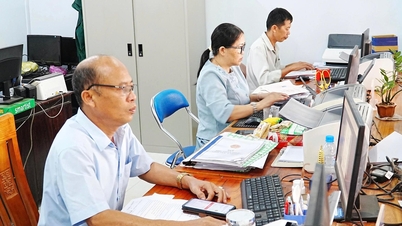
Provincial inspectors work with citizens to verify the assets and income of officials. Photo: NGUYEN HUONG
According to the Government Inspectorate 's 2024 assessment of anti-corruption work, before the merger, Kien Giang achieved 73.76/100 points (ranked 27th out of 63), while An Giang achieved 56.55/100 points (ranked 61st out of 63). These figures highlight the urgent need to improve the effectiveness of state management in anti-corruption in the context of building an honest and constructive administration. Analysis of the index shows that some criteria groups still have low scores, focusing on leadership and direction; preventive measures; detection and handling of corruption; and asset recovery. This is not only a limitation in ranking but also a basis for localities to clearly identify "bottlenecks" that need to be addressed.
The Provincial People's Committee's plan identifies the central objective as raising awareness and responsibility among heads of agencies, units, and localities in leading and directing anti-corruption efforts; and promoting the proactive role of the entire political system in implementing measures to prevent, detect, and handle acts of corruption. Accordingly, the provincial-level anti-corruption assessment is a regular annual task. Heads of departments, agencies, and local governments must adhere closely to the criteria set by the Government Inspectorate, carefully studying each component criterion to organize implementation, and will be held responsible if their actions negatively impact the overall results of the province. Agencies and units are also required to strengthen internal self-inspection, regularly review compliance with anti-corruption laws, and promptly identify loopholes in management to rectify them early and proactively.
One of the key solutions emphasized is the strict implementation of openness and transparency in the operations of state agencies and the non-state sector. Areas requiring full transparency include: administrative procedures; recruitment and appointment of civil servants and public employees; state budget; management of public assets; codes of conduct for officials and those in positions of power; results of digital transformation; and implementation of norms, regulations, and standards. The province requires strict control over conflicts of interest; the rotation of positions for officials and public employees according to regulations; increased declaration and public disclosure of assets and income; and strict handling of violations. The handling of citizen inquiries by heads of agencies is also required to comply with the law, with specific schedules for receiving citizens, and complete records kept, even in cases where no citizen shows up, to ensure evidence for evaluation purposes.
Along with prevention, the province has determined that it is necessary to improve the effectiveness of detecting and handling corruption through inspection, supervision, and the resolution of complaints and feedback from citizens. Functional agencies such as the Provincial Police, the Provincial People's Procuracy, the Provincial People's Court, and the Civil Enforcement Agency are requested to closely coordinate in the investigation, prosecution, and trial of corruption cases; to fully compile statistics on the amount of money and assets misappropriated; and to regularly monitor, urge, and summarize the results of recovery at each stage of the proceedings. The plan emphasizes the requirement to hold heads and deputy heads accountable if corruption occurs within their areas of management; considering this a crucial solution for prevention at its root.
The Provincial People's Committee assigned the Provincial Inspectorate as the focal point to guide, supervise, and inspect the implementation of the plan; and at the same time, advise on the issuance of guiding documents and plans for verifying assets and income, and to compile the results of implementation. Other departments and agencies were also assigned specific tasks such as reviewing legal documents, promoting anti-corruption propaganda; effectively carrying out citizen reception work as one of the important channels for receiving information on corruption, waste, and negative practices; publicly disclosing financial budgets and public assets; monitoring administrative reform, job rotation, and disciplinary action against officials; and effectively implementing digital transformation tasks...
The issuance of the plan to improve the results of anti-corruption assessment is not only aimed at improving the ranking on the national leaderboard, but more importantly, at building a transparent, accountable administration that serves the people and businesses. With strong political determination, the synchronized involvement of the entire political system, and the sense of responsibility of each official and civil servant, An Giang expects to create a clear shift in anti-corruption work in 2026 and subsequent years, contributing to strengthening the people's trust in the Party and the State.
Source: https://baoangiang.com.vn/tang-trach-nhiem-nguoi-dung-dau-a484491.html


































































































Comment (0)