

Euronews reported on May 17th that media outlets linked to Iran's Revolutionary Guard Corps (IRGC) have called on Tehran to charge fees for underwater cables across the Strait of Hormuz and monitor global data traffic, citing its claimed sovereignty over the waterway.
Specifically, the Tasnim news agency, which is linked to the IRGC, suggested that Iran should collect transit fees from international corporations that own and operate cable lines and provide maintenance services, and require companies including Google, Meta, Microsoft, and Amazon to operate under Iranian regulations.
Mostafa Taheri, a member of the Iranian Parliament's Industry Committee, estimates that potential revenue from transit fees could reach $15 billion.
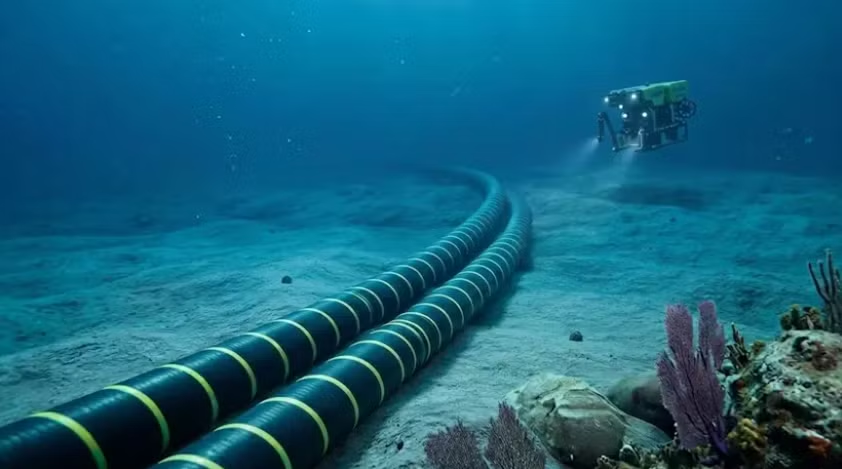
The Tasnim and Fars news agencies even suggested that Iran could monitor data traffic passing through undersea cables – the infrastructure that carries cloud computing services, financial messaging systems including SWIFT, and a large portion of global internet traffic.
Tasnim claims that at least seven major communications cables serving Gulf countries pass through the strait, including the FALCON, GBI, and Gulf-TGN systems, connecting data centers across Asia, Europe, and the Middle East.
According to Euronews, the legal basis for such proposals is weak. However, Iranian media outlets cite the 1982 United Nations Convention on the Law of the Sea (UNCLOS), arguing that the narrow topography of the strait places the seabed under the jurisdiction of Iran and Oman.
UNCLOS includes principles on the right of transit, the protection of the free flow of maritime activity, and international communication. Iran has signed UNCLOS but has never ratified it.
Analysts say that underwater cables are owned by international corporations, and any attempt to impose fees or monitor them would face immediate international legal and political resistance.
According to analysts, equipped with combat divers, small submarines, and underwater drones, the IRGC poses a threat to underwater cables. Any attack could trigger a chain reaction of digital disasters across multiple continents.
Amidst concerns that the US and Israel may resume military action against Iran as early as next week, Tehran is increasingly signaling that it possesses powerful tools beyond military force.
Source: https://cand.vn/tehran-co-kha-nang-thu-phi-cap-internet-ngam-qua-hormuz-post811165.html




























































































Comment (0)