

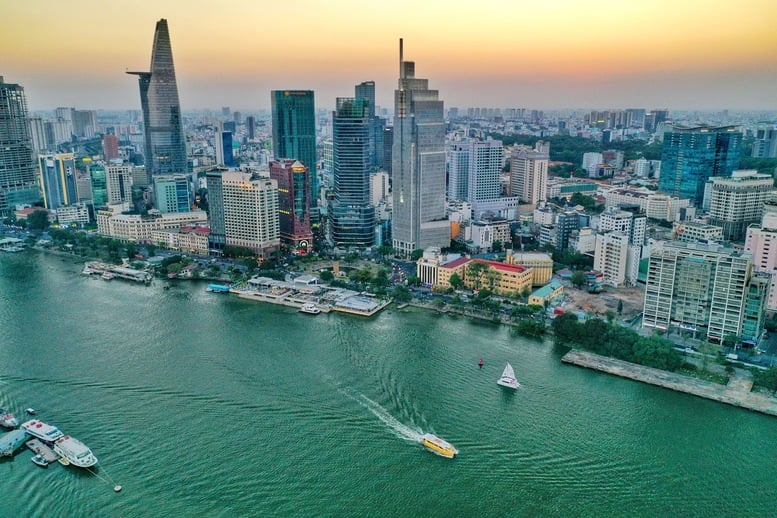
A proper pilot step in Ho Chi Minh City could open a new development trajectory for the entire Vietnamese economy .
In that context, the urgent question is what should Ho Chi Minh City do to become a real driving force, a new pole of a new growth and development model? The answer is increasingly clear: the city needs to be identified as a "national laboratory (sandbox)" for pioneering green-digital models.
As Prime Minister Pham Minh Chinh stated, Ho Chi Minh City needs to be ready to pioneer in becoming a sandbox for green economic models, green finance, smart cities, especially an international financial center preparing for operation. And on a national scale, Vietnam is also ready to become a "green-digital laboratory" of the region.
Why a national "sandbox"?
Ho Chi Minh City is facing three major pressures at the same time: maintaining its role as a growth engine; facing pollution, infrastructure overload, and declining living environment quality; and transforming its development model in the context of the world shifting strongly to green economy and digital economy.
A city with more than 14 million people and a dense economic activity density like Ho Chi Minh City simply cannot continue to maintain the growth model based on cheap labor, resource exploitation and energy consumption, accepting environmental trade-offs as before. If the model is not renewed, the city will not only lose its competitive edge but also have to pay an increasingly high price in terms of environment, traffic jams and social issues.
In that context, the unique advantages of Ho Chi Minh City become the most convincing reason to choose the city as the national "sandbox" for green economy and green finance. This is where the most dynamic business ecosystem in the country converges, capable of receiving and quickly testing new business models.
This is also a leading center of technology and innovation, where digital solutions, artificial intelligence, and data analysis can be directly applied to measure emissions, optimize energy, and design green financial products. The dense financial-banking-fintech system helps the city have the conditions to test new financial instruments, from green credit, green bonds to investment models based on ESG standards. On that foundation, the pioneering spirit and daring to think and do of the urban government makes Ho Chi Minh City an ideal candidate to test breakthrough mechanisms and policies.
Setting up a green economic-green finance sandbox in Ho Chi Minh City is therefore not only to "solve the city's own problems", but also to create an institutional laboratory for the whole country. If the mechanisms and models here prove effective, they can be quickly systematized, raised to the level of national policy and replicated in other localities. In other words, a correct pilot step in Ho Chi Minh City can open a new development trajectory for the entire Vietnamese economy.
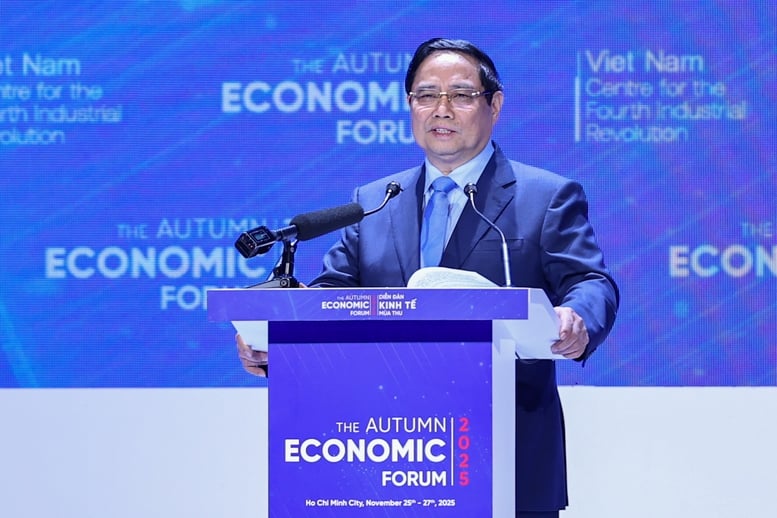
Prime Minister Pham Minh Chinh said that Ho Chi Minh City needs to be ready to pioneer in becoming a sandbox for green economic models, green finance, smart cities, especially an international financial center preparing to operate - Photo: VGP/Nhat Bac
Institutional bottlenecks are holding businesses back
The Autumn Economic Forum outlined an unavoidable reality: Vietnamese businesses want to make a green transition, but there is still a gap between aspiration and implementation, because the legal framework has not caught up with new development requirements.
The first bottleneck is the absence of a set of criteria for identifying green businesses. Without criteria, banks do not know what to rely on to assess green credit; businesses do not know whether they meet the requirements of ESG standards or not.
Second, the incentive mechanism for green activities is fragmented, lacking connectivity and strength to change market behavior. Many businesses want to invest in clean technology, but when comparing costs and benefits, they are forced to delay due to lack of policy incentives.
Third, Vietnam has not yet formed a true green financial market. From green bonds, green credit, to green investment funds or blended finance models ( a mechanism that combines public and private capital to attract investment in renewable energy, green transport and circular cities) are all still at the single experimental level. There is no synchronous legal framework, no specific risk monitoring mechanism, and no emission data infrastructure - the core condition for the market to operate transparently and effectively.
Finally, the link between the State - enterprises - scientists - financial system is still fragmented. Green transformation requires cross-sectoral coordination from scientists providing solutions, enterprises implementing, banks providing capital, to the State creating the legal framework.
These challenges collectively show that each bottleneck cannot be solved with single measures. They require an institutional space that is large enough, flexible enough, and safe enough for new models to be truly tested. And it is this need that makes the green economic-green finance sandbox in Ho Chi Minh City the optimal solution to "unlock innovation" and create a model that can be replicated nationwide.
Green economic sandbox - green finance: institutional tools of the new era
In the context of the traditional development model reaching its limit, a new institutional framework is a prerequisite to pave the way for innovation. The green economic-green finance sandbox is such a tool: a controlled legal experimental space in which Ho Chi Minh City is allowed to apply mechanisms that go beyond the limits of current regulations. The 3-5 year period is not just a pilot period, but a flexible enough institutional buffer to test new models, assess impacts and perfect policies before replicating on a national scale.
The most important point of sandbox is not to “do it differently”, but to do it quickly, to do it flexibly, and to do it based on real impact assessment. This is how many pioneering countries such as Singapore, UAE, and South Korea have used it to shorten policy cycles, reduce testing costs, and create leaps in growth model innovation.
For Ho Chi Minh City, a green sandbox needs to start from the areas with the strongest spillover effects:
1. Green credit and green bonds: develop a separate set of criteria, a rapid appraisal mechanism, and a preferential interest rate roadmap to unblock capital flows.
2. Pilot carbon markets: carbon pricing, carbon credit trading and emission data standardization - essential foundations for the Net-zero commitment.
3. Green PPPs in public transport, renewable energy and waste management to attract private capital into transformational infrastructure projects.
4. Green Fintech: testing green payment models, ESG credit scoring and supply chain emissions tracking technology.
5. Green industrial park - circular urban area: testing superior incentive mechanisms to attract clean technology enterprises and promote zero-waste models.
These fields, when deployed within the sandbox framework, will create a synchronous institutional-technological-financial innovation ecosystem, helping Ho Chi Minh City transform from a traditional growth model to a green-digital model quickly and substantially.
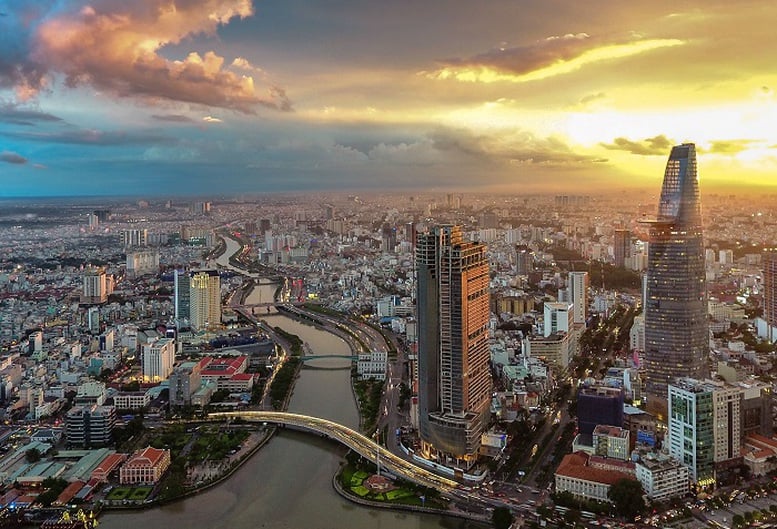
Building a green economic and green finance sandbox in Ho Chi Minh City not only benefits the city itself, but also opens up three strategic values for the country.
Strategic benefits for the nation
Building a green economic and green finance sandbox in Ho Chi Minh City not only benefits the city itself, but also opens up three strategic values for the country.
First, creating new growth drivers. Green finance and clean technology are the world's "growth engines". The Sandbox will allow Vietnam to receive priority capital flows from international financial institutions, while promoting the formation of new industries - renewable energy, smart cities, and circular economy.
Second, reinforce the Net-zero 2050 commitment with practical solutions. The Net-zero commitment cannot be based on general policies but must be based on tools to measure, price and manage emissions. The Sandbox allows these tools to be tested earlier, faster and more accurately, creating a foundation for Vietnam to enter the global carbon market.
Third, raise the national profile. In the race to attract high-quality investment, the country that builds a green-digital institutional framework first will have an advantage. A successful sandbox in Ho Chi Minh City will put Vietnam among the region’s leading countries in institutional innovation, create trust for international corporations and reshape the national brand in the green era.
Concluding the dialogue session at the Forum, Prime Minister Pham Minh Chinh emphasized the common spirit of this transformation: "This forum converges intelligence, strengthens trust, increases solidarity - green - digital harmony, towards the future, sharing benefits". That is also the spirit that the green economic - green finance sandbox of Ho Chi Minh City aims for: an open institutional space to connect all subjects, liberate resources and create a strong shift for the whole economy.
Conditions for sandbox success
In order for the green economic-green financial sandbox in Ho Chi Minh City to not just stop at being a slogan, but to truly become the "institutional laboratory" of the whole country, a number of fundamental conditions need to be met.
First of all, there must be a superior legal framework at the national level specifically for the green sandbox. That is, the National Assembly and the Government need to give Ho Chi Minh City the right to "do differently" and "do first" in a number of areas from credit mechanisms, taxes, PPPs, to carbon markets. Without a sufficiently wide and clear legal space, all pilot efforts will be blocked by the very barriers that the sandbox wants to remove. This legal framework also needs to clearly stipulate the objectives, scope, time limit, monitoring mechanism and summary-replication mechanism, to ensure both flexibility and safety.
Second, digital data infrastructure must become the “backbone” of the green sandbox. Ho Chi Minh City needs to build and operate shared databases on emissions, green projects, green businesses, as well as digital platforms to connect banks, investors, and management agencies. Only when data becomes transparent, measurable, and verifiable can green credit, green bonds, or carbon markets operate reliably and sustainably.
Third, high-quality green-digital human resources are an irreplaceable condition. The green sandbox will require a generation of managers, financial experts, technology engineers, environmental scientists, etc. who are able to simultaneously understand the language of finance, technology and climate. This can only be achieved if the city invests heavily in training, nurturing, attracting talent, and creating an environment for them to experiment, make mistakes and correct mistakes within the sandbox framework.
Finally, extensive international cooperation is a "catalyst" to shorten the learning curve. Ho Chi Minh City cannot and does not need to re-learn the lessons that the world has paid for. Closely connecting with WEF, WB, ADB, IFC, climate funds and the world's leading financial-technology centers will help the city access international standards, advanced financial tools, as well as long-term capital for green projects. At that time, Ho Chi Minh City's green sandbox will not only be a local pilot, but also a link in the global innovation network on green economy and green finance.
A strategic choice that paves the way for the future
Turning Ho Chi Minh City into a national sandbox for the digital economy, green economy and green finance is not just a local initiative, but a national institutional breakthrough. This is an opportunity to contribute to shifting Vietnam from extensive to intensive development, from intensive to value-based, from high emissions to green, circular and sustainable development.
Ho Chi Minh City - with its stature, capacity and aspiration, can absolutely play the role of an institutional laboratory, paving the way for a greener, more modern and more competitive Vietnam in the era of rising up.
Dr. Nguyen Si Dung
Source: https://baochinhphu.vn/thanh-pho-ho-chi-minh-va-ky-vong-tu-sandbox-quoc-gia-102251201065749009.htm


![[Photo] Prime Minister Pham Minh Chinh receives President of Cuba's Latin American News Agency](/_next/image?url=https%3A%2F%2Fvphoto.vietnam.vn%2Fthumb%2F1200x675%2Fvietnam%2Fresource%2FIMAGE%2F2025%2F12%2F01%2F1764569497815_dsc-2890-jpg.webp&w=3840&q=75)





![[Infographic] Progress of drafting the Law on Deposit Insurance (amended)](https://vphoto.vietnam.vn/thumb/402x226/vietnam/resource/IMAGE/2025/12/02/1764634623165_z4503972187742-e86f53ddc73de4234b8edd143f53681e20251201152033.jpeg)



























































Comment (0)