

Green transition brings double benefits
The city's green transformation orientation does not stop at a vision or slogan but has been concretized through many important programs and action plans to implement Resolution No. 57-NQ/TW. These include Action Program 115-CTr/TU dated February 24, 2025 of the City Party Committee; Plan 295-KH/TU dated June 30, 2025 defining the vision of building a "heritage, unique, smart, adaptive, green, clean, beautiful, safe and sustainable" city.
These orientations clearly demonstrate the determination to harmoniously combine preservation and innovation, between traditional values and modern development requirements as the spirit of Resolution 57 emphasized: developing science, technology, innovation and digital transformation is the "top priority breakthrough" to bring the country to breakthrough development in the new era.
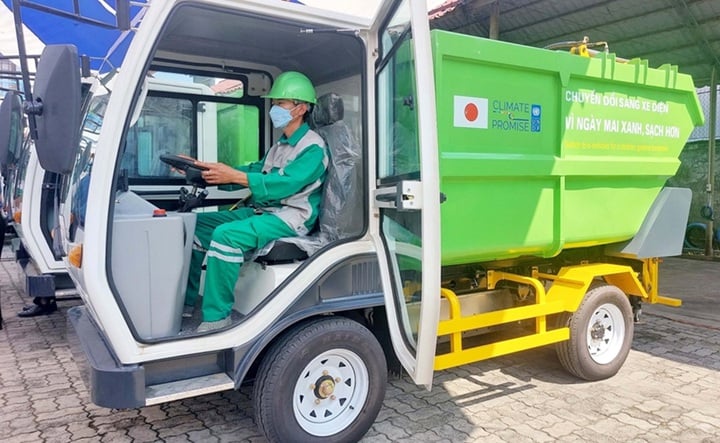
Hue City uses electric trucks to collect and transport garbage.
On that basis, the city has implemented a series of projects associated with the goal of an ecological, smart and sustainable urban area. Tourism is a key economic sector oriented towards green development, associated with heritage conservation, environmental responsibility and community benefits. Accommodation establishments and destinations are encouraged to reduce plastic waste, save energy and use environmentally friendly materials. Many training programs for people and businesses are organized, especially in ethnic minority areas such as A Luoi and Nam Dong, helping the community directly participate in sustainable tourism; community tourism models are also expanded. Along with that, the city coordinates with localities such as Da Nang to enrich tourism products and share green development experiences.
These efforts have contributed to impressive results. In 2024, the locality welcomed more than 3.9 million visitors, with tourism revenue reaching about VND7,900 billion. This strong growth comes with challenges in pollution control, landscape protection and waste management; therefore, orienting tourism development in a responsible direction becomes even more urgent. The city has expanded the tram system, enhanced walking routes, deployed smart tourism applications, and renovated iconic spaces such as Phuoc Tich, Thien An, Thuy Bieu, etc. These are specific steps towards the goal of becoming an ecological, smart and sustainable city by 2030.
In the field of urban environment, with an average amount of household waste of more than 407.2 tons per day, of which plastic waste accounts for a significant proportion, the city has synchronously implemented many solutions such as investing in modern waste treatment plants, sorting waste at source, and building a model of "Residential areas without plastic waste". The project "Hue - Plastic-reducing urban area in Central Vietnam" aims to reduce 30% of plastic waste lost to the environment and achieve 70% of solid waste classified according to the correct process, showing that the green transformation roadmap has a scientific basis and the support of the community.
Along with waste management, the city "greens" the energy and infrastructure sectors through renewable energy projects: Phong Dien solar power plant with a capacity of 42 MWp, researching a 151 MWp project in Phu Loc; a small and medium-sized hydropower system with a total operating capacity of more than 459 MW; a 12 MW waste-to-energy plant in operation and oriented for expansion. These are steps in line with the spirit of Resolution 57, making the Faculty of Science, Technology, Innovation and Digital Transformation the pillar of sustainable urban development.
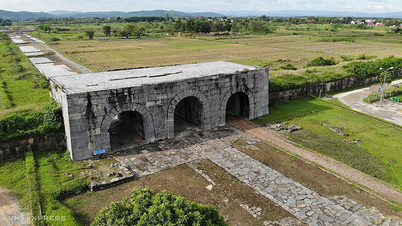
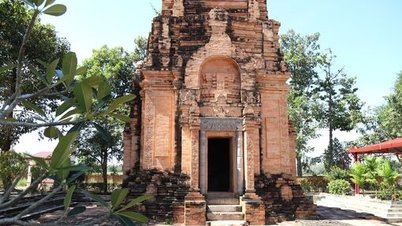
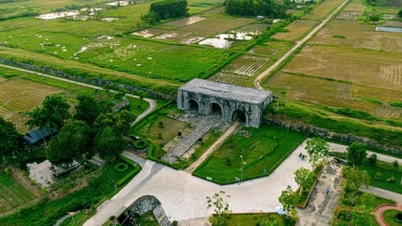
In preserving heritage, a valuable resource of the world heritage city, the locality adheres to the principle of harmonious development, conservation, and landscape management, limiting concreting and density control. Heritage tourism is oriented towards experience and responsibility, instead of increasing in quantity. Thanks to that, the sustainable values of heritage are exploited without destroying the cultural structure and landscape.
Positive socio-economic results show that green transformation brings "double benefits", improving the living environment, reducing social costs, and increasing urban competitiveness. More green space, better waste and wastewater treatment, and smart public services help people interact conveniently, while attracting high-quality human resources and investors.
Science, Technology, Innovation and Digital Transformation in the Green Transformation Journey
In the process of moving towards an ecological, smart and sustainable urban model, science, technology, innovation and digital transformation play a decisive role. This is not only the strategic orientation established by the Politburo in Resolution No. 57-NQ/TW, but also the foundation for the city to realize three important pillars of sustainable development: climate change response, environmental protection, and heritage value promotion.
On that basis, the city has soon concretized Resolution 57 by building e-government, data infrastructure and a synchronous digital ecosystem. The Smart City Monitoring and Operation Center (IOC) was formed with 14 smart systems, 289 stations/information portals operating on a cloud computing platform, allowing multi-field management from security, traffic, environment to health, education and tourism. The system of more than 560 cameras integrated with artificial intelligence (AI) helps automatically detect traffic violations, forest fires, congestion and urban order issues, contributing to improving safety, reducing management costs and increasing response speed.
In parallel with the IOC, the city has strongly developed a digital service ecosystem through the Hue-S platform - a super application serving residents and tourists. With 900,000 downloads, 76,000 electronic accounts and connections to nearly 700 digital payment points, Hue-S has become a bridge between residents and the government, helping to resolve administrative procedures, receive on-site feedback, pay for public services and access urban information in real time. The widespread deployment of a digital platform creates a fundamental change in urban governance methods, from the traditional model to a data-based governance model.
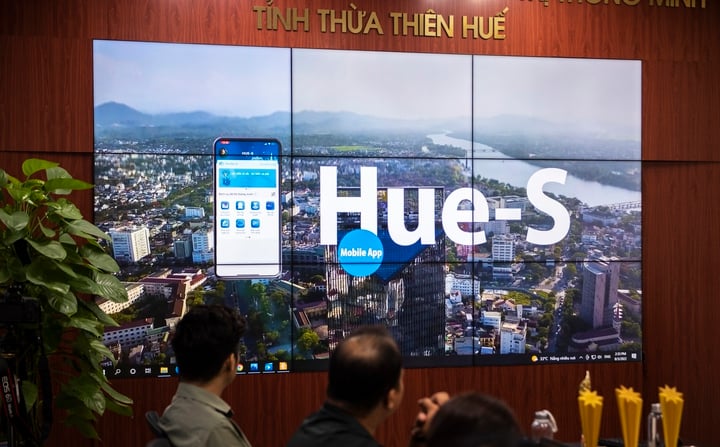
Hue-S platform – super application serving people and tourists.
In the field of environmental protection and climate change response, the city strongly applies modern technologies. GIS technology is deployed in planning management, ecosystem monitoring and land use control. The proactive disaster warning system is digitized, allowing for forecasting heavy rains, floods and landslides, contributing to increasing the ability to adapt to climate change, a specific challenge for coastal, lagoon and midland localities. Air, water, waste and flow quality monitoring systems are integrated into the IOC, providing real-time data for proactive handling by authorities.
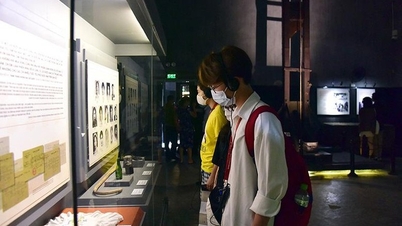
In preserving and promoting heritage values, digital transformation has become a new way to manage and promote relics. The city has digitized heritage data, built 3D models of works in the Hue Monuments Complex, supported restoration and renovation work, and at the same time created smart tourism products, enhancing the visitor experience. This is a clear demonstration of how technology helps heritage become "more alive", more widely accessible while still preserving its core cultural values.
Digital economy and knowledge economy are identified as the foundation for improving productivity, innovating growth models and promoting innovative startups. The city encourages the application of AI, IoT, Big Data, Blockchain in urban management, public services and production and business activities. Training, incubation and support programs for innovative startups are developed based on the advantages of the university system, especially Hue University, a major training and research center in the Central region. Technology human resources are focused on to ensure that staff, businesses and the community are all capable of participating in the digital transformation process.
Overall, science, technology, innovation and digital transformation not only support urban governance, improve quality of life and optimize resources, but also create conditions for the city to develop in a green, smart and adaptive direction. This is the "dual driving force": promoting economic growth while protecting the environment and heritage, in line with the orientation in Resolution No. 57-NQ/TW and Conclusion No. 81-KL/TW of the Politburo on climate change response and environmental resource management. Despite many difficulties, with the determination to innovate, adaptability and consensus of the community, the city has all the foundations to become a green, smart and sustainable urban model - where people, nature and heritage are in harmony in a proud living space.
Source: https://mst.gov.vn/thanh-pho-hue-hanh-trinh-chuyen-doi-xanh-vi-mot-do-thi-sinh-thai-thong-minh-va-phat-trien-ben-vung-197251201225045683.htm
![[Photo] Parade to celebrate the 50th anniversary of Laos' National Day](/_next/image?url=https%3A%2F%2Fvphoto.vietnam.vn%2Fthumb%2F1200x675%2Fvietnam%2Fresource%2FIMAGE%2F2025%2F12%2F02%2F1764691918289_ndo_br_0-jpg.webp&w=3840&q=75)

![[Photo] Worshiping the Tuyet Son statue - a nearly 400-year-old treasure at Keo Pagoda](/_next/image?url=https%3A%2F%2Fvphoto.vietnam.vn%2Fthumb%2F1200x675%2Fvietnam%2Fresource%2FIMAGE%2F2025%2F12%2F02%2F1764679323086_ndo_br_tempimageomw0hi-4884-jpg.webp&w=3840&q=75)











































Comment (0)