

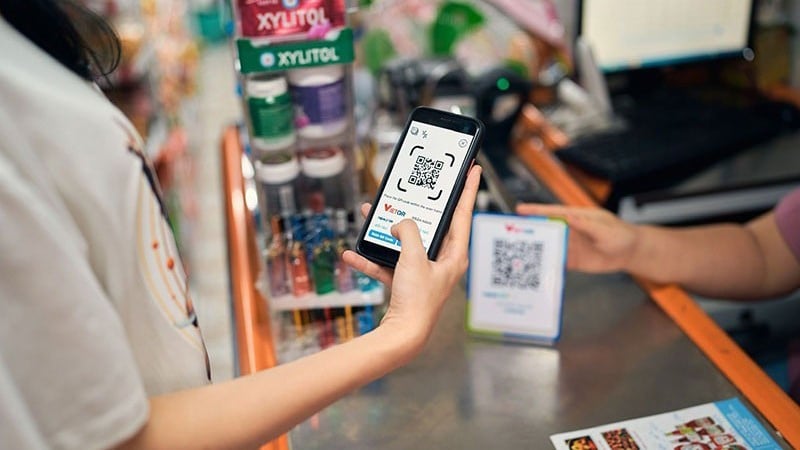
Connecting the digital economic ecosystem
According to the State Bank of Vietnam , in the first 9 months of 2025, non-cash payment transactions across the system increased by 43.32% in quantity and 24.23% in value compared to the same period in 2024, showing that the trend of electronic payments is becoming increasingly popular and sustainable.
Notably, transactions via the Internet increased by 51.2% in quantity and 37.17% in value; via mobile phones increased by 37.37% in quantity and 21.79% in value; in particular, transactions via QR codes skyrocketed by 61.63% in quantity and 150.67% in value, clearly reflecting the popularity of convenient payments in daily life. In contrast, transactions via ATMs continued to decrease by 16.77% in quantity and 5.74% in value, showing that people's habit of withdrawing cash is being replaced by more modern payment methods.
The national payment infrastructure system continues to operate stably, safely and effectively. Transactions via the interbank electronic payment system increased by 46.87% in value, while the financial switching and electronic clearing system increased by 19.14% in quantity. To date, 53 organizations have been licensed to provide intermediary payment services, of which 49 organizations provide e-wallets, contributing to diversifying the payment service market.
The Mobile Money model continues to be effective in universalizing comprehensive finance. By the end of September 2025, the country had more than 10.89 million Mobile Money accounts, of which 70% were in rural, mountainous and island areas. The total number of transactions reached more than 290.4 million, with a value of about VND 8,511 billion, helping millions of people in remote areas access modern financial services without the need for a bank account.
The State Bank encourages credit institutions to accelerate digital transformation, connect with other industries and sectors to expand the digital service ecosystem, focusing on customers. Many banks have now applied artificial intelligence (AI), big data, machine learning in behavior analysis, customer assessment, thereby personalizing products, optimizing processes and automating business operations.
To date, most basic banking services have been digitized, with about 95% of transactions conducted on digital channels. The digital payment ecosystem has closely connected banks and public services such as electricity, water, telecommunications, healthcare, education , e-commerce, tourism, as well as online public services on the National Public Service Portal. People can pay, shop, book tickets, pay fees, charges, and pay social security directly on familiar banking applications or digital platforms.
Advances in data and electronic identification
Implementing the Government's Project 06 on developing population data applications, electronic identification and authentication to serve national digital transformation, the banking industry has achieved many outstanding results.
As of October 10, more than 132.4 million individual customer records and 1.4 million organizational customer records had been biometrically verified via chip-embedded citizen identification cards or the VNeID application. 57 credit institutions and 39 payment intermediary organizations have deployed authentication of chip-embedded citizen identification cards via phone, while 63 organizations have applied authentication of citizen identification cards at the counter.
In addition, 32 credit institutions and 15 payment intermediaries are implementing customer authentication via VNeID, of which 19 units have officially operated. 28 banks and 4 payment intermediaries have linked bank accounts with social security accounts via VNeID, contributing to safer, more transparent and convenient social security payments.
The National Credit Information Center (CIC) has also coordinated with the Ministry of Public Security to clean up more than 57 million customer records, creating an accurate data platform for credit analysis and systemic risk prevention.
Synchronizing and cleaning customer data associated with national electronic identification not only helps improve security and safety for the financial and banking system, but also paves the way for smart financial service models, contributing to promoting the comprehensive development of Vietnam's digital economy and digital society.
Source: https://nhandan.vn/thanh-toan-khong-tien-mat-tang-truong-an-tuong-post919000.html




![[Photo] Urgently help people soon have a place to live and stabilize their lives](/_next/image?url=https%3A%2F%2Fvphoto.vietnam.vn%2Fthumb%2F1200x675%2Fvietnam%2Fresource%2FIMAGE%2F2025%2F12%2F09%2F1765248230297_c-jpg.webp&w=3840&q=75)

























































![[Photo] General Secretary To Lam works with the Standing Committees of the 14th Party Congress Subcommittees](https://vphoto.vietnam.vn/thumb/402x226/vietnam/resource/IMAGE/2025/12/09/1765265023554_image.jpeg)






























Comment (0)