

Many businesses still prefer cash payments, even refusing to sell goods if buyers request bank transfers. This reality shows that the habit of using cash still strongly influences individual business operations, despite the increasing popularity of electronic payment methods.

Lesson 2: Data Gaps
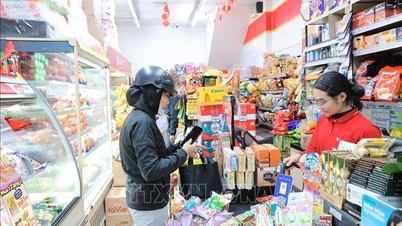
At Tho Tang market (Vinh Phuc province), Ms. V., a small trader selling plastic goods who regularly sources her supplies there, said that many wholesalers still only accept cash payments. "Once I suggested transferring money for convenience, but they said they only accept cash. If I don't have cash, they'll sell to someone else," she recounted.
Conversely, Ms. V. herself also faced difficulties in changing this habit. As someone who wanted to manage cash flow more transparently, she had encouraged customers to transfer money for easier revenue reconciliation. However, many wholesalers still only accepted cash payments. "They said cash was faster; if they had to transfer money, they would go get their goods from somewhere else," she said.
A survey conducted in the Ninh Hiep market area ( Hanoi ) also shows that the use of cash remains quite common. An official from a commercial bank operating near this market stated that in the first quarter of 2026, the volume of transactions through payment accounts showed signs of decreasing among some groups of small business owners and traders in the market.
According to financial experts, the defensive mindset towards the risks of electronic transactions is one of the reasons why many small business owners still prefer cash.
Amidst increasingly sophisticated high-tech scams, many business owners believe that holding cash is a way to control "visible" assets.
Associate Professor Dr. Le Xuan Truong, a financial and tax expert, believes that security is the main reason many small business owners are hesitant about electronic payments. “If digital payment methods are secure and minimize fraud risks, business owners will naturally switch to using them. However, if this hesitation is exploited to avoid transparency in business, that's a different legal issue,” Dr. Truong stated.
However, experts also suggest that another reason why some businesses still prefer cash is their reluctance to accept the transparency of cash flow. When sales revenue is held outside the banking system for direct transactions, business data is not fully digitized, thereby limiting the ability to connect and synchronize information across electronic systems.
Some small business owners also expressed concern that any money transferred into personal accounts, which is considered non-revenue or income from business, could be subject to inspection and taxation by the tax authorities. Representatives from the tax authorities have repeatedly affirmed that this is an inaccurate understanding. According to current regulations, the tax authorities do not have direct access to individuals' personal accounts. Verification of financial information is only carried out when there are signs of violations and through a mechanism of coordinated information provision from relevant organizations as stipulated by law.
Besides psychological factors, some experts believe that at large wholesale markets like Tho Tang or Ninh Hiep, the preference for cash transactions sometimes stems from the specific characteristics of the goods. A portion of the goods circulating in these markets may lack complete invoices and input documents, or their origin may be unclear. When transactions are primarily conducted in cash and no bank transfers occur, tracing the flow of money becomes more difficult.
Many long-established businesses maintain a cash flow cycle in their operations. Sales revenue is retained to purchase inventory, pay labor costs, or cover daily expenses, thus forming a closed loop: cash received from customers is then used to pay suppliers or other expenses.
Experts call this the "cash-for-cash" phenomenon. When this cycle is complete, sellers feel secure in the short term, but in reality, they are building a wall separating themselves from preferential capital flows and legal protection.
Holding cash is not only a technical barrier but also a trade-off in terms of legal security and growth opportunities. When businesses maintain a "cash-for-cash" cycle, they are building a separate and opaque financial system.
In reality, in the era of big data, the fact that money doesn't flow through banks doesn't make businesses "hide" safely as many people mistakenly believe. The discrepancy between the scale of goods in circulation and the cash flow displayed on the system is the clearest risk indicator that tax authorities can use to prioritize audits.
Maintaining transactions primarily in cash is therefore not a "safe zone" as many mistakenly believe. On the contrary, it can become a risk factor for the business itself when data on goods in circulation, invoices, and cash flow are no longer compatible within the tax management system.
Furthermore, the lack of a banking transaction history also makes it difficult for many businesses to access formal credit. Many small business owners have high revenues but almost no cash flow records in the banking system, leading to limited creditworthiness when applying for loans to expand their businesses.
According to Mr. Dinh Trong Thinh, a financial and banking expert, when transaction flows do not pass through the banking system, much economic data will not be fully reflected. He believes that cashless payments not only make transactions more convenient but also create a "trace" of money flows, providing the financial system and regulatory agencies with more data to assess economic activity.
"In the modern economy, the more transparent the flow of money, the better the risk management. When many transactions are still conducted in cash, a portion of business operations will be outside the official data channels of the financial system," Mr. Thinh analyzed.
According to the State Bank of Vietnam, in recent years the banking system has boosted digital payment infrastructure, expanded 24/7 fast payment services, interbank QR code connectivity, and low-cost electronic payment methods to facilitate easier access to cashless payments for individuals and businesses.
In fact, a trend of change is gradually taking place in some traditional markets. Surveys conducted at Dong Xuan Market (Hanoi) and Ben Thanh Market ( Ho Chi Minh City) in early April 2026 showed that many business owners have proactively accepted both cash and bank transfers.
Ms. Lan, the owner of a clothing stall at Dong Xuan Market, said that implementing QR code payment is now almost a necessity. "Customers now carry less cash. If we don't display QR codes, we'll essentially lose customers. Accepting bank transfers eliminates worries about counterfeit money or mistakes when giving change," she said.
At Ben Thanh Market, Mr. Tung, a souvenir vendor, said that the number of customers paying by bank transfer or QR code scanning is increasing, especially among young people and tourists. “Many customers only bring their phones and don’t have much cash. If I don’t accept bank transfers, they’ll go to another stall to buy. So now I accept both cash and bank transfers for convenience,” Mr. Tung shared.
The development of digital payment infrastructure, with over 11.45 million Mobile Money accounts by early 2026, is proof that electronic payments are permeating every aspect of economic life. However, this development will only be truly sustainable if the crucial link is for sellers to proactively change their mindset, instead of clinging to risky, traceless electronic transaction habits.
According to economic experts, when businesses proactively channel their cash flow into electronic tracking systems, business operations become more transparent and easier to manage. Conversely, if cash transactions without documentation continue, a portion of market data will remain outside the reach of digital management tools.
Lesson 3: Refusing a transfer can do more harm than good.
Source: https://baotintuc.vn/kinh-te/thanh-toan-so-minh-bach-thue-bai-2-20260429170934259.htm

































































































Comment (0)