

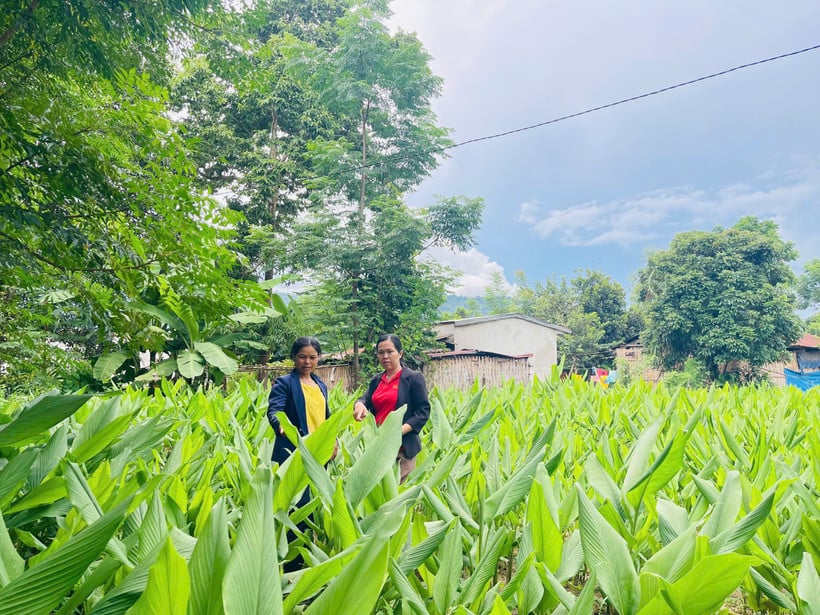
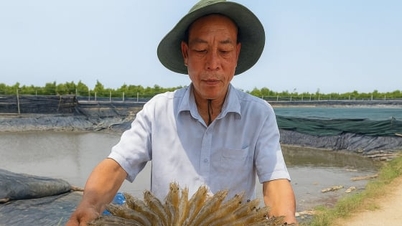
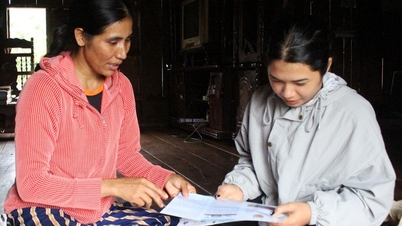
Livelihood model helps many people in the western mountainous areas of Quang Ngai increase their income.
Some limitations and shortcomings
After nearly 5 years of implementing the National Target Program on Sustainable Poverty Reduction for the 2021-2025 period, the whole country has achieved remarkable achievements. According to the Summary Report on the implementation results of the Socio- Economic Development Plan for 2025 and the 5-year period 2021-2025; the Government's Socio-Economic Development Plan for 2026, the multidimensional poverty rate decreased from 4.4% in 2021 to 1.3% in 2025, exceeding the set target. The rate of extremely disadvantaged communes in coastal and island areas that escaped from difficult situations reached 35.2%, exceeding the target of 30%.
Many localities have made clear changes, with the poverty rate continuously decreasing year by year and the appearance of remote and isolated communes increasingly improving. Party committees and local authorities at all levels have identified poverty reduction as a major and consistent policy of the Party and State, a central, continuous and long-term political task of the entire political system and society, contributing to the realization of social progress and equity, constantly improving the material and spiritual life of the people, focusing on effective leadership and direction. Implementation documents have been issued promptly and fully, with determination to strive to achieve and exceed poverty reduction targets. Funds mobilized for poverty reduction have been diversified, allocated and used for the right purposes and in accordance with regulations; decentralization and delegation of authority have been strengthened along with a transparent accountability mechanism; inspection and supervision of the implementation of programs and projects have been closely monitored; the capacity of cadres working on poverty reduction at the grassroots level has been improved.
Thanks to the promotion of propaganda and mobilization, many poor and near-poor households have gradually reduced their dependence on State support, organized production effectively, gradually stabilized their lives, and self-reliantly escaped poverty sustainably. The emulation movement "For the poor - leaving no one behind" has spread widely, contributing to improving the spiritual and material life of the poor.
However, the journey of sustainable poverty reduction still faces many difficulties and challenges, especially in mountainous provinces. The implementation process also revealed some shortcomings that need to be promptly resolved. The number of regulations and guidelines related to the implementation of the Program is large and some documents need to be changed and supplemented, with inconsistent and unclear contents, slow issuance or issuance but not synchronous, leading to confusion among sectors and localities in implementation, difficulties in researching and applying the detailed allocation to each content, task, and sub-project. The implementation process of some policies still has many different interpretations, and there is no more complete guidance document in applying the policy mechanism.
Sustainable poverty reduction in Bac Ninh is a bright spot in the country. It is expected that by the end of 2025, the province's poverty rate will be only about 0.56%. 2022 is the first year of implementing the National Target Program on Sustainable Poverty Reduction for the period 2021-2025. The content, policies and activities of the Program have many new points. There are many guiding documents for implementation from the Central Government, and many contents are assigned to localities to issue legal documents affecting the development and issuance of mechanisms for implementing the Program assigned by the Central Government to the province.
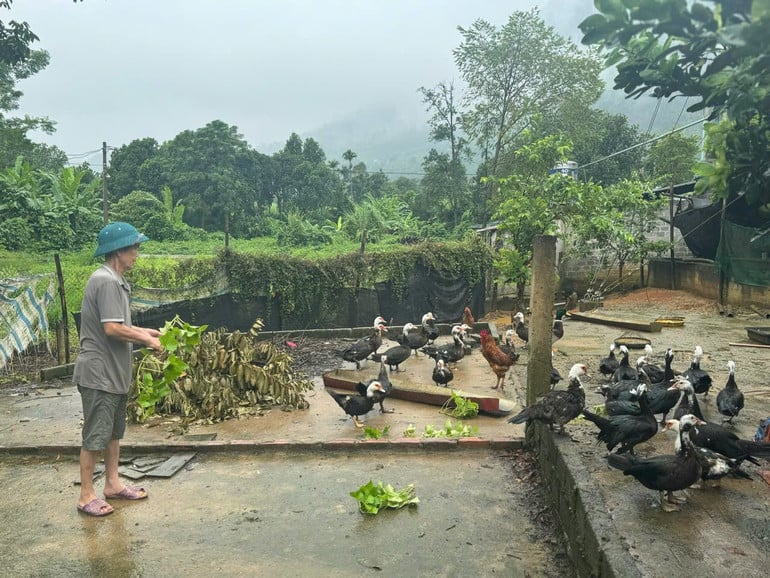
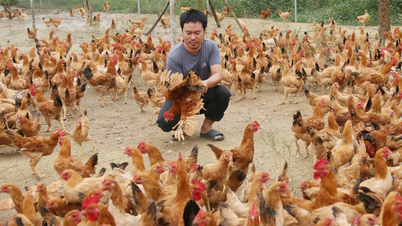
Households in Tuyen Quang develop their economy from livestock farming models.
The disbursement rate of Sub-project 1, Project 4 "Developing vocational education in poor and disadvantaged areas" in some localities is still low, one of the reasons is that the Central Government has not clearly defined the criteria for determining "low-income workers". Not to mention, workers from poor households, near-poor households, and households that have just escaped poverty are mainly social protection beneficiaries, have little ability to work, and have little need to register for vocational training, so it is difficult to organize vocational training classes; facilities, equipment, teaching staff, and capacity of Vocational Education - Continuing Education Centers in some (old) districts have not met the demand for vocational training. In Quang Ngai, many workers from poor households, near-poor households, households that have just escaped poverty, and low-income people do not want to participate in vocational training, so mobilization is difficult, and it is impossible to order vocational training institutions to provide vocational training.
The implementation efficiency of Sub-project 2, Project 4 "Support for workers going to work abroad under contract" in Quang Tri and Thanh Hoa is not high, mainly because workers cannot provide invoices and documents for language tuition, orientation education, and exit costs used for payment to State agencies; there are no guidelines for issuing prices for foreign language training services for Vietnamese workers going to work abroad under contracts using funds from the state budget, causing difficulties in determining unit prices to order foreign language training with service units.
Recommendations from reality
In order for poverty reduction in the coming period to continue to achieve positive results, each locality needs to proactively review and comprehensively analyze difficulties and limitations; clearly identify subjective and objective causes affecting poverty reduction progress. On that basis, propose specific, practical solutions and recommendations suitable to regional characteristics, from policy mechanisms, investment resources to implementation at the grassroots level. This work not only helps to properly orient the upcoming poverty reduction journey, but also contributes to creating a more sustainable foundation to improve people's quality of life and narrow the development gap between regions.
Lai Chau recommends that the Central Government complete the policy mechanism in implementing national target programs in the direction of increasing decentralization to localities, minimizing guidance documents to avoid overlap in the implementation process. Guidance documents are issued in full and synchronously before assigning capital plans (in the 2021-2025 period, the Central Government issued more than 143 documents, and localities had to specify 174 documents); at the same time, research to shorten the focal point for issuing guidance documents, unify one focal point instead of dividing each ministry and branch in charge of each component content, causing difficulties in implementation at the grassroots level. Career capital needs to be assigned according to the 5-year estimate and Central capital sources only assign the total amount of each Program, not assign details of each component project and expenditure field.
Towards the new stage, Dien Bien proposed specific solutions to remove obstacles such as not decentralizing to the provincial level to regulate the form of documents, procedures, criteria for selecting projects, plans, and options in implementing production development support activities. Because, the regulation of administrative procedures in legal documents of the provincial level can only be implemented when permitted by the Law or when stipulating measures of a specific nature of the locality. On the other hand, the capital source of the national target program is the central budget source, so if the provincial level regulates administrative procedures for the use of this capital source, it is unreasonable and takes a lot of time to develop and implement. In addition, it is necessary to clearly stipulate the implementation order, expenditure content, and specific expenditure levels of the project to support the development of production linked to the value chain because the current regulations of this project are very complicated, there is no timeline according to administrative procedures for implementation.
Quang Tri Province proposed to merge Project 2 "Diversifying livelihoods, developing poverty reduction models" and Sub-project 1, Project 3 "Supporting production development in the agricultural sector" into the Production Development Support Project. Both contents focus on supporting poor and near-poor households to develop livelihoods and increase income through small-scale agricultural or non-agricultural production models. Separating them can easily cause overlaps and duplications during implementation, while merging them helps simplify implementation in localities.
The province also requested the Government to promptly issue the overall program framework for the 2026-2030 period, ensuring consistency in component projects, activities and beneficiaries, and minimizing mid-term adjustments that affect implementation progress at the grassroots level. Ministries and sectors in charge of the fields should promptly issue synchronous, detailed and practical guidance documents to help localities proactively implement.
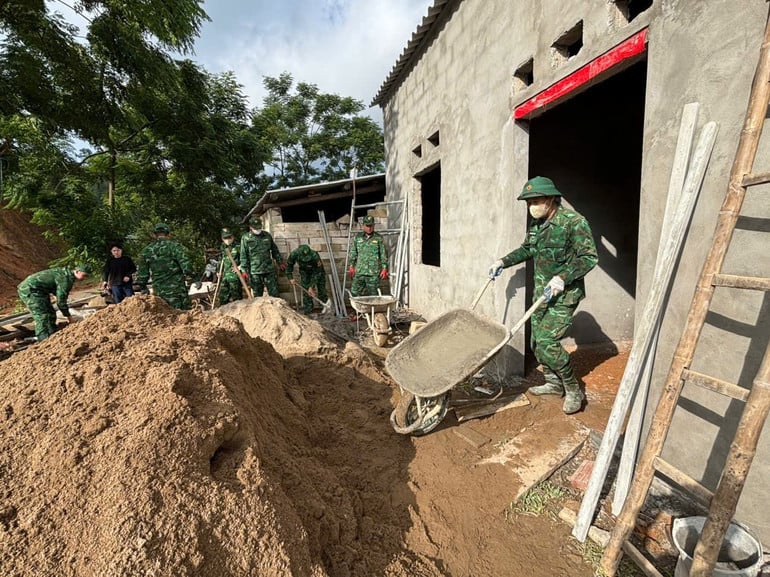
Border guards build houses to help people in Lang Son.
According to the recommendations of some localities, research and develop the National Target Program for Sustainable Poverty Reduction for the 2026-2030 period in the direction of close integration with the National Target Program for New Rural Development, in order to improve investment efficiency, overcome the situation of resource dispersion and overlapping content between programs. Integrate closely related contents between the two programs such as: investment in essential infrastructure, support for livelihoods - employment - housing, policy communication, education - health - social services... to create comprehensive changes in living conditions and development opportunities of people, especially in extremely difficult areas, ethnic minority and mountainous areas. Although integrated, clearly define the independent implementation content, clearly identify the management focal point for each component to avoid duplication of subjects, improve accountability and coordination efficiency between levels and sectors.
Compared with the regulations, the Center for Vocational Education - Continuing Education is not a beneficiary of the vocational education contents of the 3 National Target Programs for the period 2021 - 2025, so the implementation of the project to develop vocational education and sustainable employment faces many difficulties, with large resources but limited in terms of subjects and implementation content. Therefore, Lang Son province proposed to expand the scope and beneficiaries of investment capital to include Centers for Vocational Education - Continuing Education; amend and supplement the regulations on policies to support elementary level training and training under 3 months in the direction: each person is only supported for training once in a policy, those who have been supported for training once from a policy will not be continued to be supported for training under that policy.
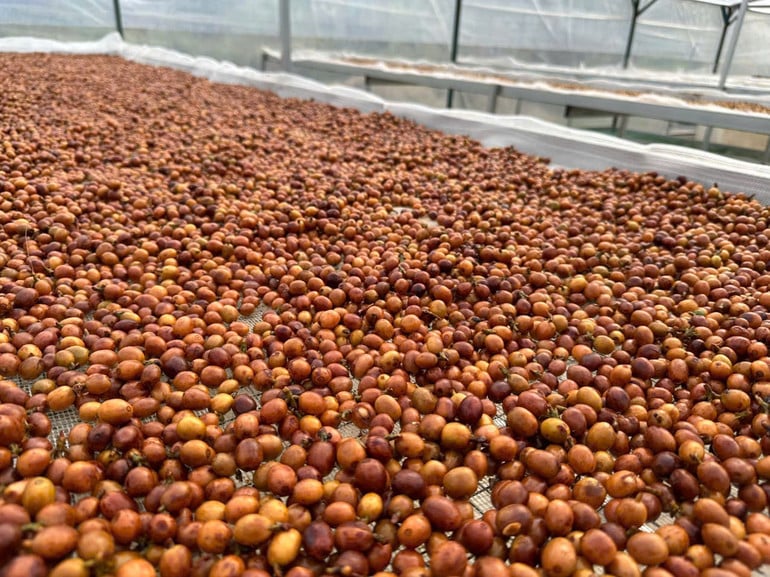
Coffee harvest in Dien Bien
The journey to sustainable poverty reduction is still arduous, requiring perseverance, creativity and determination. The implementation in provinces and cities shows that sustainable poverty reduction requires perseverance, long-term investment and policies appropriate to the characteristics of each region and locality, and requires the consensus of the entire political system, the active participation of the community, businesses and the determination of the people to rise up. The Central Government's early promulgation of new poverty standards and guidance on organizing the review of poor and near-poor households according to the standards for the 2026-2030 period will help localities proactively review and develop plans and policies to reduce poverty that are close to and appropriate to the actual situation.
MINH NGUYEN
Source: https://nhandan.vn/thao-go-vuong-mac-tao-da-giam-ngheo-ben-vung-post928655.html

![[Photo] Urgently help people soon have a place to live and stabilize their lives](/_next/image?url=https%3A%2F%2Fvphoto.vietnam.vn%2Fthumb%2F1200x675%2Fvietnam%2Fresource%2FIMAGE%2F2025%2F12%2F09%2F1765248230297_c-jpg.webp&w=3840&q=75)





![Major decisions to develop Thanh Hoa agriculture: [Part 1] Cua Dat Lake - a great migration for the people's happiness](https://vphoto.vietnam.vn/thumb/402x226/vietnam/resource/IMAGE/2025/12/09/1765248819994_z7282526539020_1ee647dc8468da9b9f2428712b435ae7-nongnghiep-165859.jpeg)






![[Photo] Urgently help people soon have a place to live and stabilize their lives](https://vphoto.vietnam.vn/thumb/402x226/vietnam/resource/IMAGE/2025/12/09/1765248230297_c-jpg.webp)






























































Comment (0)